



Contents: Automatic transmission modes and…⬇ Manual gear shifting (tiptronic mode) ⬇ Start of movement ⬇ Stop ⬇ Parking ⬇ Coasting in E mode ⬇ Launch-control function (1) ⬇ Kick-down ⬇
Warning! Do not press the gas pedal when changing the forward driving mode on a stationary vehicle with the engine running - this may cause an accident! Never move the selector lever to position R or P while the vehicle is moving - this may cause an accident! A stationary vehicle with the engine running and the automatic transmission in position D, B or B must be held in place with the brake pedal. Some torque continues to be transmitted to the vehicle wheels even when the engine is idling - an unbraked vehicle will slowly move forward (or backward). When leaving the vehicle, be sure to set the automatic transmission selector to position P. Otherwise, the vehicle may start moving - risk of accident. If the selector lever was moved to position N while moving, then before switching back to forward driving mode, you must remove your foot from the gas pedal and wait until the engine reaches idle speed. At temperatures below -10°C, the engine can only be started if the selector lever is in position P. When stopping on an incline, never hold the car in place with the gas pedal - risk of damage to the gearbox. The ignition key can only be removed after turning off the ignition if the selector lever is in position P.
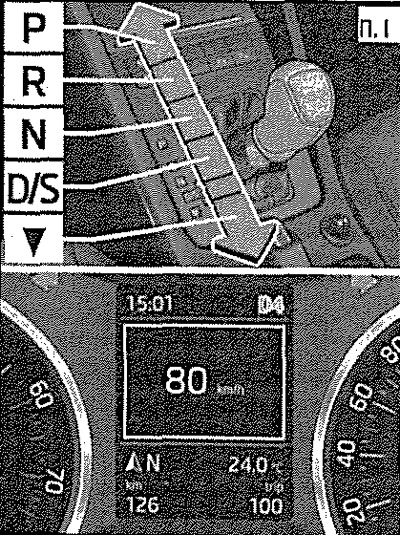
Automatic transmission modes and selector lever control
Selector lever/display message
Lock key
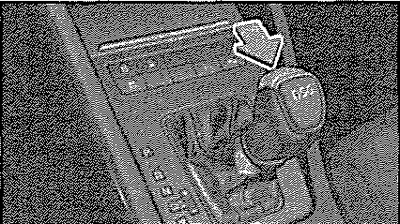
When the ignition is on, the display shows the gearbox mode and the gear engaged. The selector lever can be used to select the following modes.
P - parking mode
In this position mode, the drive wheels are mechanically locked. The parking position may only be engaged after the vehicle has come to a complete stop.
(Source of the article web resource: skodabook)
R - reverse gear
Reverse gear may only be engaged when the vehicle is stationary and the engine is idling. Before engaging position R from position P or N, the brake pedal must be pressed and the lock button must be pressed at the same time.
N - neutral
In this position, torque is not transmitted to the drive wheels.
D/S - Forward mode (regular program)/Forward movement mode (sports program)
Switching between modes is done by moving the selector to the spring-loaded V position/selecting the driving mode. In the D or S mode, the forward gears are shifted automatically depending on the engine load, the pressure on the gas pedal, the vehicle speed and the selected driving mode. If the Sport or Normal driving mode is selected and the selector is in the D/S position, the gearbox automatically switches to the S or D mode. In the S mode, the forward gears are automatically shifted up and down at higher engine speeds than in the D mode.
E - economy mode
If the Sport or Eco driving mode is selected and the selector is in the D/S position, the gearbox automatically switches to E mode. This mode is not activated by the selector lever. In E mode, the forward gears are automatically shifted up and down at lower engine speeds than in D mode.
Releasing the selector lever in the PhN positions (selector lever lock)
In the P and N positions, the selector lever is locked to prevent accidental engagement of the forward position. The control lamp in the instrument cluster lights up
 .
.
The selector lever is released by pressing the brake pedal and the lock button at the same time. When quickly switching through the N position (for example, from I to D/S) the selector is not locked. This allows, for example, to free a car stuck in snow by rocking it. If the selector lever is in the N position for more than 2 seconds without pressing the brake pedal, it is locked in this position. The selector lever is locked only when the car is stationary and when driving at a speed of up to 5 km/h.
Selector lever lock malfunction
If the selector lever lock is faulty or there is no power supply in its circuit (the battery is discharged, the fuse is blown), the selector lever cannot be moved out of position P in the normal way. It is necessary to perform an emergency release of the selector lever.
Note: To shift from P to D/S, move the selector lever quickly. This will prevent accidental engagement of R or N.
Manual gear shifting (tiptronic mode)
Selector lever/multifunction steering wheel
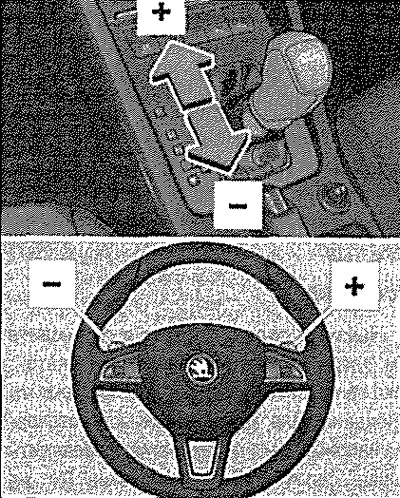
Tiptronic mode allows you to change gears using the selector or the paddles on the multifunction steering wheel. This mode can be selected both when the car is stationary and while driving. The gear engaged is shown on the display.
Enabling manual gear shift mode
Move the selector lever from the D/S position to the right or, on right-hand drive vehicles, to the left.
Shifting into a higher gear
Push the lever forward "+". Briefly pull the right paddle shifter "+" towards the steering wheel.
Downshifting
Push the selector back "-". Briefly pull the left paddle shift "-" towards the steering wheel.
Temporary switch to manual shifting in position D/S
Briefly pull one of the "-" / "+" paddle switches towards the steering wheel. If the "-" / "+" switches are not used for more than one minute, the manual shift mode is deactivated. Temporary switching to manual gear shifting You can manually deactivate by pulling the right "+" switch button and holding it for more than 1 second. When accelerating, the gearbox will automatically shift up shortly before reaching the maximum permissible engine speed. If one of the lower gears is selected, the automatic will only switch to it if the engine speed does not then exceed the permissible maximum.
Note: Manual shifting can be useful, for example, when driving uphill. In this situation, shifting to a lower gear will reduce the load on the brakes and reduce their wear.
Start of movement
Start the engine. Press and hold the brake pedal. Press and hold the lock button. Move the selector lever to the desired position and release the lock button. Release the brake pedal and press the accelerator pedal.
Stop
Press the brake pedal and stop the car. Keep the brake pedal depressed until you can continue driving. For a short stop, for example at an intersection, you do not need to move the selector lever to position N.
Parking
Press the brake pedal and stop the car. Apply the parking brake. Press and hold the lock button. Move the selector lever to position P and release the lock button.
Coasting in E mode
Move the selector lever to the D/S position. Select the Eco driving mode. Remove your foot from the accelerator pedal. The car moves without engine braking. The gear is automatically re-engaged if you briefly press the brake pedal or pull the left "-" switch toward the steering wheel.
Launch-control function (1)
The Launch-control function allows you to start off with maximum acceleration in S or Tiptronic mode. Switch off the ASR system. Switch off the START-STOP system. Press and hold the brake pedal with your left foot. Fully depress the accelerator pedal with your right foot. Release the brake pedal. The car will accelerate with maximum possible acceleration. When the car has accelerated to the desired speed, switch on the ASR and the START-STOP function again.
(1) Vehicles are equipped with this function only on certain engines.
Kick-down
The Kick-down function allows you to develop maximum acceleration while driving. The Kick-down function is activated in any forward driving mode when the driver fully depresses the gas pedal. Depending on the driving speed and engine speed, the gearbox switches down one or even several gears and accelerates the car. Switching to a higher gear occurs only when the maximum specified engine speed is reached.