



Contents: Camber adjustment ⬇ Convergence adjustment ⬇
Camber adjustment
Note: Camber adjustment is not provided, but it can be aligned by moving the subframe.
1. Remove the sound insulation under the engine compartment (see Chapter 11).
2. Loosen the bolts (1 on the accompanying illustration) consoles/subframe (2) on both sides and move the subframe in the direction of the arrows (3) to the left or right.
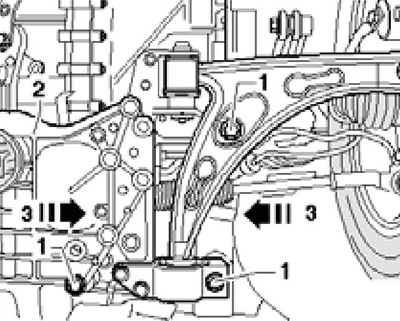
19.2 Adjusting the front wheel camber
Note: Never move the subframe forward or backward.
The camber adjustment range is limited by the tolerances of the holes in the subframe. If the required value is not achieved by moving the components, these components should be checked as well as the body. After adjustment, tighten the new subframe bolts to the body (see Specifications).
3. After moving the subframe and, accordingly, the steering mechanism, you should check the gap between the steering column hinge and the edges of the opening in the engine compartment bulkhead. To do this, unscrew the screws (see illustration 5.2) and remove the cover behind the pedals. The gap between the hinge (2 in illustration 5.3) and the edges of the opening must be at least 5 mm around the entire circumference.
Convergence adjustment
4. Loosen the locknut (2 in illustration 17.1), holding the tip (1 or 11) of the steering rod. Loosen the clamp (3), pull it off the boot. Adjust the toe-in by turning the left and/or right steering rod with an open-end wrench by the hexagon on it.
5. After rotating the rods, make sure that the dust boots are not twisted, as this will lead to their rapid wear.
6. Tighten the lock nut with the VAG1332/11 open-end wrench to 70 Nm, holding the tip (1 on the accompanying illustration) traction, and check the convergence again.
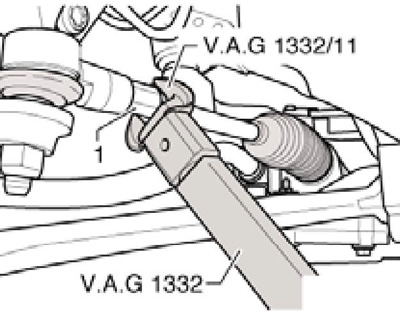
19.6 Tightening the lock nut
7. After achieving the desired result, tighten the boot clamp.