



Attention! Remember that brake pads are subject to replacement only as a set and simultaneously on both wheels of one axle - replacement on only one of the brake mechanisms is fraught with a violation of the uniformity of the gripping force and loss of directional stability of the car during braking.
Remember that dust generated during wear of the friction material of the pads may contain asbestos, which is harmful to health - do not blow it off with compressed air or inhale it under any circumstances. When servicing the brake mechanisms, wear a protective mask or respirator. Do not use petroleum-based solvents to wash off brake dust - wipe the brake components only with methyl alcohol or a special cleaner.
1. Support the rear wheels of the car with chocks, set the parking brake, then jack up the front of the car and place it on supports. Remove the front wheels.
2. Pull the caliper outward until it presses into the piston in the cylinder.
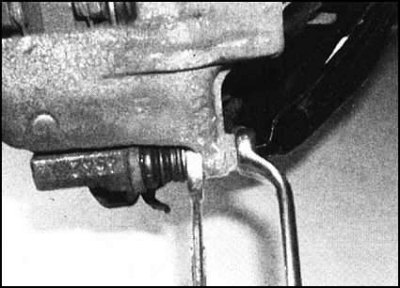
3. Remove the lower caliper guide pin bolt. While loosening the bolt, hold the pin from turning with an open-end wrench.
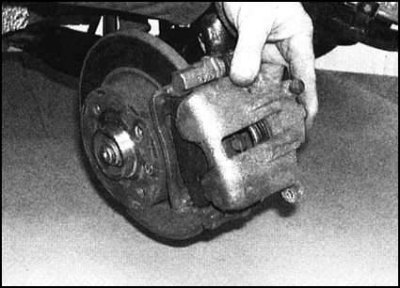
4. Turn the caliper upward, remove it from the pads and the brake mechanism anchor bracket and tie it with wire to the suspension elements.
Note: Never over-stretch the flexible brake hose.
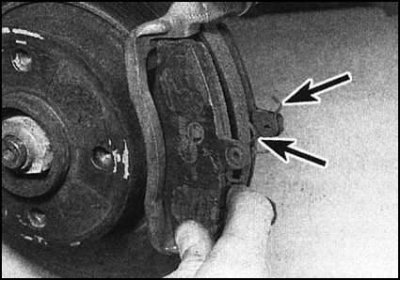
5. Remove the two pads from the brake mechanism anchor bracket.
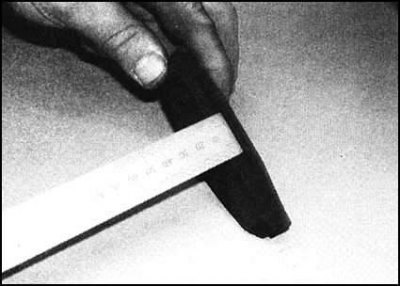
6. Measure the remaining thickness of the friction lining of each of the pads. If any of the pads is worn more than the permissible limit at any point, all four pads (from both brake mechanisms of this axle of the vehicle) are subject to replacement. The pads should also be replaced if they are oiled or greasy. First, you should identify and eliminate the cause of oil getting into the brake mechanism. If you find signs of uneven wear on the pads, you should also try to identify and eliminate the cause of the defect.
7. If the condition of the pads is considered satisfactory, they should be thoroughly cleaned with a metal brush, paying special attention to the quality of cleaning the rear walls of the metal substrates. Do not forget to clean the grooves made in the body of the friction linings, completely removing debris and small foreign objects stuck in them. Having finished with the pads, clean the contact surfaces of their seat in the caliper and anchor bracket.
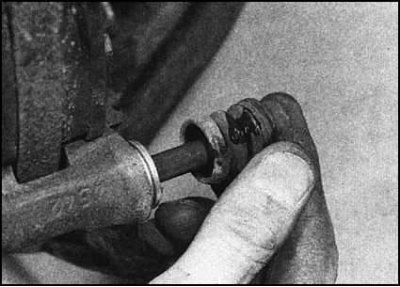
8. Before installing the pads, check the tightness of the caliper guide pins, then assess the condition of the protective pin covers. Remove dust and dirt from the surfaces of the caliper and piston. Assess the condition of the piston dust boot. Check the piston itself for signs of leaks, corrosion and mechanical damage. If defects are detected, the components must be replaced (see section Removal, major repair and installation of front wheel brake calipers).
9. When installing new (and therefore thicker) the caliper piston must be recessed in its cylinder to ensure sufficient free space. Use a clamp or a suitable wooden block (as a lever). If the brake master cylinder has not been overfilled, pressing the piston should not cause the brake fluid to overflow the edge of the reservoir, but this point should be checked. When the fluid level reaches the MAX mark, its excess should be pumped out of the brake master cylinder reservoir, or released through a hose through the bleed valve.
Warning! To avoid poisoning, never suck out brake fluid from the cylinder by mouth - use a syringe or a rubber bulb!
(Text obtained from the website SKODABOOK.ru)
10. Remove all traces of old sealant from the bolt threads and guide pin. If thread defects are found, the bolt must be replaced.
11. Install the pads into the brake mechanism anchor bracket (friction linings to the disc).
12. Lower the caliper, making sure that the anti-squeal springs are positioned correctly in it.
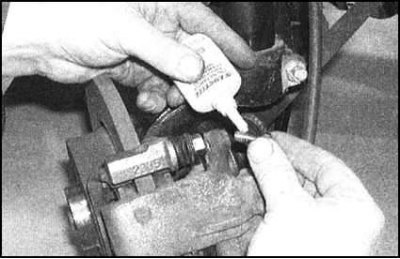
13. Lightly lubricate the guide pin bolt threads with a sealant such as Loctite 243.
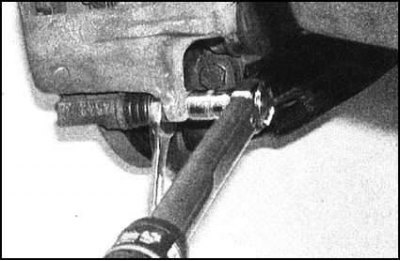
14. Press the caliper down, screw in the bolt and tighten it to the required torque (hold your finger from turning with an open-end wrench).
15. Press the foot brake pedal several times to restore pressure in the hydraulic system.
16. Repeat the described procedure for the brake caliper of the opposite wheel.
17. Replace the wheels, lower the vehicle to the ground and tighten the wheel bolts to the required torque.
18. Check the hydraulic fluid level.
Attention! Full braking efficiency is achieved only after the new brake pads have been fully run in. Avoid abrupt braking during the first few hundred kilometers after replacing brake components.