



2. Ensure that the synchronizer hubs have a tight fit on the corresponding shaft.
3. Synchronizer hubs that do not have tension when fitted onto the shaft must be replaced.
4. Determine the degree of wear of the internal splines of the hub. Gear shifting may be difficult due to the formation of steps on the teeth.
5. The worn synchronizer hub must be replaced.
6. Troubleshoot the following:
- Engine vibration.
- Driving at low speed in high gear.
- Crankshaft damper failure.
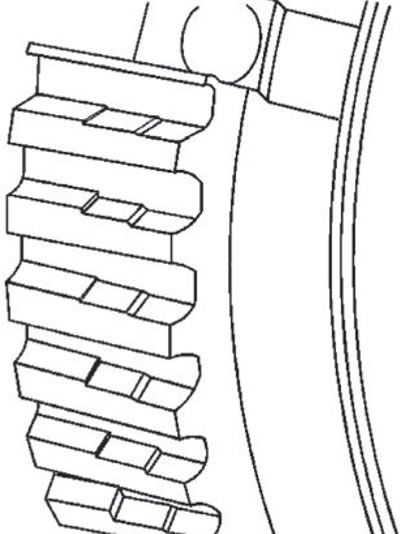
Formation of steps on the synchronizer teeth
7. Inspect the synchronizer sleeve teeth (a) for the following defects, which may negatively affect the quality of gear shifting:
- Worn teeth.
- Chips on the teeth.
- Blunt teeth.
8. Inspect the synchronizer sleeve lock stops (b) for signs of wear or chips.
9. If the above defects are present on the teeth or limiters, replace the synchronizer assembly.
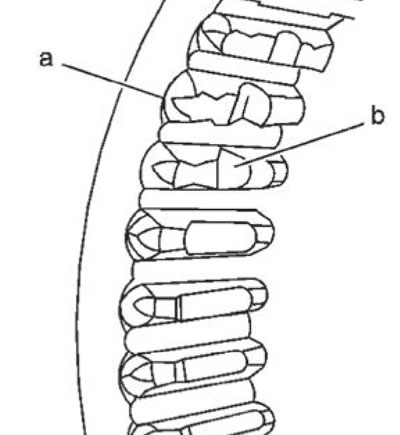
Damage to the synchronizer sleeve teeth
This material is published on the portal: skodabook
10. Inspect the locking rings for wear along the grooves (a).
11. Replace the locking ring with a worn groove.
12. Measure the gaps between the synchronizer locking rings and the gears (except for the 5th gear).
- Install the locking ring on the corresponding gear.
- Press the ring against the gear.
- Using a set of flat feeler gauges, determine the gap between the teeth of the locking ring and the transmission gear.
Minimum allowable clearance between the blocking ring and the 4th, 3rd, 2nd and 1st gear pinion: 0.8 mm.
13. If the correct clearance is not achieved when installing a NEW locking ring, replace the gear.