



Installation of windshield washers
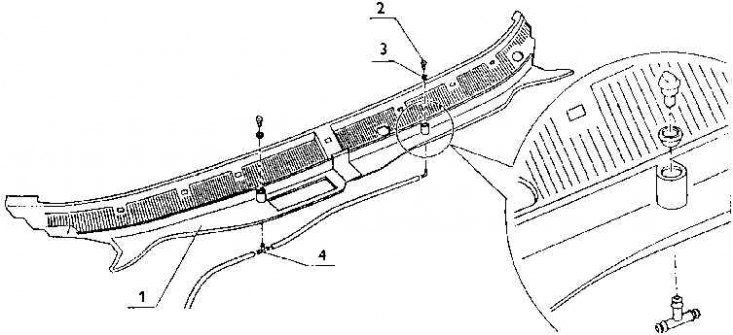
1 – partition cover 2 – injector assembly; 3 – reinforcing sleeve; 4 – supply of liquid to the washers
Installation of headlight washers
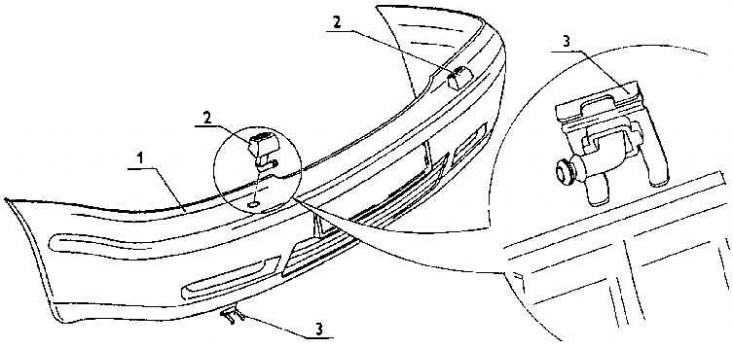
1 – front bumper; 2 – nozzle holder assembly 3 – headlight washer holder
The two windshield washer nozzles are twinned. The plastic holder of each nozzle contains two steel balls for spraying the washer fluid. The direction of the fluid flow is adjusted by a needle inserted into the holes in the balls. The assembled nozzles are inserted into rubber bushings embedded in the plastic cover of the dividing partition (see fig. Installation of windshield washers).
The polyethylene reservoir for the washer fluid has a capacity of 3 liters and is designed for both the windshield and rear window washers. It is located in the engine compartment and there is a common pump built in there, combined in one housing with an electric motor. The pump is reversible, so it can change the direction of rotation and thus it can be used either for washing the windshield or the rear. There are check valves in the fluid outlets. The fluid is supplied to the windshield washer nozzles by rubber hoses with a diameter of 3.5 / 7 mm, to the rear window wiper (if there is one) polyethylene hose with a diameter of 4.5/6 mm.
Driving safety depends on the cleanliness of the headlights. In a dense stream of cars on a wet road, the headlights can only be kept clean by cleaning them or spraying liquid under pressure. In Skoda Octavia cars, the second method was chosen, it is just as effective, but the equipment is less vulnerable to it.
Headlight washers in all modifications (LX, GLX, SLX) are mounted as special equipment.
(Data Copied from the portal: SKODABOOK.RU)
Each of the two headlights is cleaned by a stream of liquid from two nozzles located in the plastic holders-extensions of the front buffer (see fig. Installation of headlight washers). In case of installation of headlight washers, a 5.5 l washer fluid reservoir is installed (general and for window washers). However, the headlight washer pump is separate. The washer only works when the headlights are on (even parking lights) and start the windshield washer.
In summer, water with the addition of a non-foaming degreaser is used as a washer fluid; in winter, a mixture of water and antifreeze liquid specifically for washers is used.
The following damages are possible in washers. It is quite common for some nozzles to become clogged with dirt from the liquid. In this case, some nozzles do not work. A pin is enough for cleaning. Another malfunction, not so common, is the hose slipping off some fitting (pump, wiring, nozzle). In this case, the liquid flows out through the dropped hose and the washer does not work. It is easy to put the hose on. If the end of the hose has burst or stretched out, the damaged piece can be cut off. If the electric motor does not work, neither the rear nor the front window is washed. The operability of the electric motor can be checked with a 12 V bulb. Touch it to the connectors of the wires disconnected from the motor, and simultaneously press the washer switch. If the bulb does not light (with ignition on), you need to make sure the fuse is intact. The switch may also be defective. If the light comes on, the pump motor is damaged. The last possible defect may be damage to the connection between the motor and the pump. In this case, the motor works (can you hear it), and the pump is not. Repairs should always be carried out in a specialized service. No maintenance of the washer is required. From experience, it is recommended to fill the tank with a mixture filtered through a fine sieve (silon fabric) and take the tank out twice a year, rinse it and wipe it to remove dirt and sediment. This significantly reduces the risk of clogging the sprayers and the pump.