
Company vehicles Hyundai Company vehicles Kia Company vehicles Lada Company vehicles Mazda Company vehicles Mercedes-Benz Company vehicles Opel Company vehicles Mitsubishi
English Русский
Български
Беларускі
Український
Српски
Hrvatski
Română
Polski
Slovenský
Magyar
Articles   
Bookmark Contacts Sitemap
SkodaBook.ru


Fabia Rapid Octavia Superb Kodiaq Yeti Others
Octavia 1 (1996-2004) Octavia 3 (2013-2019)

Radiators and Fans — Design Description (Skoda Octavia 1U)

  • Main
  • Octavia
  • 1U (1996-2004)
  • Power unit
  • Cooling system
  • Radiators and Fans — Design Description
0

Assembling the radiator
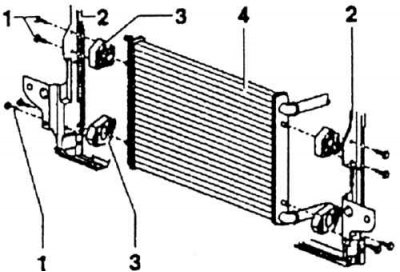


1 – screws for fastening the radiator sockets; 2…

1 – screws for fastening the radiator sockets; 2 – side radiator brackets; 3 – upper elastic socket and lower elastic socket; 4 – radiator


Elastic radiator sockets
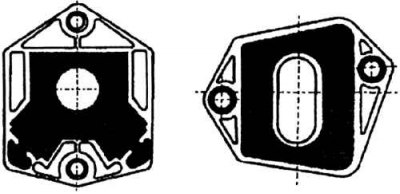


upper nest; lower nest

upper nest; lower nest


The radiators listed below are all composite. This means that they have plastic side chambers and aluminum tubes inserted into them for the liquid to flow through, held in place by rubber seals. The tubes are either circular in cross-section (for radiators with a thickness of 23 mm), or a section of a narrow oval, the major axis of which is oriented in the assembled radiator parallel to the air flow (34mm thick radiators). The plates that transfer heat to the air flow are made of aluminum sheet and are simply tightly fitted onto the tubes.


Radiators are so-called two-pass. They have a horizontal partition in the middle of the left chamber, dividing the chamber, as well as a neck into two parts - fittings for supplying and removing coolant - both are on the left side (in the direction of movement). The liquid flowing through the upper fitting flows from the upper half of the left chamber horizontally into the right chamber, which has no partition, and from there enters the lower part of the left chamber.

The inlet and outlet fittings have a seal for the plastic hose tips and holders with a snap-on spring for quickly clamping these tips.

All types of radiators have the same height - 414 mm; the length and depth vary according to the type of radiator. The radiator together with the fan is mounted on a pre-assembly to the front cross wall of the body, which is then installed completely in the body.

Depending on the type and number of fans, a corresponding bracket is used.

The fastening of all radiators is the same. On the plastic chambers on each side there are two pins. Elastic sockets made of rubber-plastic are put on them. A schematic representation of the elastic sockets is shown in Fig. Elastic sockets of the radiator. The sockets are paired: upper and lower, differing in shape, but the same for the left and right sides. The elastic sockets are fastened to the supporting frame with two thread-cutting screws.

Information taken from this resource: SKODABOOK
This article is available at russian, bulgarian, belarusian, ukrainian, serbian, croatian, romanian, polish, slovak, hungarian
Article verified: Eleonora Afanasyeva
Share with friends:
◀ Previous
Skoda Octavia 1: Cooling system
Next ►

Coolant — General Information
Engine cooling system — design description
Fans and radiators used in cars
Thermostat — General Information and Testing
Coolant expansion tank and its cap
Cooling system connecting hoses and clamps
Read similar articles on other Skoda models

➧ Design of engine lubrication system Skoda Fabia 1 (1999-2007)
➧ Dual Clutch — Design (Robotized 7-speed Gearbox) Skoda Rapid 1 (2012-2022)
➧ Removal and installation the radiator and its fans with the casing Skoda Superb 2 (2008-2015)
➧ Removal and installation the radiator and its fans with the casing Skoda Yeti (2009-2017)
➧ Description of the carburetor design Skoda Felicia (1994-2001)
Link to this article in various formats
Reviews and comments of visitors
No comments yet


Add two numbers: 32 + 31


Octavia 3 (2013-2019) 
  • General information
  • User manual
  • Car driving
  • Maintenance
  • Petrol engines 1.2 l
  • Engine repair
  • Cooling system
  • Supply system
  • Petrol engines 1.4 l
  • Engine repair
  • Supply system
  • Petrol engines 1.8/2.0 l
  • Engine repair
  • Cooling system
  • Supply system
  • Diesel engines 1.6/2.0 l
  • Engine repair
  • Cooling system
  • Supply system
  • Transmission
  • Mechanical gearbox 02S
  • Automatic gearbox 0CW
  • Automatic gearbox 0D9
  • Chassis (running gear)
  • Front suspension
  • Rear suspension
  • Brake system
  • Steering
  • Body and interior
  • Doors, locks and windows
  • Exterior (external elements)
  • Interior (internal elements)
  • Ventilation and air conditioning
  • Electrical equipment
  • Equipment and devices
  • Headlights and lighting
  • Wiring diagrams (basic)
  • Wiring diagrams (comfort)
Octavia 1 (1996-2004) 
  • General information
  • Vehicle details
  • Maintenance
  • Power unit
  • Petrol engines 1.6 l AEE
  • Petrol engines 1.8 l AGN
  • Diesel engines 1.9 l AGR
  • Fuel system
  • Exhaust system
  • Cooling system
  • Transmission
  • Clutch
  • Car gearbox
  • Gearbox repair 02J
  • Gearbox repair 02K
  • Chassis (running gear)
  • Wheels and tires
  • Suspension and axles
  • Brake system
  • Body and interior
  • Exterior (external elements)
  • Interior (internal elements)
  • Doors, locks and windows
  • Electrical equipment
  • Equipment and devices
  • Electrical circuits
SkodaBook.ru © 2018–2026 | Mobile version | Articles on Skoda | Sitemap EN BG BY UA RS HR RO PL SK HU | Feedback | Site search | Bookmark
Fabia 1 (1999-2007) | Fabia 2 (2007-2014) | Rapid 1 (2012-2022) | Octavia 1 (1996-2004) | Octavia 3 (2013-2019) | Superb 2 (2008-2015) | Kodiaq 1 (2016-2024) | Yeti (2009-2017) | Favorit (1987-1994) | Felicia (1994-2001) |
By continuing to use the site, you agree to the use of cookies.