



Carburetor Cover Components
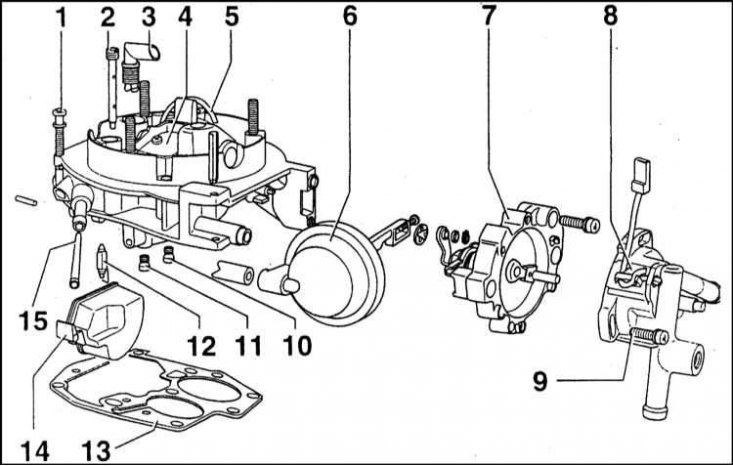
1 - Screw (7 Nm); 2 - Freewheel tube; 3 - Ventilation tube; 4 - Air damper; 5 - Econostat chamber II; 6 - Vacuum chamber of the additional starting device (Pulldown); 7 - Starting device; 8 - Semi-automatic trigger cover
Carburetor Body Components
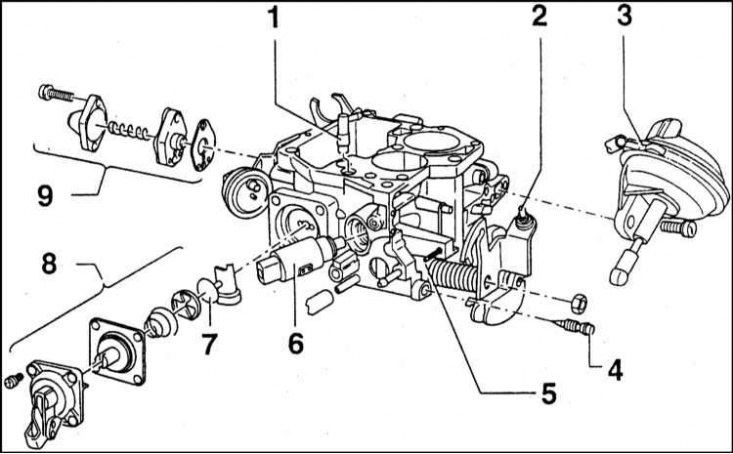
1 - Economizer tube; 2 - Fast idle speed adjustment screw; 3 - Throttle position sensor II; 4 - Idle mixture quality adjustment screw; 5 - Idle speed adjustment screw; 6 - E/M shut-off valve of the forced idle economizer (EISE); 7 - Accelerator pump inlet valve; 8 - Accelerator pump; 9 - Economizer
Fragment of a cross-section of a float chamber
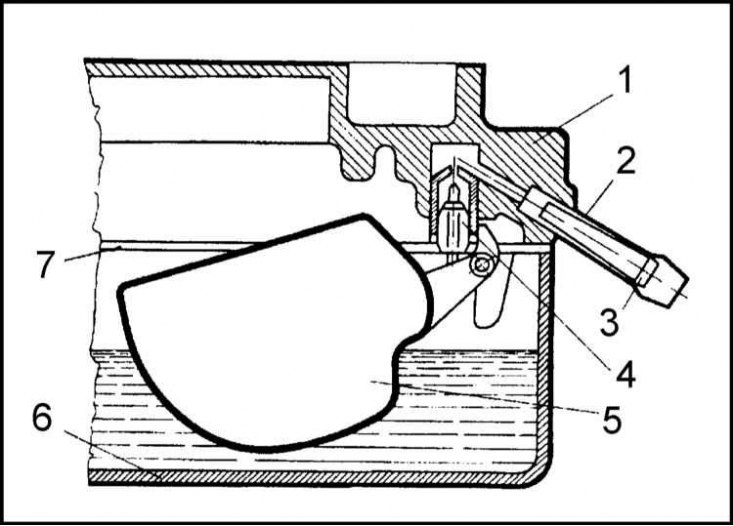
1 - Carburetor cover; 2 - Inlet pipe; 3 - Mesh filter element; 4 - Needle valve; 5 - Float; 6 - Carburetor body; 7 - Sealing gasket
Design of the filter/return device
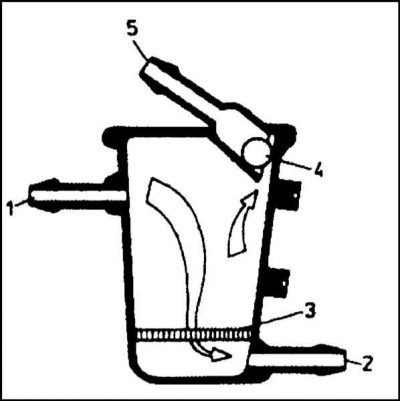
1 - Fuel supply nipple from the fuel pump; 2 - Fuel supply nipple to the carburetor; 3 - Mesh filter; 4 - Ball valve; 5 - Drain nipple
Gas pedal and throttle cable
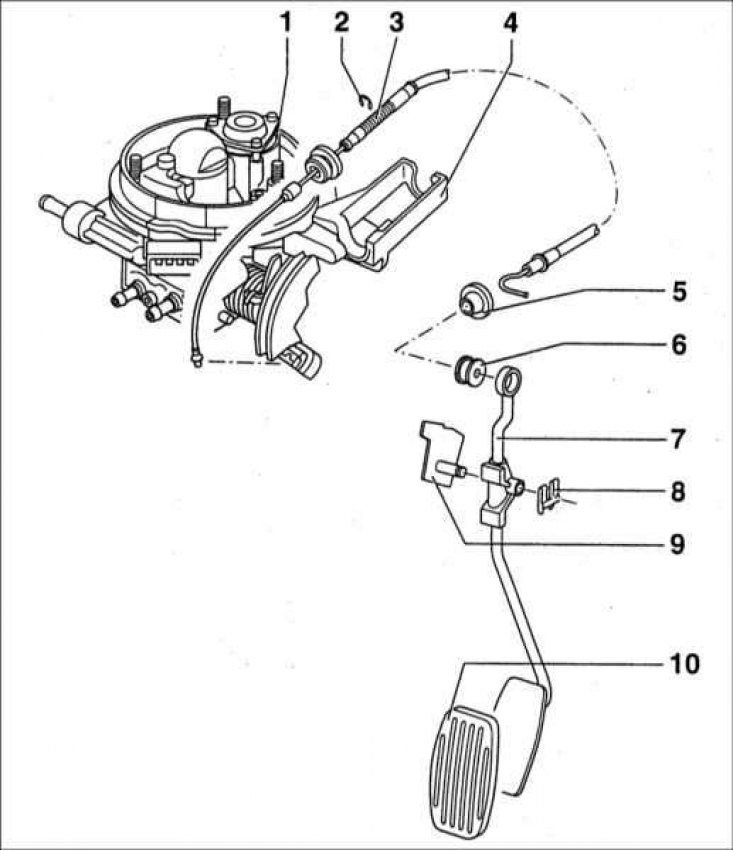
1 - Carburetor; 2 - Retaining ring; 3 - Throttle cable; 4 - Bracket; 5 - Rubber sealing sleeve; 6 - Rubber bushing; 7 - Gas pedal; 8 - Retainer; 9 - Pedal axle; 10 - Rubber pedal pad
The location where the drive cable is attached to the throttle lever
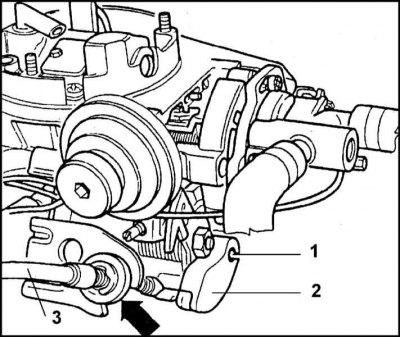
1 - Cable end seat retainer socket; 2 - Throttle actuator lever; 3 - Throttle cable
Adjusting engine idle speed
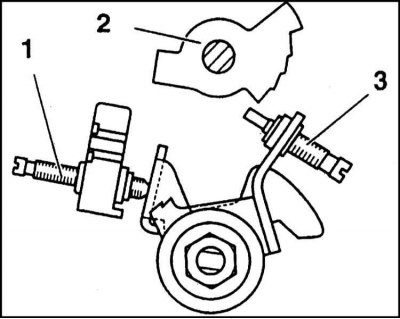
1 - Idle speed adjustment screw; 2 - Step pulley; 3 - Screw for adjusting the position of the air damper of the semi-automatic starter
Adjusting the free travel of the throttle drive mechanism
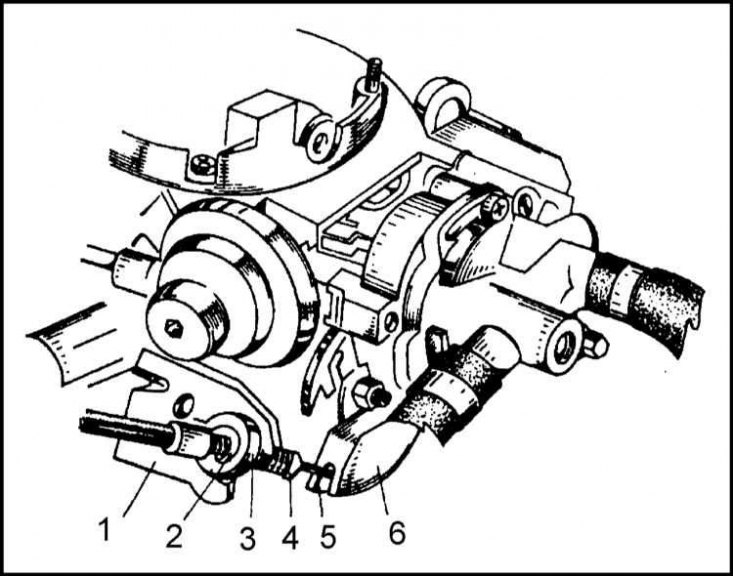
1 - Bracket; 2 - Retainer; 3 - Rubber washer; 4 - Cable sheath; 5 - Drive cable; 6 - Throttle actuator lever
Composition and design
The carburetor is designed to prepare the air-fuel mixture and its metered supply to the combustion chambers depending on the current load and engine speed.
The Pierburg 2E3/Jikov 28-30 LEKR carburetor used to equip the models under consideration is equipped with a semi-automatic starting system, which ensures reliable engine starting in all typical middle-zone temperature conditions, and also allows you to start driving immediately after a cold start. The factors that determine the operating mode of the semi-automatic starting system include:
- a) Ambient air temperature;
- b) Engine coolant temperature;
- c) Depth of vacuum in the intake manifold.
After starting the engine, the mixture is depleted in two stages. If the system is functioning properly, the engine starts on the first, maximum on the second attempt, even in frosty weather at an air temperature of -20°C.
The design of the carburetor is shown in the illustrations. The main components of the carburetor include the following devices:
- a) Semi-automatic starting device;
- b) Idle speed control system, ensuring stability of engine idle speed (800÷850 rpm);
- c) Transition system of chamber I, providing a smooth increase in engine speed when opening the throttle valve II;
- d) Air-fuel mixture enrichment system (econostat) at full load;
- e) Accelerator pump of diaphragm type with mechanical drive;
- f) An electromagnetic shut-off valve that shuts off the fuel supply to the carburetor after the ignition is turned off, as well as when the forced idle economizer (FIE) is activated;
- g) A float chamber that maintains a given fuel level in the carburetor.
Under the needle valve of the float chamber there is a filter element, the mesh of which performs fine cleaning of the fuel supplied to the carburetor.
Inside the needle valve there is a small spring on which a ball rests, partially protruding outward. By deforming, the spring dampens the jerks of the float lever during rapid movement of the car. Thanks to this adjustment, the fuel level in the float chamber is maintained constant.
The valve needle is coated with a highly durable Viton compound, which is particularly durable. This coating ensures high tightness of the unit's fit. The needle valve is designed for approximately 150,000 km of mileage and does not require additional regular maintenance.
When the fuel level in the chamber drops, the float moves down and slightly opens the needle valve. At the same time, the required additional amount of fuel is pumped into the chamber. An increase in the amount of fuel causes the float to rise and the valve to close automatically.
The carburetor is also equipped with an additional mesh filter. The filter assembly is installed at the inlet to the float chamber and is equipped with a ball valve, which allows excess fuel to be diverted from the carburetor back to the fuel tank. In addition, fuel vapors are diverted through the valve when the hot engine is turned off. The presence of the valve also prevents fuel vapors from entering the carburetor when the engine is running in hot weather, which leads to a violation of the stability of the latter's speed.
The carburetor is attached to the intake manifold with three M6x20 bolts through a rubber-metal sealing gasket, which reliably seals the joint. The gasket is attached to the intake manifold with four bolts with Allen key heads.