



Fuel tank lines
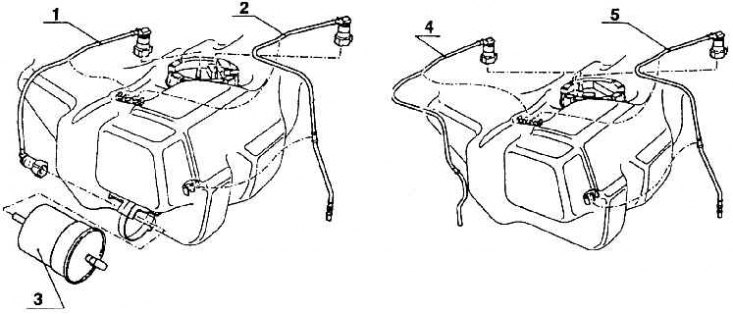
Petrol engines: 1 – fuel supply line; 2 – fuel outlet line; 3 – petrol filter
Diesel engines: 4 – fuel supply line; 5 – fuel outlet line
Thermal insulation casing of fuel lines in the engine compartment and designation of fuel lines (cars with gasoline engines)
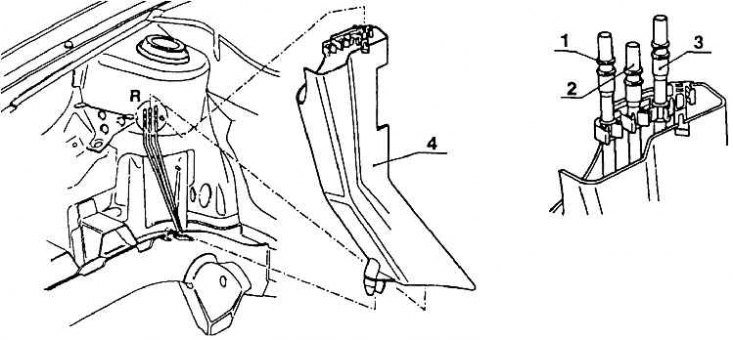
1 - pipeline for gasoline vapors between the tank and the activated carbon tank (not painted); 2 – return fuel line (blue); 3 – fuel supply to the engine (black); 4 – heat-insulating casing.
All fuel lines are made of polyamide tubes (material PA 12) and rubber hoses. The diameter of the tubes is 8/6.2 mm. The tubes are connected using quick-acting couplings made of two parts, also made of plastic. The ends of the couplings themselves are either straight or at an angle.
The quick-acting coupling is connected only by pressing one part to the other. Disconnection is performed by stretching them while simultaneously pressing the opposite projections of the plastic spring sticking out on the sides of the larger (black) part of the coupling. The tubes are put on the quick-acting coupling nipples after preliminary heating and this connection cannot be disassembled without damage. If a rubber hose is put on the quick-acting coupling nipple, the connection is ensured by an elastic steel clamp. The terminals (nipples) from the fuel filter, fuel pump, etc. have tips for fitting and fastening quick-acting couplings.
All pipelines (tubes) are pre-profiled and secured along their entire length by snapping into plastic clamps, which protect the tubes from contact with other parts.
Text copied from this resource: Skodabook.ru
A petrol filter is cut into the pipeline connecting the outlet of the fuel tank to the petrol engine. It is secured with a clamp in a stamping on the side of the tank.
In the engine compartment, the fuel lines are routed to the right side and protected there by a heat-insulating casing.
The conclusions are marked with colors (to facilitate orientation when installing pipelines from the engine). The fuel supply to the engine is marked with black paint, blue indicates the outlet pipe and a third, unpainted pipe (for gasoline engines) connects to the pipeline leading to the activated carbon tank.