



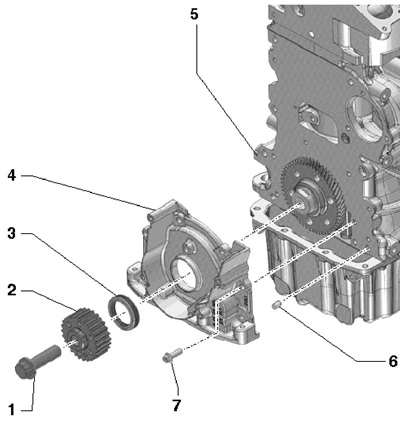
37.1a Installation details of crankshaft oil seals, their sealing flanges and some related components
1 Bolt, to be replaced, 120 Nm, then tighten to an angle of 90°
2 Crankshaft gear
3 Front oil seal
4 Front sealing flange, installed on centering bushings with silicone sealant D176 404A2
5 Cylinder block
6 Centering sleeve, 2 pcs.
7 Flange bolt 4, 15 Nm
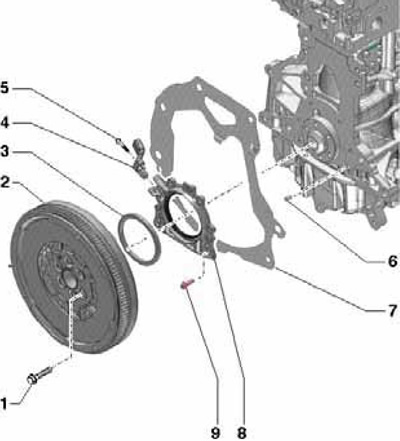
37.1b Installation details of crankshaft oil seals, their sealing flanges and some related components
1 Bolt, to be replaced, 60 Nm, then tighten to an angle of 90°
2 2-mass flywheel
3 Rotor of the CKR sensor
4 Sensor SKR "G28"
5 Bolt, 5 Nm
6 Centering sleeve, 2 pcs.
7 Intermediate plate, installed on centering bushings
8 Rear sealing flange with rear oil seal, can only be replaced as a whole
9 Bolt, 15 Nm
Note: Do not apply additional lubricant to the crankshaft oil seal lips. Before installing the oil seal, remove any remaining oil from the crankshaft with a clean cloth.
2. To remove the front oil seal, it is necessary to remove the timing belt (see Section 36) and the crankshaft gear. Use a suitable puller and drift to remove/press the oil seal. Press the oil seal onto the shaft flush with the edges of the hole in the sealing flange. There must be no grease between the crankshaft and its gear when installing. Use a new bolt to secure the gear; screw it in without lubrication.
3. To remove the front sealing flange, it is necessary to remove the timing belt (see Section 36), crankshaft gear and engine oil pan (see Section 41). When installing, apply a bead of silicone sealant D176 404A2 with a diameter of 2-3 mm to the flange, as shown in Illustration 7.8.
4. Removal and installation of the flywheel are carried out in the same way as on the 3.6 l engine (see Section 8).
5. Replacing the rear sealing flange assembly is done in the same way as on the 1.4 l engine (see Section 18). The only difference is in the use of the guide pin (F, with black handle) instead of a guide pin (G, with red handle), - see illustration 18.15.