Company vehicles Hyundai Company vehicles Kia Company vehicles Lada Company vehicles Mazda Company vehicles Mercedes-Benz Company vehicles Opel Company vehicles Mitsubishi
English Русский
Български
Беларускі
Український
Српски
Hrvatski
Română
Polski
Slovenský
Magyar
Articles   
Bookmark Contacts Sitemap
SkodaBook.ru


Fabia Rapid Octavia Superb Kodiaq Yeti Others
Superb 2 (2008-2015)

Features of engine overhaul (Skoda Superb B6)

  • Main
  • Superb
  • B6 (2008-2015)
  • Power unit
  • Diesel engines 2.0 l
  • Features of engine overhaul
0
Note: The presence of metal shavings or large amounts of small metal particles found during engine rebuild may indicate damage to the crankshaft and connecting rod bearings. To prevent further damage, thoroughly clean the oil passages and replace the oil jets, oil cooler and oil filter.


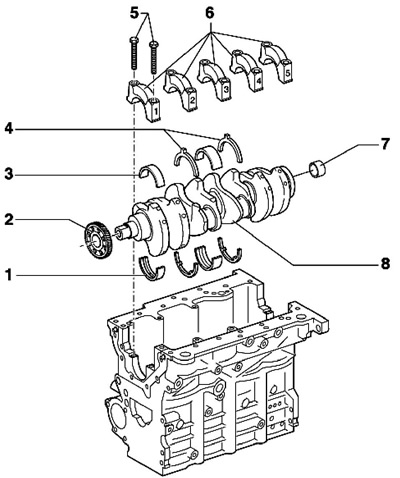
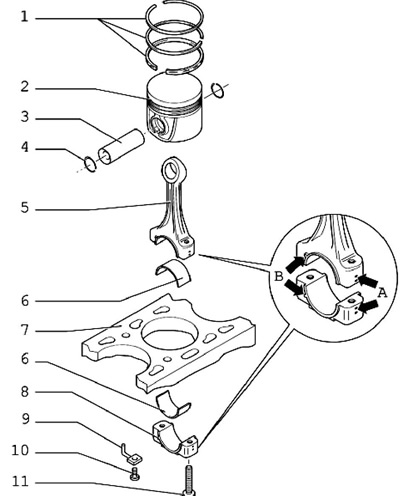
1. The details of the installation of the crankshaft and connecting rod-piston group are shown in the accompanying illustrations.

42.1a Crankshaft installation details

42.1a Crankshaft installation details
1 Upper main bearing shell (with lubrication groove)
2 Helical gear of the crankshaft, for driving the balance shaft module and the oil pump, is replaced together with the intermediate gear
3 Lower main bearing shell (without lubrication groove)
4 Main bearing thrust washers No.3
5 Bolts, to be replaced, 65 Nm, then tighten to an angle of 90°
6 Main bearing caps, No.3 - with grooves for washers 4
7 Needle bearing, only on models with DSG
8 Crankshaft


42.1b Connecting rod and piston group parts

42.1b Connecting rod and piston group parts
1 Piston rings are installed at an angle of 120° between the locks
2 Piston with combustion chamber, arrow on the bottom points towards the timing drive, numbering from the timing drive side
3 Piston pin, heat to 60°C for easier installation
4 Retaining ring
5 Connecting rod, replaceable only in pairs with cover 8, with marks indicating cylinder (A) and timing drive side (B)
6 Main bearing shells
7 Cylinder block


2. If the removed parts are to be reused, arrange them so that they will be in the same locations and orientations when reinstalled.


3. Replacing the needle bearing on models with DSG is done in the same way as on 3.6 l petrol engines (see Section 14). Install the bearing to a depth of 1.5-1.8 mm.

4. The connecting rod bearing shells installed on the connecting rod side are made of a more wear-resistant material than the lower shells and are marked with a black line on the working surface in the connection area. The upper shells can be distinguished by a black marking on the mating surface.

5. Connecting rods and connecting rod bearing caps are manufactured using a chipping method, so they should only be replaced together. The marks on the connecting rods and connecting rod bearing caps should be on the same side. Install the connecting rod bearing shells in the center (both in the connecting rod and in its cover), so that the distance on both sides is the same. The procedure for breaking off the cap from the new connecting rod is the same as described for the 3.6 L engine (see Section 14).

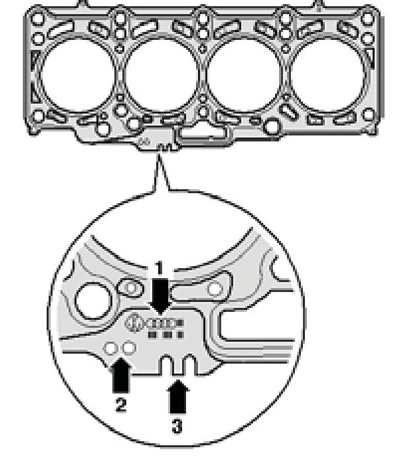
6. If new pistons are being installed or a short cylinder block is used, the number of marking holes in the cylinder head gasket must be determined (see accompanying illustration), which depends on the maximum value of the protrusion of all pistons relative to the upper surface of the cylinder block. One hole corresponds to a protrusion of 0.91-1.00 mm, two holes - to a protrusion of 1.01-1.10 mm, and three holes - to a protrusion of 1.11-1.20 mm.

42.6 Cylinder head gasket markings

42.6 Cylinder head gasket markings
1 Part number
2 Marking holes
3 Production Control Code (doesn't matter)
This article is available at russian, bulgarian, belarusian, ukrainian, serbian, croatian, romanian, polish, slovak, hungarian
Article verified: Leonid Vladimirov
Share with friends:
◀ Previous
Skoda Superb 2: Diesel engines 2.0 l
 

Work with lubrication system and balance shafts
Work with the gas distribution mechanism
Removal and installation the cylinder head, vacuum pump and CMP sensor
Removal and installation the cylinder head cover
Removal and installation of some parts related to the crankshaft
Removal and installation the timing belt, setting the timing phases
 
Read similar articles on other Skoda models

➧ Starting a gasoline engine Skoda Fabia 1 (1999-2007)
➧ Actions in case of engine overheating Skoda Rapid 1 (2012-2022)
➧ Changing engine oil Skoda Octavia 1 (1996-2004)
➧ Actions in case of engine overheating Skoda Kodiaq 1 (2016-2024)
➧ Features of engine overhaul Skoda Yeti (2009-2017)
➧ Engine Removal and Overhaul Procedures — General Description Skoda Favorit (1987-1994)
Link to this article in various formats
Reviews and comments of visitors
No comments yet


Add two numbers: 22 + 47


Superb 2 (2008-2015) 
  • General information
  • User manual
  • Car driving
  • Maintenance
  • Power unit
  • Petrol engines 3.6 l
  • Petrol engines 1.4 l
  • Petrol engines 1.8/2.0 l
  • Diesel engines 2.0 l
  • Diesel engines 1.9 l
  • Cooling system
  • Climate system
  • Power and exhaust system
  • Ignition and preheat system
  • Launch and charge system
  • Transmission
  • Manual gearbox and clutch
  • 7-speed DSG gearbox
  • 6-speed DSG gearbox
  • Transmission line
  • Chassis (running gear)
  • Brake system
  • Front suspension
  • Rear suspension
  • Steering
  • Body and interior
  • Exterior (external elements)
  • Interior (internal elements)
  • Electrical equipment
  • Equipment and devices
  • Lighting and signaling
SkodaBook.ru © 2018–2026 | Mobile version | Articles on Skoda | Sitemap EN BG BY UA RS HR RO PL SK HU | Feedback | Site search | Bookmark
Fabia 1 (1999-2007) | Fabia 2 (2007-2014) | Rapid 1 (2012-2022) | Octavia 1 (1996-2004) | Octavia 3 (2013-2019) | Superb 2 (2008-2015) | Kodiaq 1 (2016-2024) | Yeti (2009-2017) | Favorit (1987-1994) | Felicia (1994-2001) |
By continuing to use the site, you agree to the use of cookies.