



Removal and installation
Note: The engine is removed from underneath the engine compartment downwards together with the transmission.
1. Remove the top engine cover. To do this, pull it out of the supporting hinge sockets one by one (1-4 in illustration 34.1a), grasping the edges of the cover as deeply as possible. To install, press the cover into the sockets until you feel it lock into place. You may need to adjust the hinge sockets to the correct position before installing (see illustration 34.1b).
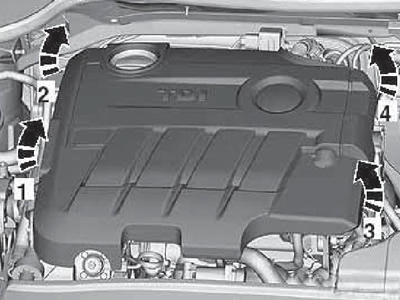
34.1a Removing the top engine cover
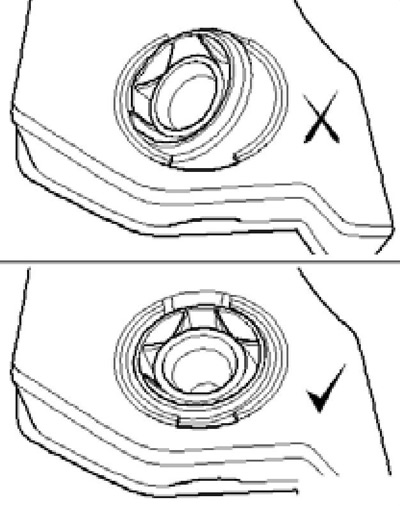
34.1b Correct (bottom) and incorrect (top) positions of the socket for the upper engine cover
2. Remove the battery and its holder (see Chapter 5).
3. Remove the air cleaner together with the MAF sensor and intake tube (see Chapter 4).
4. On CFFB and CFGB engines, disconnect the following connectors on the engine compartment bulkhead (see accompanying illustration): sensor "G648" EGR No.4 (2, orange), sensor "G235" EGR No.1 or temperature sensor after turbocharger "G507" (3, black), lambda probe "G39" (4, black) and EGR sensor No.3 "G495" (6, brown).
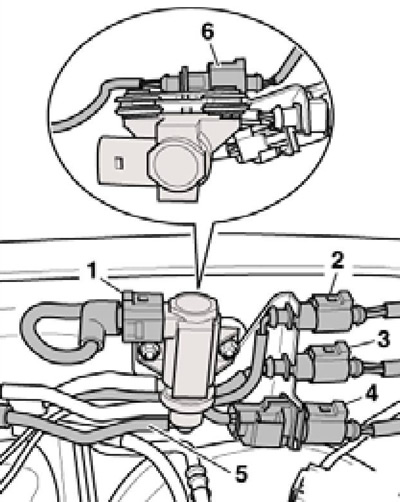
34.4 Sensors and vacuum hose on the engine compartment bulkhead
5. Disconnect the vacuum hose (5 in illustration 34.4) from the electromagnetic valve "N75" for regulating the boost pressure.
6. Drain the coolant (see Chapter 3).
7. Disconnect the connector (1 in illustration 5.16) sensor "G266" of the engine oil level and temperature. Remove the bracket (2) of the electrical wiring of the sensor G266 from the support of the power unit.
8. If equipped, remove the right drive shaft heat shield (see illustration 23.4).
9. Remove the wheel arch liners from both front wheel arches (see Chapter 11).
10. Disconnect the left drive shaft from the transmission flange (see Chapter 8).
11. Remove the exhaust pipe with the particulate filter (see Chapter 4).
12. On AWD models, separate the driveshaft from the manual transmission/DSG (see Chapter 8).
13. Remove the left stabilizer bar nut (2 in illustration 5.5) and press it away from the stabilizer. Then loosen the three nuts (3) of the ball joint and separate it from the suspension arm. If available, remove the front left suspension height sensor. Turn the steering wheel all the way to the left, pull the ball joint outward and, using a suitable strap (A), secure the left drive shaft (1) to the suspension strut so that the CV joint does not bend too much. Insert a stud into the suspension arm to stabilize the ball joint.
14. Remove the radiator (see Chapter 3), remove the bolts (arrows in the accompanying illustration), release the coolant hose (1), loosen the clamp (3), disconnect the connector (2) of the "G31" sensor and remove the right air pressure pipe.
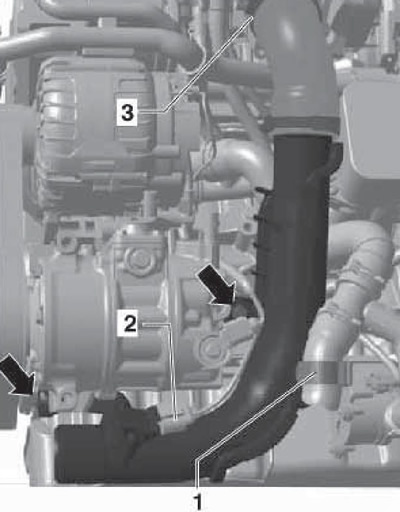
34.14 Removing the right air pressure tube
15. Unscrew the bolt (arrow on the accompanying illustration) and move the coolant circulation pump No.2 "V178" to the side.
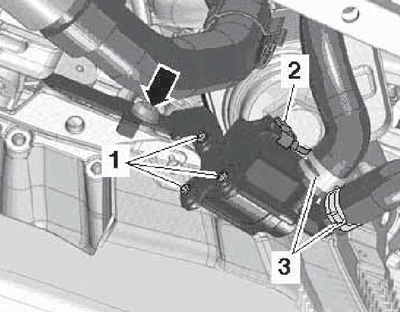
34.15 Pump fastener "V178"
16. Remove the vacuum hose (2) from the turbocharger vacuum element and disconnect the vacuum hose (3).
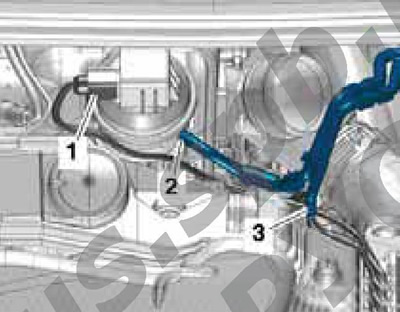
34.16 Vacuum hoses
17. Remove the vacuum hose from the brake booster (see accompanying illustration).
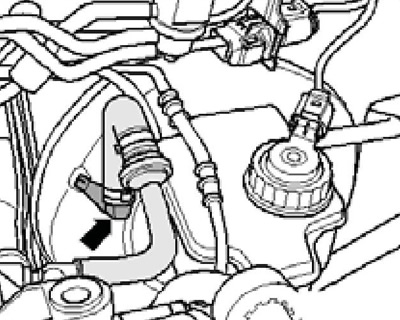
34.17 Vacuum hose on brake booster
18. Disconnect the feeder (2 on the accompanying illustration) and return fuel lines.
The original article is located on [SkodaBook]
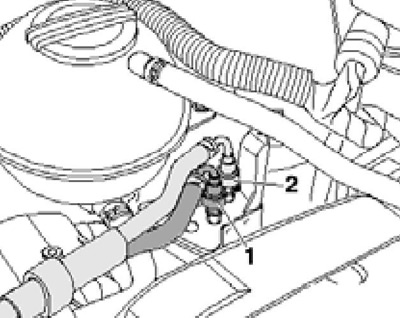
34.18 Fuel lines
19. Disconnect the connector (4 on the accompanying illustration) fuel temperature sensor "G81", loosen the clamps (2 and 3) and remove the supply and return fuel lines.
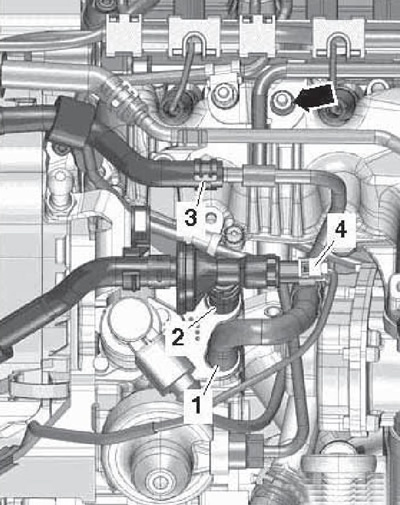
34.19 Sensor connector "G81" and fuel lines
20. Unscrew the bolt (1 on the accompanying illustration) and move the neck (2) of the washer fluid reservoir together with the tube to the side.
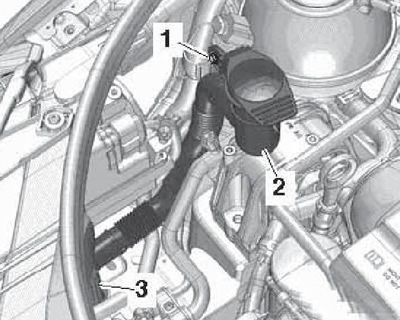
34.20 Removing the washer fluid reservoir neck
21. Release the fuel hose (2 on the accompanying illustration) from the bracket. Remove the fuel line bracket upwards in the direction of the arrow and place it to the side. Disconnect the connector (1) of the additional fuel pump "V393" and unscrew the bolts (3).
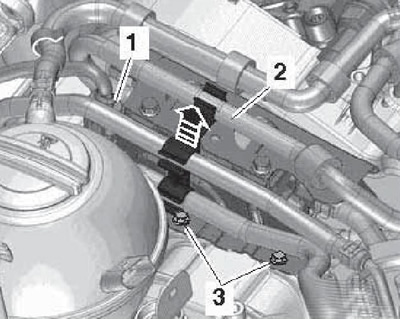
34.21 Fuel line bracket and auxiliary fuel pump connector
22. Loosen the bolt (1 on the accompanying illustration) 2 turns, unscrew the bolt (2) and loosen the nut (3). Separate the coolant line bracket from the fuel filter. Remove the fuel filter together with the connected hoses and remove the bracket together with the "V393" pump.
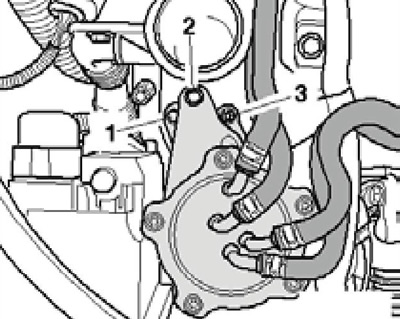
34.22 Removing the fuel filter and additional fuel pump
23. Remove the accessory drive belt (see Section 35) and the air conditioning system compressor without disconnecting the refrigerant lines from it (see Chapter 3). Secure the compressor to the hood latch bracket with wire so that the refrigerant lines are not pulled or kinked (see accompanying illustration).
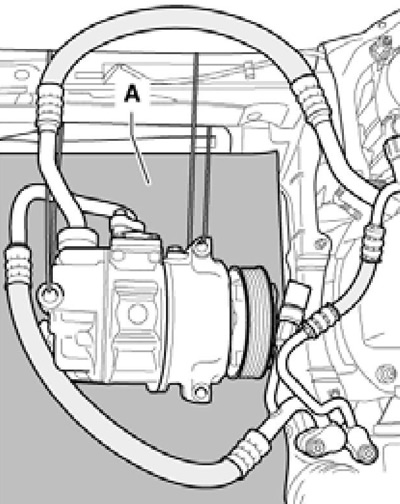
34.23 Fixing the compressor to the hood lock holder
24. Remove the fuse and disconnect the front ECM connector (see Chapter 5).
25. Remove the wiring harness guide plate retainer (see illustration 5.17) and pull it up from the bulkhead near the expansion tank.
26. Open all the wiring harness guides and set it aside (see accompanying illustration).
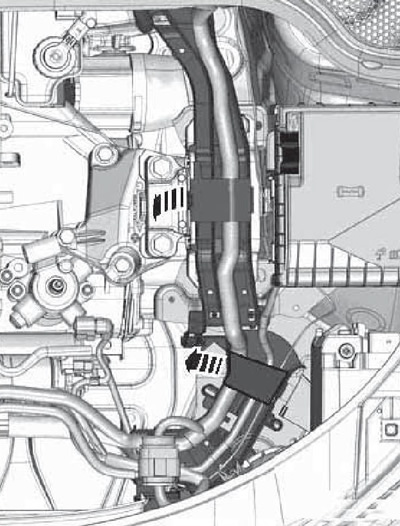
34.26 Wiring Harness Guides
27. Disconnect the connector (1 in the illustration 23.12) and open the bracket (2) under the wiring guide. Release the engine wiring harness going to the ECM and place it on the engine.
28. Disconnect the connector on the lower left side member (see accompanying illustration).
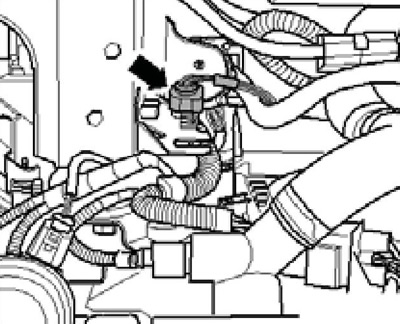
34.28 Connector on the left side member
29. Remove the clamp (arrow in illustration 23.15) protective cap (if available), disconnect the ground wire (1), disconnect the connector (2), pull back the protective cap and disconnect the B+ wire from the starter solenoid valve bracket.
30. Disconnect all remaining engine and transmission wiring connectors or disconnect the wiring harnesses from them.
31. Disconnect the coolant hoses from the heater radiator (see accompanying illustration), and also disconnect the coolant hose from the expansion tank at the top and bottom.
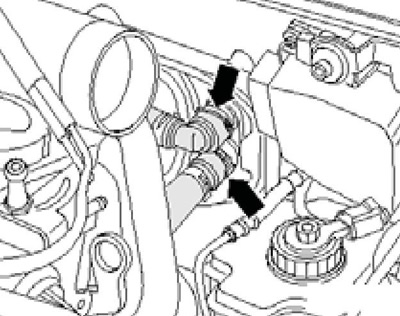
34.31 Coolant hoses on the heater radiator
32. On models with an additional heater, disconnect the coolant hoses from it, collecting the leaking liquid.
33. On models with a manual transmission, remove the gearshift mechanism from it and disconnect the pressure line from the breather/clutch slave cylinder (see Chapter 6). On models with DSG, remove the gearshift mechanism from it (see Chapter 7).
34. Disconnect all remaining engine and transmission connections, coolant hoses, vacuum and vent hoses.
35. Remove the bolts in the following sequence (1-3 in illustration 5.11) and remove the transmission rocker support.
36. Secure the T10012 support to the cylinder block by tightening the nut (2 on the accompanying illustration) and bolt (1) with a force of 20 Nm. Insert the VAG1383A transmission jack into the T10012 support and support the engine to relieve its supports.
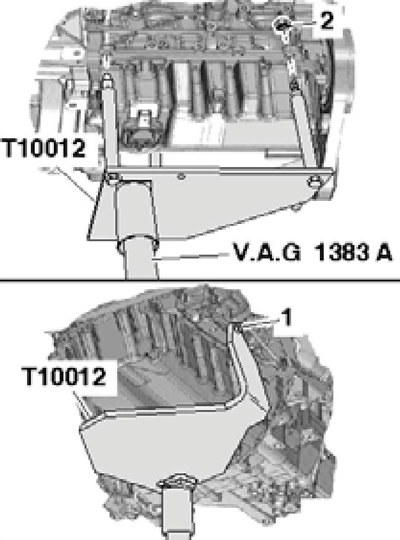
34.36 Support for lifting the power unit
37. Remove the bolts from the stepladder (see accompanying illustrations) fastening the right and left brackets (on the engine and transmission).
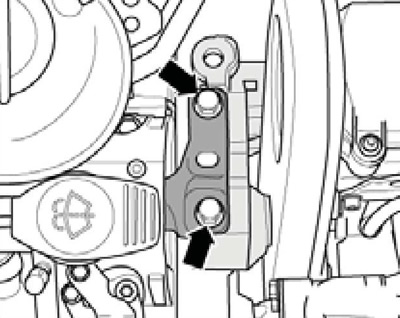
34.37a Right engine mount bolts
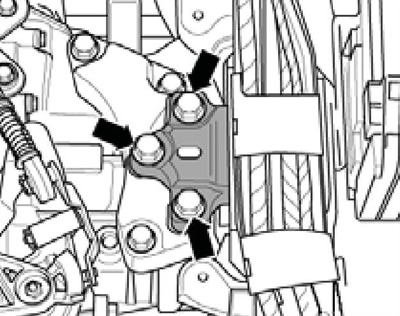
34.37b Left engine mount bolts
38. With the help of an assistant, carefully lower the power unit from the engine compartment using the jack. If necessary, rotate or move the power unit to prevent damage to its parts and to the components of the engine compartment.
39. Secure the engine to the mounting stand and separate the transmission from the engine (see Chapter 6 or 7).
40. Installation is carried out in the same way as for 1.8/2.0 l petrol engines (see Section 23). The pressing depth of the crankshaft needle bearing is 1.5-1.8 mm. A description of the inspection and adjustment of the power unit supports is given in the subsection below.
Checking and adjusting the powertrain supports
41. The details of the support fastenings are shown in the accompanying illustration.
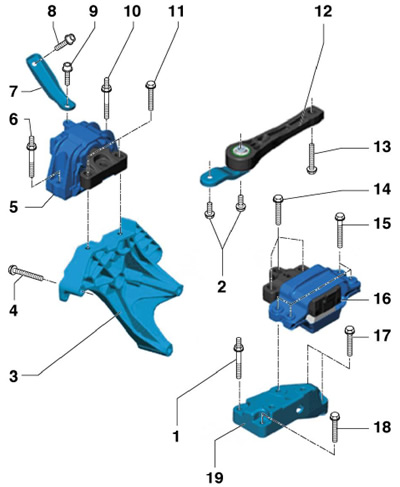
34.41 Powertrain support fastening parts
1 Bolt
2 Bolt, strength class 10.9, to be replaced, 50 Nm then tighten to an angle of 90°
3 Engine support bracket
4 Bolt, to be replaced, 40 Nm then tighten to an angle of 180°
5 Engine support
6, 10, 15 Bolt, must be replaced, 40 Nm then tighten to an angle of 90°
7 Connecting piece
8, 9 Bolt, subject to replacement, 20 Nm then tighten to an angle of 90°
11, 14 Bolt, subject to replacement, 60 Nm then tighten to an angle of 90°
12 Swinging support
13 Bolt, to be replaced, 100 Nm then tighten to an angle of 90°
16 Transmission support
17 Bolt
18 Bolt, only on models with "DQ250" transmission
19 Transmission support bracket
42. When securing the engine mount to the cylinder block, tighten the bolts in the following sequence: (1-3 on the accompanying illustration) in three stages: first by hand, then with a force of 40 Nm, and finally, pull them to an angle of 180°.
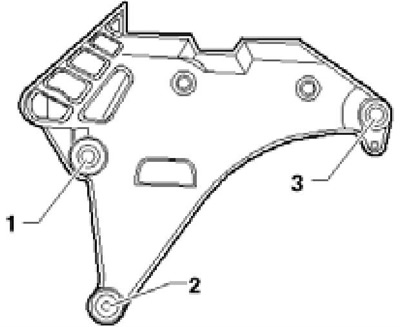
34.42 Engine Mount Bolt Tightening Sequence
43. To check the installation of the bracket, measure the distance (and in the illustration 15.45) between the bracket and the support, - it should be 10-13 mm. The cast edge of the support (2) should be parallel to the support arm (1), i.e. the distance (x) should be the same at the front and rear. If the engine or transmission hits the side member when turning and the distance (a) is not 10-13 mm, adjust the bracket as described below.
44. Remove the battery and its holder (see Chapter 5).
45. Remove the front bonnet bumpers from the upper sides of both front fenders. Insert the T10311 plates on the right (And in illustration 5.47) and left (B) sides in the direction of the arrows until they stop so that the arrows "R" and "L" on the plates point to the rear. These plates are needed to prevent damage to the wings.
46. Install the MP9-200 support with MP9-200/10 spindles (see illustration 5.48). The heel of the support should rest against the buffers. Evenly unload the power unit supports by rotating both spindles.
47. Loosen the bolts securing the right and left brackets (see illustrations 34.37a-b) approximately 1 turn. If the bracket bolts were not yet replaced when installing the engine, screw in the new bolts one by one.
48. Move the power unit using a lever installed between the support lever (1 in the illustration 15.45) and support (2) so that the distance (a) is 10 mm and the distance (x) is the same at the front and back.
49. Tighten the support bolts (see illustration 34.41).
50. Install the remaining parts.