



Note: An assistant is required to check the compression pressure. Starting the engine with the fuses removed or the wiring disconnected may store a fault code in the ECM memory and should then be cleared (see Chapter 5). Different designs of compression gauges and fluctuations in the starter speed usually only allow us to compare the compression in all cylinders.
Note: The compression pressure of the VMR engine must be checked using the VAS5051A diagnostic equipment connected to the diagnostic device.
1. Measuring the compression pressure allows you to get a general idea of the current condition of such engine components as the cylinder head gasket, valve train components, pistons and piston rings. Analysis of the test results allows you to determine whether the engine needs a major overhaul or whether it is sufficient to replace only the cylinder head gasket. The measurement is performed using a compression gauge.
2. Warm up the engine to a temperature of at least 30°C and turn it off.
3. Make sure that the battery is fully charged and that the valve clearances are adjusted correctly.
For petrol models only
4. Remove the spark plugs (see Section 14 Chapter 1).
5. Remove the fuse for the ECM power supply relay "J271" from the fuse box in the engine compartment.
6. Screw in the VAG1763 compression tester instead of one spark plug.
For diesel models only
7. Prevent fuel supply, unscrew the corresponding glow plug (see Chapter 5), screw the VAG1381/12 adapter into its place and connect the VAG1763 compression gauge to it (see illustration 2.7a). To prevent fuel supply on 1.9 l engines, disconnect the central connector of the pump-injectors and the outer connector of the glow plugs, and on CFFB/CLJA/CFGB engines, disconnect the connector of the fuel pressure regulating valve (see illustration 2.7b).
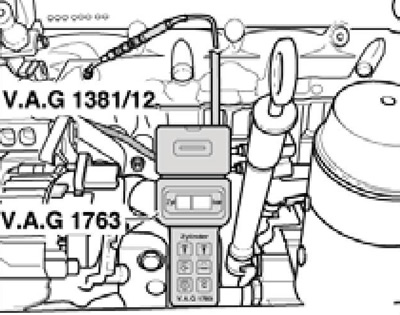
2.7a Compression gauge with adapter, connected to 1.9 l engine
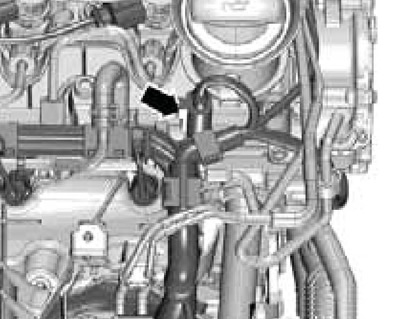
2.7b Fuel pressure control valve connector for CFFB/CLJA/CFGB engines
All models
8. Fully depress the gas pedal and, turning the engine with the starter, read and record the compression gauge readings when they stabilize (will stop increasing).
Note: The measurement time should be as short as possible.
9. Check the compression pressure in the remaining engine cylinders and compare the measurement results with the requirements Specifications.
10. Compression in a healthy engine increases very quickly. A low value after the first cycle, increasing with subsequent cycles, indicates wear of the piston rings. A low value after the first cycle, not increasing after the following ones, indicates leaks through the valves, or a broken cylinder head gasket (the cause could also be a crack in the head). The presence of carbon deposits on the valve plates can lead to a decrease in compression.
11. The results obtained from measuring compression should be approximately the same for all cylinders.
If the pressure in any cylinder is at the minimum permissible level (see Specifications) and even lower, then to find out the reason, pour a teaspoon of engine oil into the cylinder through the spark plug hole and repeat the measurement.
12. If adding oil temporarily improved compression, the reason for its decrease is most likely wear of the piston, rings or cylinder. If there is no increase in compression, then it can be assumed that the reason is a loose valve fit or a broken cylinder head gasket.
13. Low compression in two adjacent cylinders is almost certainly a result of a blown head gasket. The presence of coolant in the combustion chambers or in the engine crankcase will confirm this assumption.
14. If the compression in one of the cylinders differs from the others by more than 1 bar, and the idle speed is unstable, then the reason may be excessive wear of the camshaft cam.
15. After completing the check, disconnect the compression gauge with the adapter (if used), install the removed components and connect the electrical wiring. Tighten the glow plugs of the 1.9L engines with a force of 15 Nm.
16. Finally, use a diagnostic tool to clear the errors from the ECM memory.