



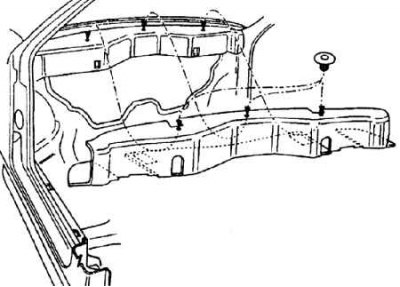
Soundproofing of the crossbar
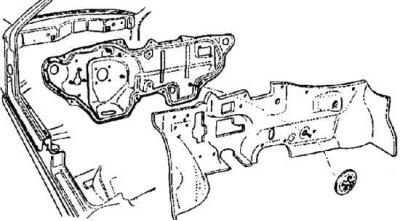
Front panel insulation
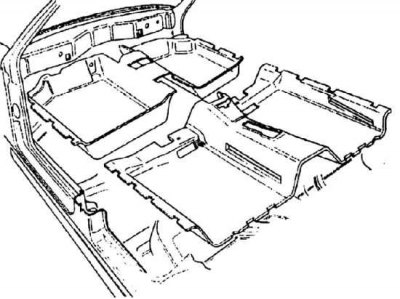
Insulation of the front and middle floor
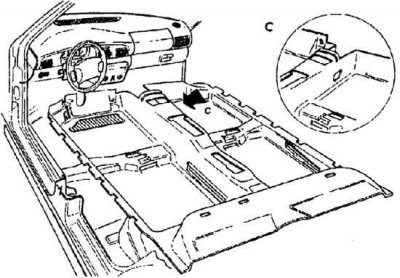
Assembled mat
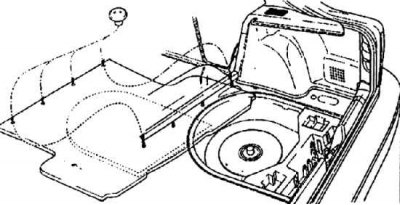
Luggage compartment mat
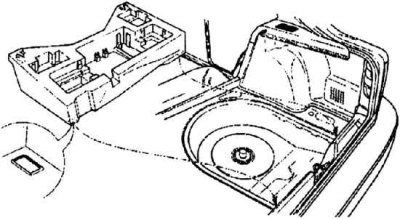
Insert in the luggage compartment (for the spare wheel)
The sound insulation of the crossbar, end wall, front and middle floor is an independent assembly unit. All the mentioned parts are pre-stamped in volume. The base of all is felt, and some also have a coating of heavy, sound-insulating film of varying density according to the type and modification of the car. The insulation elements for cars with left-hand steering differ from the insulation elements for cars with right-hand steering, as well as for cars with petrol and diesel engines.
Soundproofing of the crossbar (i.e. the upper part of the wall between the front pillars of the body) (see fig. Soundproofing of the crossbar) is made of stamped felt. It is secured at the top with three large plastic hollow nails in the shape of corks. At the bottom, it is glued to the body with two self-adhesive tapes. There are two types of crossbar insulation. For cars with a gasoline engine and left-hand steering, only felt is used for insulation. If the car has right-hand steering or is equipped with a diesel engine, the felt insulation is also covered with a heavy sound-insulating film.
Front panel insulation (i.e. the wall located in the recess under the crossbar) (see fig. Front panel insulation) for left-hand drive vehicles there are also two types. In both versions, the felt forms the lining, but the soundproofing film covering it has a different density for vehicles with diesel and petrol engines. In right-hand drive vehicles, the insulation is also made of felt, but the soundproofing film for vehicles with different engines does not differ from each other: it has the same density as in left-hand drive vehicles with a diesel engine. Similar insulation is also on the front floor; mid-floor insulation (see fig. Insulation of front and middle floor) in cars with petrol engines made of felt; in cars with diesel engines, a soundproofing film is also added.
The floor and end wall are also covered with a three-dimensionally stamped carpet, the design of which is unified for all vehicle modifications (see fig. Assembled mat). The mat extends from the top of the end wall to the rear edge of the rear seat. It is installed in the car after the air distribution to the rear floor is installed, but before the door sill panels, the central console of the dashboard and the seats are mounted. PVC pads are inserted into the mat where the driver's left foot rests and also as heel pads near the pedals.
In the luggage compartment, the side walls are covered only with stamped mats, secured at the top edge with just two plastic clips (see fig. Luggage compartment mat). The segment of the compartment behind the spare wheel is made in the form of an insert made of foamed polypropylene, which has cavities for storing vehicle equipment (warning triangle, tool, spare lamps, etc.) (see (fig. Insert in the luggage compartment (for the spare wheel)). This box, as well as the spare wheel, are covered by a flat mat that forms the bottom of the trunk. The mat is mounted under the back of the rear seat on four threaded pins and secured with plastic threaded buttons.