



- by fully loading the faulty vehicle onto the tow truck platform (preferably);
- by the partial loading method (one axle on the tow truck's overhead shelf, and the other either on a special trolley or on the ground), taking into account the restrictions below.
Please note the following limitations:
- towing without lifting the front wheels off the ground is prohibited if there is no oil in the gearbox or if the gearbox is damaged;
- towing without lifting the front wheels off the ground is prohibited if the steering wheel is locked when the battery is discharged;
- models with manual transmission without lifting the drive wheels off the ground are allowed to be towed only at a speed of no more than 50 km/h and for a distance of no more than 50 km;
- models with DSG without lifting the drive wheels off the ground are allowed to be towed only in extreme cases, only in the "N" position, only at a speed of no more than 50 km/h and for a distance of no more than 50 km (otherwise the DSG may be damaged, as the oil pump does not work in neutral gear);
- when towing all-wheel drive models using the partial loading method (the front or rear axle is suspended) the engine must be turned off.
Preparing for towing
Note: Remember to comply with the legal requirements for turning on external lighting devices on both the towing and towed vehicles.
Removable towing eye (with left-hand thread) is part of the on-board tool kit (see illustration 4) and, if necessary, screws into the front or rear bumper. The hole for the towing eye is closed with a plug on the right side of the corresponding bumper. To remove the plug, press on its lower edge, carefully pry the plug from below, pull it out and leave it hanging (see illustrations 9a-b). Screw the eye firmly into the hole behind the plug until it stops. It is convenient to insert a wheel brace into the eye for this purpose. After towing, the eye should be unscrewed, cleaned and stored in the on-board tool kit. When installing the plug, press in its upper part, then the lower part.
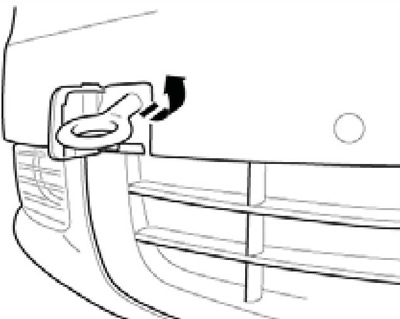
9a Screwing the towing eye into the front bumper
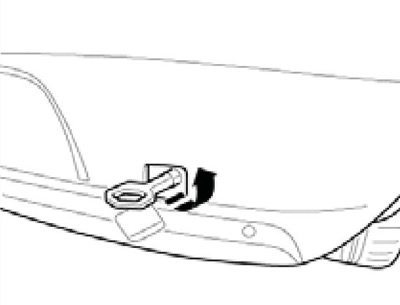
9b Screwing the towing eye into the rear bumper
Caution: Do not use towing eyes for other purposes (when transverse forces act on them), for example, to lift a car; attaching a rigid towing bar to the front of the vehicle is also not permitted.
Before towing, make sure the steering column lock is released, the transmission is in neutral and the parking brake is released. The ignition must be on so that the steering wheel is not locked and the brake lights, turn signals, windshield wipers and horn are operational.
Note: If the ignition is on but the engine is not running, the brake booster and power steering will not work either. Therefore, you will have to press the brake pedal and turn the steering wheel with more force than would be required with the engine running. The hazard warning lights are automatically switched off while the direction indicators are on.
The most reasonable towing method is a rigid hitch, but in this case the towing eyes on both vehicles must be installed on the same side. If this condition is not met, the vehicle will be subject to lateral forces, and when cornering, the towing beam may damage the body. When towing with a flexible hitch, use only an elastic rope specially designed for this purpose.
Before starting to move, drivers of both vehicles (towing and towed) the route should be agreed upon among themselves.
Towing for the purpose of starting the engine
Note: Try starting the engine with a booster battery first (see below). Towing or pushing is not possible on DSG models; on models with manual transmission, when starting the engine by towing, to avoid the possibility of damaging the catalytic converter, the towing distance should not exceed 50 m, and the engine should not be warm.
Note: Towing start of the engine is not permitted on models with the "KESSY" system (steering column lock may not turn off), and also when the battery is discharged (the engine control unit may not be working properly).
If necessary, turn on the hazard warning lights.
Turn on the ignition (see Chapter "Controls and operating techniques").
Engage 2nd or 3rd gear and depress the clutch pedal. When both cars are moving, slowly engage the clutch (release the pedal).
Once the engine starts, depress the clutch pedal and shift out of gear to avoid colliding with the towing vehicle.
Towing a damaged vehicle
Note: Please note the restrictions listed at the beginning of the "Transporting a Damaged Vehicle" section (see above).
The driver of the towing vehicle should try to move as smoothly as possible, smoothly releasing the clutch when changing gears and, especially, when starting off.
When driving a towed vehicle, make sure that the cable remains taut throughout the movement; try to avoid sudden jerks and running over a loose cable.
The movement should be carried out along the shortest route. Observe traffic rules, avoid sudden braking, acceleration and excessive maneuvering. Remember that when towing a car along the edge of a dirt road, there is always a risk of skidding to the side of the road.