



Operating principle of the steering mechanism with a toothed rack and hydraulic booster (top - rotary ring valve in neutral position, bottom - rotary ring valve in working position - steering wheel turned)
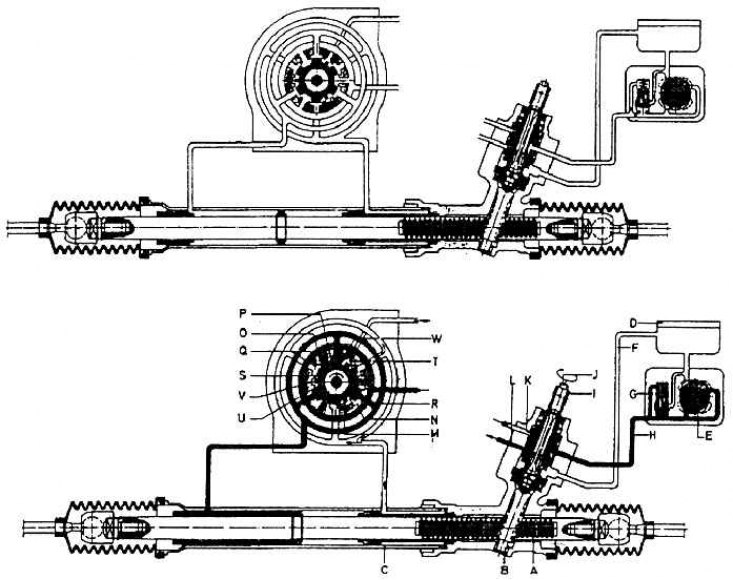
A - toothed rack; B – steering gear pinion; C – working cylinder; D – oil equalization tank; E – vane pump; F – return pipeline; G – valve with oil flow limiter; H – high pressure pipeline; I – inner part of the control box; J – rotating rod; K – radial groove I; L – radial groove II; M – rotating sleeve; N – guide bushing; O – inlet groove; R – intake groove; 0 – axial groove; R – axial groove; S – return gap; T – return groove; U – return gap; V – partition; W – control gap
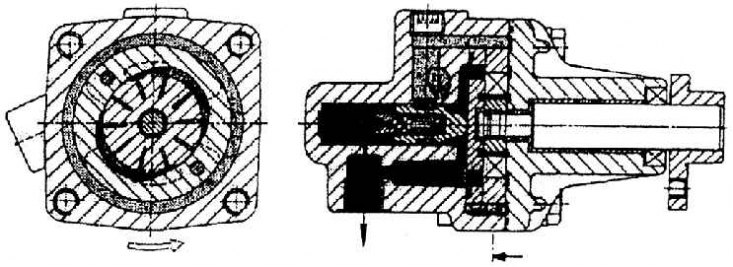
The working principle of a vane pump (pressurized oil for power steering)
The steering boost effect depends on the torque of the torsion element on the steering gear. The greater the force required to turn the steering wheel, the greater the twist of the torsion element, and the greater this elastic deformation, the greater the boost effect.
The principle of the power steering is to bypass a special oil to the left or right side of the piston connected to the toothed rack of the steering rod. The oil helps to move the piston, and therefore the toothed rack, pressing on the corresponding side with a proportional amount of oil that passes through a system of bypass radial and axial channels - grooves - the holes are opened by twisting the torsional element of the steering control.
[Information published on the website: SKODABOOK.RU]
The distributor and oil dispenser is a very precise system located in the control box in the gear area. From there, the oil enters the working cylinder formed in the cavity of the horizontal part of the steering control via a high-pressure pipeline. A rod passes through the middle of the cylinder, which passes on the left side into the toothed rack of the steering control. In the middle of the rod is a narrow piston. It is well sealed with the working surface of the cylinder. On the sides, the rod slides in plain bearings, which are also well sealed. On the protruding ends of the rack are horizontal ball joints with steering rods (see fig. Operating principle of the steering mechanism with a toothed rack and hydraulic booster).
In addition to the steering itself, the system also includes an independent oil pump and an oil equalization tank. The connection between the pump and the steering is made by two pipelines, which are a combination of steel tubes and high-pressure hoses. The pipelines are not disassembled. The connection between the equalization tank and the pump, therefore, the suction and return pipelines (this means between the reservoir and the steering), are low pressure pipelines.
The oil pump for the power steering is the so-called vane pump. In principle, it is a cavity of oval cross-section in which a shaft with several axially inserted spring-loaded sealing plates rotates. When turning, the volume of the chambers changes, which are always formed by two adjacent plates and a segment of the working surface of the cavity. Thus, when the shaft rotates, oil is sucked in on one side and squeezed out on the other side (see Fig. Operating principle of a vane pump (pressurized oil for power steering)). The pump delivers an amount of oil per minute in the range of 0.3–1.7 cubic dm at a pressure of 7 to 13 MPa (maximum pressure 20 MPa) according to revolutions. The pump operates in the revolution range from 500 to 7000 1/min. It is driven by a multi-groove belt together with the generator, and sometimes with the air conditioning compressor, from the outer pulley of the crankshaft.
Power steering also works when the oil pump for the steering is not working, i.e. when the engine is off. Of course, then the force required to turn the steering wheel increases significantly, because the booster is not working. The same as in the brake system with a booster.