



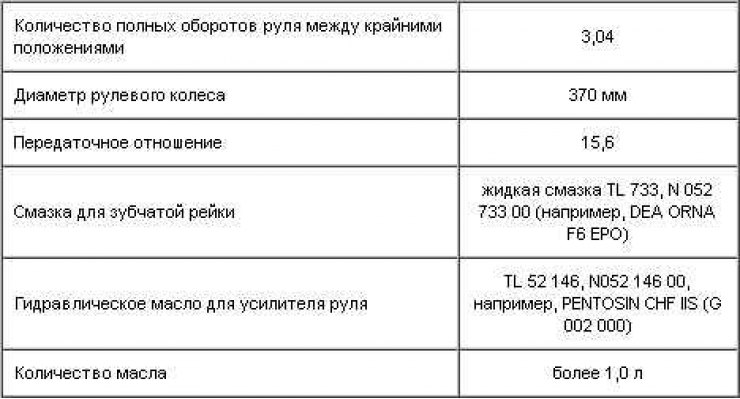
The motion and force from the universal joint - steering shaft is transmitted by the steering gear to the toothed rack, changing the rotary motion to a straight line. The toothed rack moves in the cylindrical cavity of the aluminum casting of the steering box. The gear is installed in the steering box in two rolling bearings. The toothed rack is pressed against the gear by a spring acting through the glider. The gear has longitudinal thin splines and a semicircular groove along the circumference on the outer upper end. The lower universal joint of the steering shaft is seated on the splines. Mutual fastening is carried out by a bolt, which passes through the joint boss, the gear groove and, after tightening, simultaneously compresses the joint in the splined part.
The steering gear is greased. Between the steering gear box and the lateral rods there are rubber seals that resist the action of the grease and atmospheric influences.
To move the front wheels, the toothed rack ends with bushings for the ball joints (pins) of the side control rods. These rods have threads (M12x1) on the outer ends for tightening the lock nuts (key 19 mm) and non-disassemblable ends with vertically oriented ball pins. The ball pins contain consistent grease. Their cone-shaped rods are inserted into the heads of the front wheel bearings. The cone-shaped connection is tightened with an M12x1.25 nut secured with a 3.25x25 cotter pin. After unscrewing the nut, this connection can only be loosened using the MP 7501 tool.
On the round section of the side rods of the steering control in one place make a hexagon for a 12 mm key. By turning the rods (after loosening the lock nut) you can adjust their length and, therefore, the alignment of the front wheels (see subsection 10.4).
The steering unit belongs to the front axle group. It is attached to the beam by two elastic suspensions, which naturally limit the lateral movement of the steering wheel.
Source of the article web resource (SKODABOOK)