
Company vehicles Hyundai Company vehicles Kia Company vehicles Lada Company vehicles Mazda Company vehicles Mercedes-Benz Company vehicles Opel Company vehicles Mitsubishi
English Русский
Български
Беларускі
Український
Српски
Hrvatski
Română
Polski
Slovenský
Magyar
Articles   
Bookmark Contacts Sitemap
SkodaBook.ru


Fabia Rapid Octavia Superb Kodiaq Yeti Others
Octavia 1 (1996-2004) Octavia 3 (2013-2019)

Rear Axle — Design Description (Skoda Octavia 1U)

  • Main
  • Octavia
  • 1U (1996-2004)
  • Chassis (running gear)
  • Suspension and axles
  • Rear Axle — Design Description
0

Installed rear axle assembly
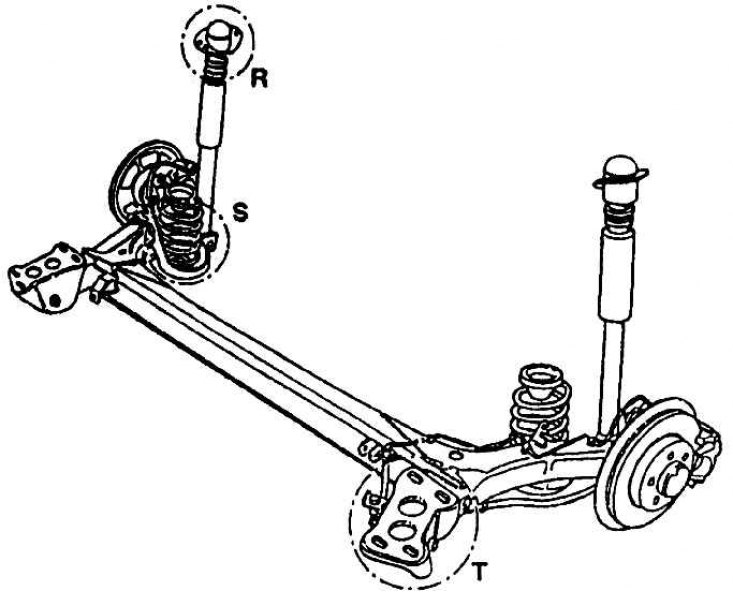


Installed rear axle assembly


On the right is the R detailing (fastening the rear axle telescopic shock absorber to the body), left - detailing S (fastening the rear axle telescopic shock absorber to the axle carrier)
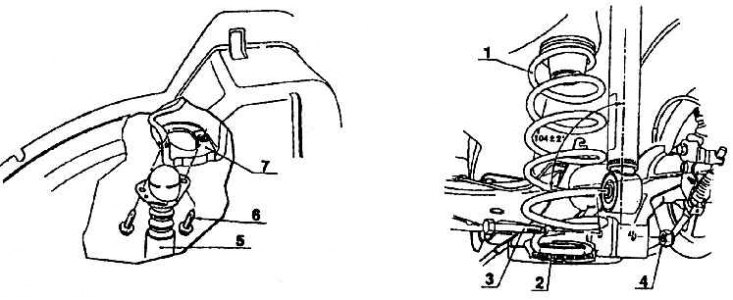


1 – rear coil spring; 2 – spring lining; 3 –…

1 – rear coil spring; 2 – spring lining; 3 – shock absorber mounting bolt; 4 – nut; 5 – telescopic shock absorber; 6 – bolt; 7 – surface for mounting the shock absorber in the body


Detailing T (rear axle mounting to body)
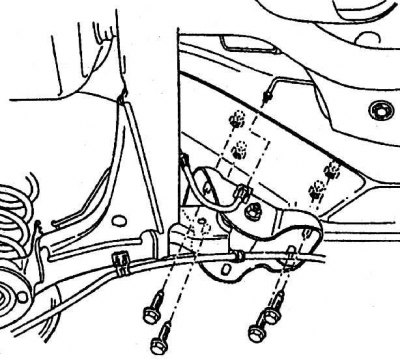


Detailing T (rear axle mounting to body)


Section of the rear wheel hub, which simultaneously forms the outer ring of a double-row ball bearing
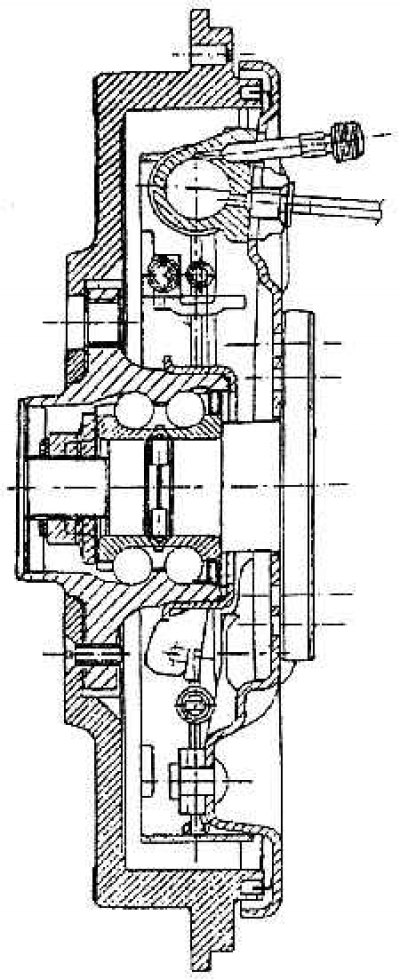


Section of the rear wheel hub, which…


The rear axle assembly in Skoda Octavia cars is an independent assembly unit. The rear axle assembly also includes the wheel hubs, rear wheel brakes, springs and telescopic vibration dampers. Since the brake device is thematically related to brakes, springs and shock absorbers to the suspension group, the description of these rear axle subassemblies is related to the mentioned topic (see subsection 11.3, subsection 9.4.2, subsection 9.4.3).


The rear axle is a crank formed by consoles connected to a transverse torsion element.

(Data taken from this portal www.SKODABOOK.ru)

On the front side (in the direction of movement) the consoles are inserted into rubber bushings of the holders, with which the bridge is attached to the car body on each side with four bolts. At the opposite ends of the consoles, the rear wheel axles are screwed to the flanges. Powerful holders of coil springs and holders of telescopic shock absorbers are welded to the consoles. The shock absorbers are located behind the springs.

The rear axle is equipped with either drum or disc brakes.

The torsional element is a steel V-profile (channel) 6 mm thick. Side consoles welded from sheet stampings are welded to the profile. On the outer sides of their ends, plates with four holes for screwing the wheel axles together are laser welded (bolts M 10). These axles are designed in a rather original way. They are formed by flanges with threads for mounting bolts, on which the axles are located. The brake device holders are also installed on the axle. Conical double-row bearings are mounted on the axles with their inner ring, their outer rings are the wheel bushings (see fig. Section of the rear wheel hub, which simultaneously forms the outer ring of a double-row ball bearing). The bushing is secured with a nut and a stamped washer (there is a plastic ring at the end of the thread). The nut has an external twelve-sided socket for a special key. The wheel hub has five threaded holes for fastening the car wheel and one M6 thread for a countersunk head bolt for fastening the brake drum or disc.


The spring holder is a sheet metal stamping welded to the inside of the rocking console.

In the lower part of the holder there is a hole, the upper outlet of which is simultaneously the centering for the galvanized sheet lining, against which the coil spring rests.

On the rear wall of the spring holder there is another holder, into which the lower eye of the telescopic shock absorber with an elastic hinge is inserted. The shock absorber is screwed with a bolt oriented horizontally.

The end turns of the coil spring are compressed at the top and bottom into a cone. A rubber profile lining is put on the spring at the top, by means of which the spring rests against the body pit.

The upper attachment of the telescopic shock absorber is carried out by two bolts in the body bracket. The shock absorber ends with a ball surface, allowing the shock absorber to be deflected during suspension.
This article is available at russian, bulgarian, belarusian, ukrainian, serbian, croatian, romanian, polish, slovak, hungarian
Article verified: Eleonora Afanasyeva
Share with friends:
◀ Previous
Skoda Octavia 1: Suspension and axles
Next ►

Power steering (servo control)
Steering — General Information
Front wheel hub assembly
Front Axle — Design Description
Cardan drive shafts
Rear suspension assembly diagram
General information about the suspension
Front elastic suspension unit
Rear suspension springs — general information
Rear telescopic shock absorber — general information
Read similar articles on other Skoda models

➧ Description of the rear suspension design Skoda Fabia 1 (1999-2007)
➧ Rear axle wheels Skoda Rapid 1 (2012-2022)
➧ Adjusting the rear view mirrors Skoda Superb 2 (2008-2015)
➧ Setting the rear axle suspension to a position corresponding to the… Skoda Kodiaq 1 (2016-2024)
➧ Removing and installing the flywheel and rear oil seal (sealing… Skoda Yeti (2009-2017)
➧ Rear suspension torsion beam axle hinge brackets Skoda Favorit (1987-1994)
Link to this article in various formats
Reviews and comments of visitors
No comments yet


Add two numbers: 49 + 44


Octavia 3 (2013-2019) 
  • General information
  • User manual
  • Car driving
  • Maintenance
  • Petrol engines 1.2 l
  • Engine repair
  • Cooling system
  • Supply system
  • Petrol engines 1.4 l
  • Engine repair
  • Supply system
  • Petrol engines 1.8/2.0 l
  • Engine repair
  • Cooling system
  • Supply system
  • Diesel engines 1.6/2.0 l
  • Engine repair
  • Cooling system
  • Supply system
  • Transmission
  • Mechanical gearbox 02S
  • Automatic gearbox 0CW
  • Automatic gearbox 0D9
  • Chassis (running gear)
  • Front suspension
  • Rear suspension
  • Brake system
  • Steering
  • Body and interior
  • Doors, locks and windows
  • Exterior (external elements)
  • Interior (internal elements)
  • Ventilation and air conditioning
  • Electrical equipment
  • Equipment and devices
  • Headlights and lighting
  • Wiring diagrams (basic)
  • Wiring diagrams (comfort)
Octavia 1 (1996-2004) 
  • General information
  • Vehicle details
  • Maintenance
  • Power unit
  • Petrol engines 1.6 l AEE
  • Petrol engines 1.8 l AGN
  • Diesel engines 1.9 l AGR
  • Fuel system
  • Exhaust system
  • Cooling system
  • Transmission
  • Clutch
  • Car gearbox
  • Gearbox repair 02J
  • Gearbox repair 02K
  • Chassis (running gear)
  • Wheels and tires
  • Suspension and axles
  • Brake system
  • Body and interior
  • Exterior (external elements)
  • Interior (internal elements)
  • Doors, locks and windows
  • Electrical equipment
  • Equipment and devices
  • Electrical circuits
SkodaBook.ru © 2018–2026 | Mobile version | Articles on Skoda | Sitemap EN BG BY UA RS HR RO PL SK HU | Feedback | Site search | Bookmark
Fabia 1 (1999-2007) | Fabia 2 (2007-2014) | Rapid 1 (2012-2022) | Octavia 1 (1996-2004) | Octavia 3 (2013-2019) | Superb 2 (2008-2015) | Kodiaq 1 (2016-2024) | Yeti (2009-2017) | Favorit (1987-1994) | Felicia (1994-2001) |
By continuing to use the site, you agree to the use of cookies.