



The DSG identification code is indicated on the vehicle data sticker (see Introduction). The DSG itself also has its identification code indicated (HLH in Illustration 10.1a), release date (130804 - August 13, 2004), factory code (14), production time (06:32) and serial number (0011). On some transmissions, additional identification data is located in the locations shown in Illustration 10.1b. To view it, it is necessary to remove the air cleaner, battery and its tray, unload the powertrain mounts and remove the left mount console (see illustration 10.1c).
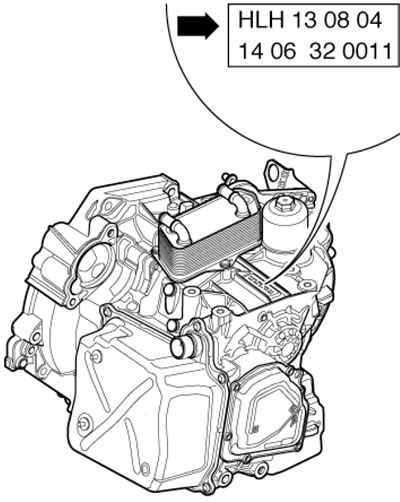
10.1a. Identification data DSG "02E", option 1
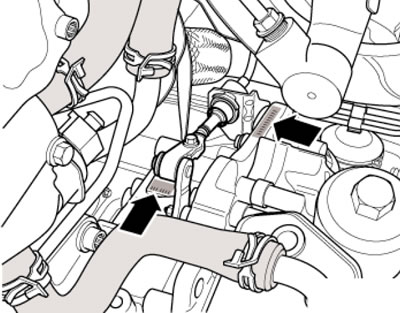
10.1b. Identification data DSG "02E", variant 2
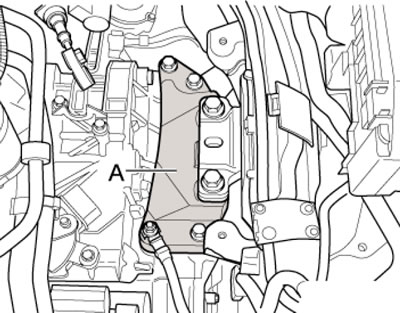
10.1s. Left powertrain support console
The main feature of DSG is the presence of two parallel clutches, which allows two gears to be selected at once (only one gear is engaged). Therefore, when changing gears, time is spent only on disengaging one clutch and engaging the other. The clutch switching moments during gear shifting overlap, which makes it possible to accelerate with virtually no interruption in power flow, allowing fuel savings of 4 to 8%. Interruption of power flow is the main drawback of traditional manual transmissions, automatic transmissions and continuously variable transmissions operating in manual mode.
The main parts of the DSG are shown in Figure 10.2.
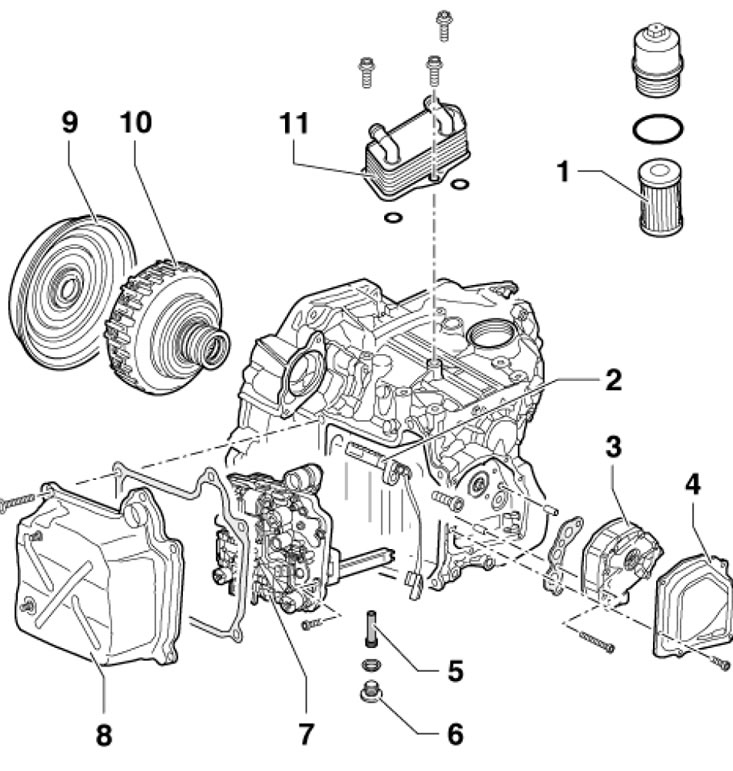
10.2. Main parts of DSG "02E" 1. DSG working fluid filter element; 2. Input shaft speed sensor "G182" and clutch temperature sensor "G509"; 3. DSG working fluid pump; 4. Pump cover 3; 5. The overflow tube, with an 8 mm hexagon, is unscrewed to drain the working fluid; 6. Service hole plug; 7. Control unit "Mechatronic" "J743"; 8. Oil pan; 9. Clutch cover; 10. Double clutch; 11. DSG working fluid radiator
Unlike the DSG "OAM", the DSG "02E" uses multi-plate wet clutches. The outer (large) clutch "K1" is responsible for engaging odd gears, and the inner (small) clutch "K2" is responsible for engaging even gears.
Maintaining the correct fluid levels in the transmission is essential for proper transmission operation. The DSG "02E" uses a common circuit of working fluid for the mechanical area and for the hydraulic control unit "Mechatronic". The fluid level of the 6-speed DSG is checked when it is replaced (see Section 21 Chapter 1). Replacement of the working fluid and filter of the 6-speed DSG is required every 60,000 km.
Description of transmission control and its modes is given in Chapter "Controls and operating techniques". Gear shifting is accomplished by hydraulic activation, with electronic control.
Repairing a transmission requires a lot of special equipment, so disassembling and assembling the transmission and its components should be entrusted to service station specialists who have the appropriate equipment.