



Contents: Brief description ⬇ Setting ⬇
Note.
- Necessary special devices, control and measuring instruments, as well as auxiliary means:
- Installation device "T10374".
- Pattern ruler "T40100".
- Glue "AMV 195 KD1 01".
- Digital depth gauge.
Note.
- The adjusting shim for the "K1" coupling is placed on the large bearing, and the adjusting shim for the "K2" coupling is placed under the small bearing.
- The position of the engagement lever must be adjusted if the clutch or clutch control drive has been replaced.
- The control also includes a fastening part.
- If the mentioned parts are simply removed and reinstalled, then there is no need for adjustment.
Note.
- Use only tools in perfect condition.
- There must not be any unevenness on the clutch housing flange. This ensures that the ruler fits correctly.
- Mechantronics is built in.
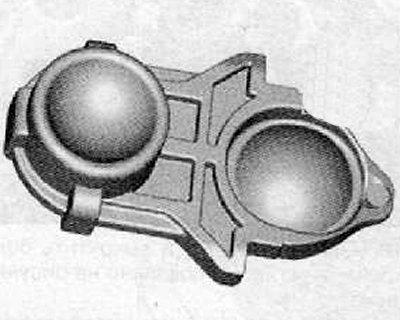
Brief description
The position of the clutch bearing is comparable to the clutch clearance of a manual gearbox. In the DSG automatic gearbox - OAM there are tolerances in the gearbox engagement system and in the gearbox itself. Tolerances are also present inside the double (double) coupling. In case of regulation it is necessary to evaluate these tolerances separately
The following description first describes how all necessary dimensions are determined "on the gearbox side" so that a suitable adjusting shim can be determined. The tolerance on the gearbox side and the tolerance in the clutch determine the thickness of the adjusting shim.
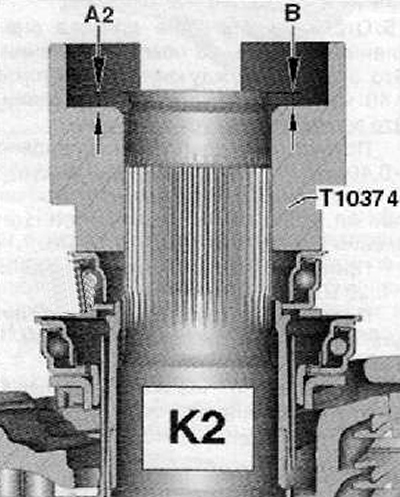
First, it is necessary to determine the dimension "B". This dimension is necessary for both clutches "K1" and "K2".
Then the dimension "A" is determined for each clutch. The figures below show the locations where the measurements are taken.
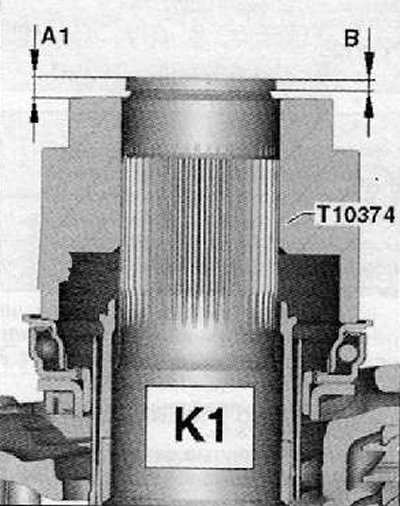
"K1"
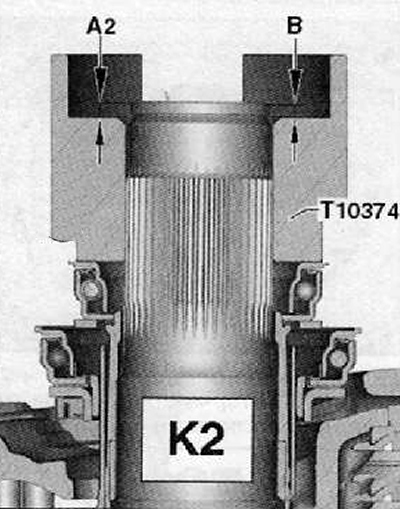
"K2"
Note: The following work steps should be performed accurately and in sequence.
Setting
1. Install the clutch components up to the larger clutch release fork as shown in the figure below.
Note: Do not install the small release bearing or insert the adjusting shim.
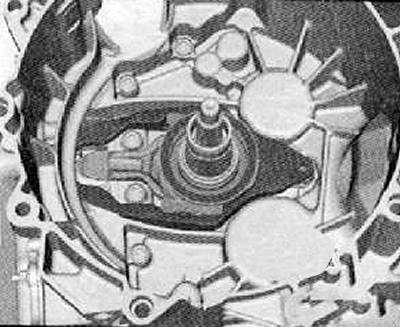
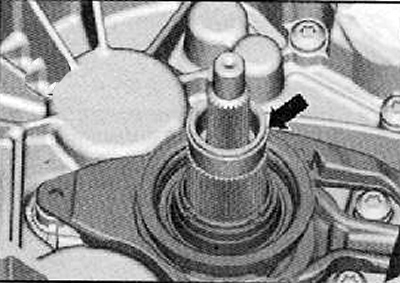
2. Install the outer drive shaft retaining ring (arrow) as shown in the figure below.
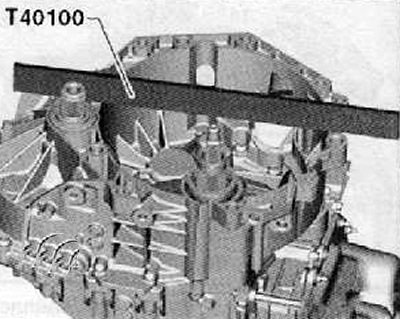
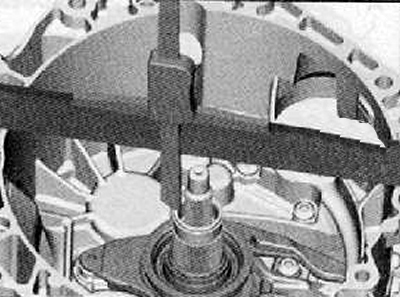
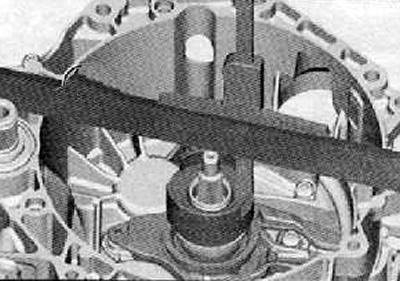
3. Place a special ruler (T40100) on the clutch housing flange, as shown in the figure below.
Note: Ensure that the ruler (T40100) is positioned in this position during the following measurements. Do not move it to another location or remove it.
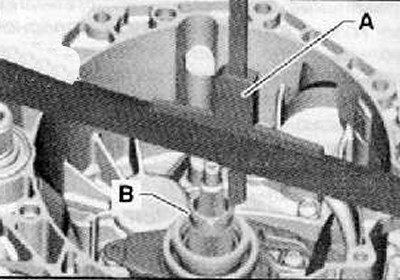
4. Place the digital depth gauge (A) on the outer drive shaft (B) as shown in the figure below. Set the depth gauge to zero.
5. Measure the distance from the retaining ring.
Mark the result and call it "B".
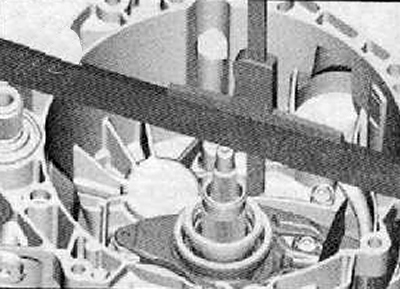
Note: Dimension "B" should be measured again in the opposite place.
Note.
- Do not measure on the ring clasp.
- The whole point is that the lock can be pressed back, which will affect the measurements.
6. Remove the retaining ring again.
Note: This ring can no longer be installed!
7. The average value should be calculated from both measurement results.
This dimension "B" will be needed for the following calculations.
In the following indicative calculations "B" = 2.96 mm (example). The dimension "B" is only for this example; its meaning may be different for other gearboxes.
Due to the fact that there are two clutches, two steps are then performed for adjustment.
Each measurement requires different preparation steps and several calculations.
8. Determine the size of the adjusting shim of the large mounting support for the clutch "K1".
Caution: Do not install any adjusting shim!
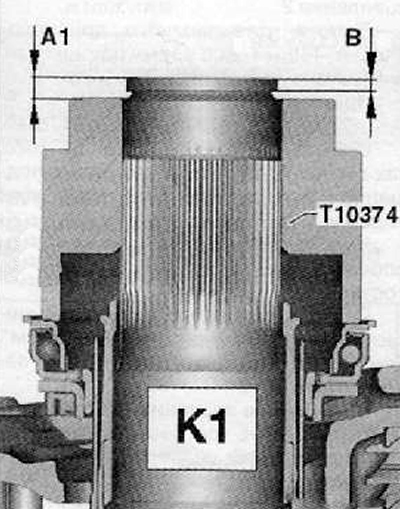
9. Place the installation tool (T10374) on the large clutch release bearing.
10. Press the installation tool (T10374) while turning it. In this way, it is possible to observe the rotation of the clutch bearing. This means that the installation tool (T10374) is also "sitting" properly on the bearing.
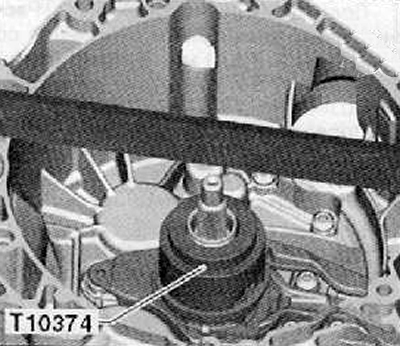
11. Place the digital depth gauge on top of the outer drive shaft.
Note: The ruler (T40100) is already placed on top of the clutch housing flange.
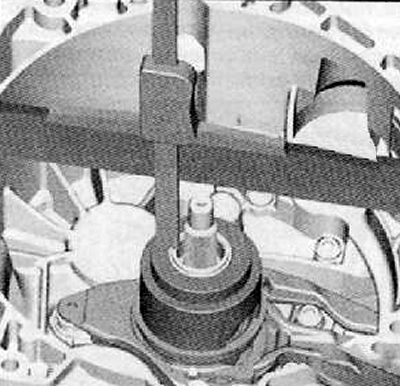
12. Using a depth gauge, measure the distance from the end of the shaft to the installation device (T10374), as shown in the figure below.
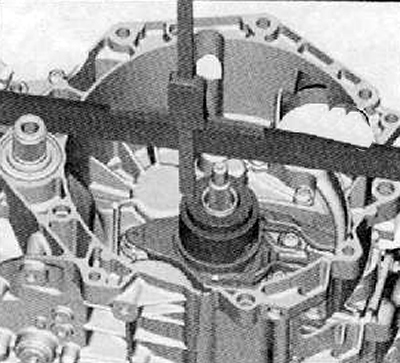
13. To make the measurement as accurate as possible, the digital depth gauge should be installed twice, in opposite places. This will give a much more accurate result, as the inaccuracy caused by the wobble on the clutch bearing is reduced to a minimum.
14. The average value should be calculated from both measurements in relation to the installation device (T10374). This value should be marked and designated "A1".
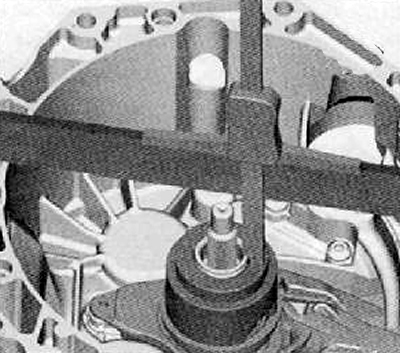
Example:
Size "A1" = (2.61+2.81)/2 = 2.71
"A1" = 2.71 mm
Next calculation:
"A1" minus "B" plus the height of the installation tool (T10374) = depth of the clutch engagement bearing 1.
The height of the mounting device (T10374) is always the same. It is 51.81 mm.
Calculation example:
2.71 mm - 2.96 mm + 51.81 mm = 51.56 mm.
The value of how deep the clutch bearing actually sits in the gearbox has now been determined.
Each gearbox requires a bearing depth of 50.08 mm.
From this true dimension, the required dimension of 50.08 mm is subtracted. This gives the true clutch clearance 1.
The revealed value (for example: 51.56 mm) minus required value = clutch clearance.
Calculation example:
51.56 mm - 50.08 mm = clutch clearance 1 = 1.48 mm.
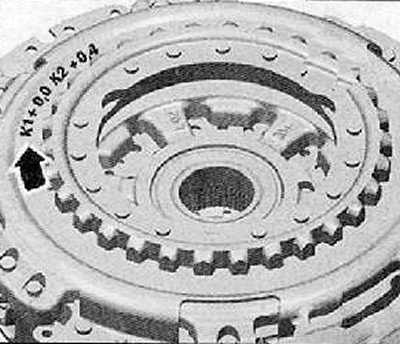
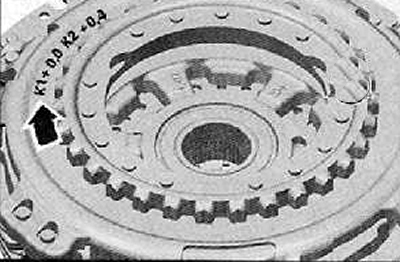
15. Read off the clutch tolerance value "arrow" on the new clutch. This value is between minus 0.40 and plus 0.40 mm and is marked on the clutch. This value should be marked.
Example 1: The clutch shows "-0.40 mm".
The last calculation for "K1": Calculated gap minus values from clutch 1 = 1.48 mm - 0.40 = 1.08 mm.
Example 2: The clutch shows "+0.20 mm".
The last calculation for "K1" looks like this: 1.48 mm + 0.20 = 1.68 mm.
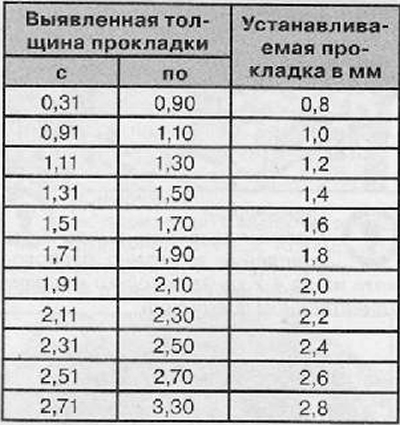
16. After selecting the correct gasket according to the table, install it.
 |
 |
Note: Later, you should insert only this one adjustment shim, not two shims.
17. Continue adjusting clutch "K2".
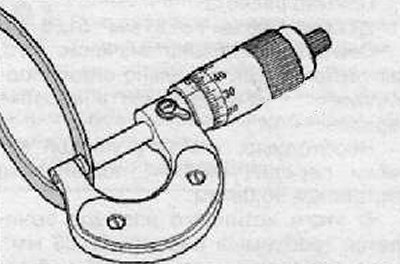
Definition of the adjusting shim of the small clutch release fork "K2"
18. Install only the small release bearing.
Caution: Do not install any adjusting shim.
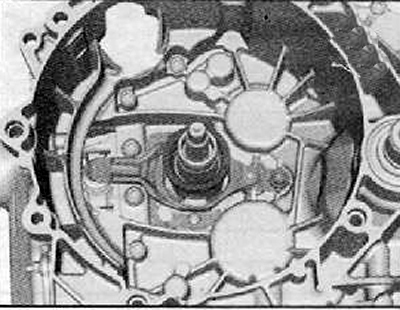
Note: The small clutch release bearing can only be located in one single position due to the 4 grooves.
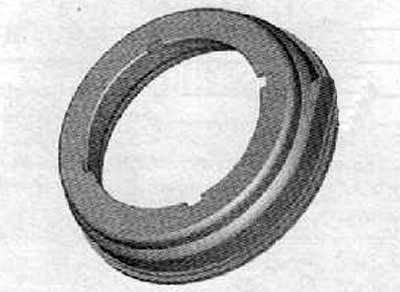
19. By turning it, check whether the small clutch release bearing is installed correctly and whether the grooves are seated correctly.
[Article source: this website: skodabook]
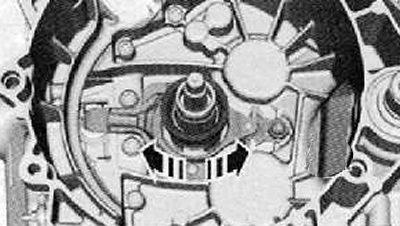
20. Place the installation tool (T10374) with the large hole facing up on the small bearing as shown in the figure below.
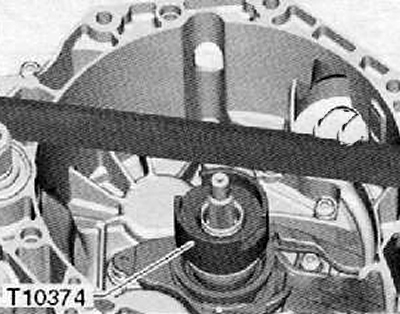
21. Place the digital depth gauge on top of the outer drive shaft as shown in the figure below.
22. Reset the depth gauge readings to zero.
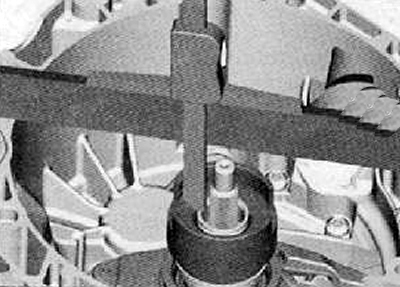
23. Using a depth gauge, measure the distance from the end of the shaft to the installation device (T10374), as shown in the figure below.
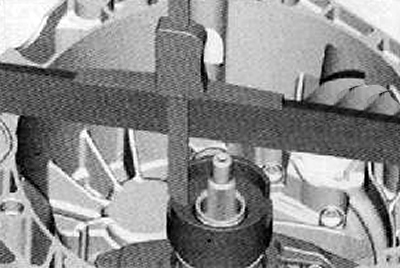
24. To ensure that the measurement is as accurate as possible, the digital depth gauge should be installed twice, in opposite places. This will give a much more accurate result, as the inaccuracy caused by vibration on the clutch bearing is reduced to a minimum.
25. The average value should be calculated from both measurements in relation to the installation device (T10374). This value should be marked and designated "A2".
Example:
Size "A2" = (2.50 + 2.54)/2 = 2.52
"A2" = 2.52 mm
Next calculation:
"A2" minus "B" plus the height of the installation tool "T10374" = depth of the clutch engagement bearing 2.
The height of the installation device "T10374" is always the same. Inside it is: 36.20 mm.
Calculation example:
2.52 mm - 2.96 mm + 36.20 mm = 35.76 mm.
Now the significance of how deep the clutch bearing actually sits in the gearbox has been revealed.
Each gearbox requires a bearing depth of 34.35 mm
From this true dimension, the required dimension "34.35 mm" is subtracted. This gives the true clutch clearance 2.
The revealed value (for example: 35.76 mm) minus required value = clutch clearance.
Calculation example:
35.76 mm - "34.35 mm" = clutch clearance 2 = 1.41 mm.
Now it is necessary to include in the calculation the tolerance in double (double) clutch.
Read off the clutch tolerance value "arrow" on the new clutch.
This value is between minus 0.40 and plus 0.40 mm and is marked on the clutch.
This value should be marked.
Example 1: The clutch shows "-0.40 mm".
The last calculation for "K2": "Calculated clearance" minus "values from clutch 2" = 1.41 mm - 0.40 - 1.01 mm.
Example 2: The clutch shows "+0.20 mm".
The final calculation for "K2" is as follows: 1.41 mm + 0.20 = 1.61 mm.
26. Select the correct gasket according to the table.
 |
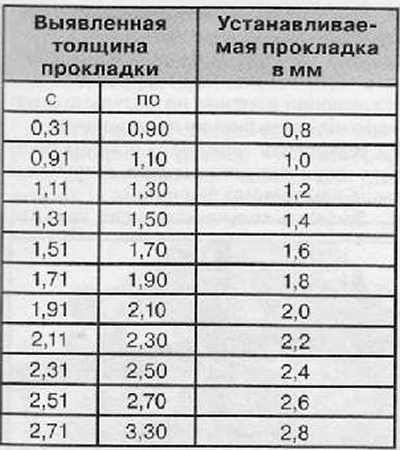 |
Note: Among the supplied gaskets, you should select the one you need.
Note: Later, you should insert only this 1 adjustment shim, NOT 2 shims.