



Note: See Asbestos Dust Warning at beginning Chapters 4.
Removal
1. The clutch release mechanism can be accessed when the power unit is removed from the vehicle for major repairs (see Section 2), or by removing the transmission as described in Section 7.
2. Loosen and remove the release fork mounting bolt, then remove the release lever from the transmission while holding the release bearing. The bearing and release fork assembly can then also be removed.
3. Unhook the release bearing from the pin on the fork and separate the two components from each other.
Inspection
4. Inspect the release mechanism for damage and signs of wear and replace any components that show any. Carefully inspect all working surfaces and contact points and replace the release lever pivot bushing if worn.
5. Check that the contact side of the release bearing rotates smoothly and easily, without noise, and that its surface is smooth and free of cracks, pitting, scoring or signs of wear. If there is any doubt about the condition of the bearing, it should be replaced. Given the difficulty of access to the bearing, it is recommended to replace it regardless of the actual condition of the component.
6. When cleaning clutch components, do not apply solvent to the release bearing - it is filled with grease that is vulnerable to such influences.
Installation
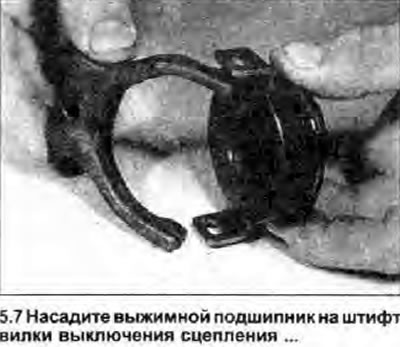
7. Place the release bearing on the clutch release fork, fitting it onto the dowel pin (see photo). Apply a small amount of molybdenum grease to the bearing centre and release lever shaft.
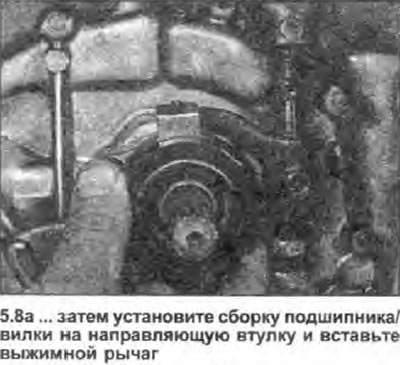
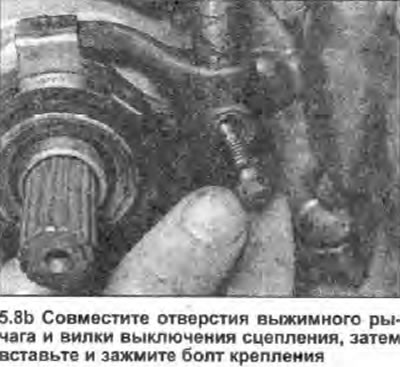
8. Install the bearing and release fork assembly onto the guide sleeve and insert the release lever. Align the holes in the fork and the release lever shaft, then install the fork mounting bolt and tighten it to the specified tightening torque Specifications (see photo).
 |
 |
9. Move the release lever back and forth to check the operation of the release mechanism, and then install the transmission as described in Section 7.