



The engine is in the car Skoda Favorit

1.3 liter gasoline engine specifications
Type - 4-cylinder, in-line, four-stroke, water-cooled Designation: 1.3 with low compression - Skoda 781.135 1.3 with high compression - Skoda 781.136 Cylinder bore diameter — 75.50 mm Stroke - 72.00 mm Working volume -...
Type - 4-cylinder, in-line, four-stroke, water-cooled Designation: 1.3 with low compression - Skoda 781.135 1.3 with high compression - Skoda 781.136 Cylinder bore diameter — 75.50 mm Stroke - 72.00 mm Working volume -...
Repair procedures in the car
Section 2, Part A describes repairs that can be performed without removing the engine from the vehicle. If the engine has been removed for overhaul, ignore the additional information that precedes each step....
Section 2, Part A describes repairs that can be performed without removing the engine from the vehicle. If the engine has been removed for overhaul, ignore the additional information that precedes each step....

Engine — general description
The engine has an overhead valve (OHV) and is made in the form of an in-line 4-cylinder block, which is mounted transversely on the front side of the car: the clutch and transmission are attached to the left end of the...
The engine has an overhead valve (OHV) and is made in the form of an in-line 4-cylinder block, which is mounted transversely on the front side of the car: the clutch and transmission are attached to the left end of the...
Repair operations performed without removing the engine from the vehicle
a) Compression check. b) Valve cover - removal and installation. c) Valve mechanism - removal and installation. d) Cylinder head - removal and installation. e) Drive cover - removal and installation. f) Drive chain and...
a) Compression check. b) Valve cover - removal and installation. c) Valve mechanism - removal and installation. d) Cylinder head - removal and installation. e) Drive cover - removal and installation. f) Drive chain and...
Compression test — description
1. If the engine does not develop full power or runs rough, or if a misfire occurs. and the malfunction is not related to the ignition or fuel system, a compression test will help you identify the cause of the failure....
1. If the engine does not develop full power or runs rough, or if a misfire occurs. and the malfunction is not related to the ignition or fuel system, a compression test will help you identify the cause of the failure....

Top dead center (TDC) for piston #1 — location
1. Top dead center (TDC) - the highest position that each piston reaches when the crankshaft rotates. Each piston reaches TDC on the compression stroke and on the exhaust stroke, but the TDC of piston #1 on the...
1. Top dead center (TDC) - the highest position that each piston reaches when the crankshaft rotates. Each piston reaches TDC on the compression stroke and on the exhaust stroke, but the TDC of piston #1 on the...

Valve cover — removal and installation
Removing 1. Disconnect the negative cable from the battery. 2. Disconnect the breather hose from the valve cover oil filler neck (see illustration). 3. Loosen and remove the two valve cover mounting nuts, and remove the...
Removing 1. Disconnect the negative cable from the battery. 2. Disconnect the breather hose from the valve cover oil filler neck (see illustration). 3. Loosen and remove the two valve cover mounting nuts, and remove the...

Valve mechanism — removal, inspection and installation
Removing 1. Remove the valve cover as described in Chapter 4 . 2. Using a 10mm Allen wrench, remove the two cylinder head bolts that also secure the left and right rocker arms to the head. 3. Evenly and gradually loosen...
Removing 1. Remove the valve cover as described in Chapter 4 . 2. Using a 10mm Allen wrench, remove the two cylinder head bolts that also secure the left and right rocker arms to the head. 3. Evenly and gradually loosen...
Cylinder head — removal and installation
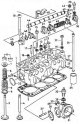
Pic. 2A.3. Cylinder head and components mounted on it 1. Cylinder head; 2. Laying under a head of the block of cylinders; 3. Inlet valve; 4. Exhaust valve; 5. External valve spring; 6. Internal valve spring; 7. Spring...
Pic. 2A.3. Cylinder head and components mounted on it 1. Cylinder head; 2. Laying under a head of the block of cylinders; 3. Inlet valve; 4. Exhaust valve; 5. External valve spring; 6. Internal valve spring; 7. Spring...

Drive cover, chain and sprockets — removal, inspection and installation
Removing 1. Position #1 piston at TDC as described in Chapter 3 , then remove the distributor together with the extension tube as described in Section 5 . 2. Remove the generator. 3. Remove the pickup tube/strainer and...
Removing 1. Position #1 piston at TDC as described in Chapter 3 , then remove the distributor together with the extension tube as described in Section 5 . 2. Remove the generator. 3. Remove the pickup tube/strainer and...
Engine oil cooler — general description, removal and installation
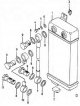
Pic. 2A.5 Engine oil cooler and hoses 1. Cooler; 2. Rubber cushion; 3. Nut; 4. Bolt-cooler to the body; 5. Spring washer; 6. Flat washer; 7. Hose; 8. Sealing washer; 9. Banjo bolt; 10. Hose; 11. Banjo bolt. General...
Pic. 2A.5 Engine oil cooler and hoses 1. Cooler; 2. Rubber cushion; 3. Nut; 4. Bolt-cooler to the body; 5. Spring washer; 6. Flat washer; 7. Hose; 8. Sealing washer; 9. Banjo bolt; 10. Hose; 11. Banjo bolt. General...

Oil pump — removal, inspection and installation
Pic. 2A.6. Oil pump components 1. Suction tube / oil pump strainer; 2. Spring washer; 3. Bolt - receiving tube to the drive cover; 4. Bolt - suction tube/strainer to bearing cap; 5. Gasket (where available); 6. Oil pump...
Pic. 2A.6. Oil pump components 1. Suction tube / oil pump strainer; 2. Spring washer; 3. Bolt - receiving tube to the drive cover; 4. Bolt - suction tube/strainer to bearing cap; 5. Gasket (where available); 6. Oil pump...

Pallet — removal and installation
Removing 1. Disconnect the negative cable from the battery. 2. Apply the handbrake, then jack up the front of the vehicle and place it on axle stands. 3. Drain the engine oil, then clean and install the drain plug,...
Removing 1. Disconnect the negative cable from the battery. 2. Apply the handbrake, then jack up the front of the vehicle and place it on axle stands. 3. Drain the engine oil, then clean and install the drain plug,...

Crankshaft seals — replacement
Right oil seal (pulley side) 1. Remove the crankshaft pulley as described in Chapter 7, paragraphs 4 and 5 . 2. Carefully remove the old oil seal from the timing chain cover using a suitable flathead screwdriver, being...
Right oil seal (pulley side) 1. Remove the crankshaft pulley as described in Chapter 7, paragraphs 4 and 5 . 2. Carefully remove the old oil seal from the timing chain cover using a suitable flathead screwdriver, being...

Flywheel — removal, inspection and installation
Removing 1. Remove the transmission, then remove the clutch assembly as described in Section 6 . 2. Block the flywheel from rotation, as shown in illustration 12.10A, or by clamping the belt between the flywheel and the...
Removing 1. Remove the transmission, then remove the clutch assembly as described in Section 6 . 2. Block the flywheel from rotation, as shown in illustration 12.10A, or by clamping the belt between the flywheel and the...

Rubber pads for engine and transmission mounts — inspection and replacement
Inspection 1. If improved access is required, jack up the front of the vehicle and place it securely on axle stands. 2. Check the condition of the rubber pads so that there is no delamination from the metal base;...
Inspection 1. If improved access is required, jack up the front of the vehicle and place it securely on axle stands. 2. Check the condition of the rubber pads so that there is no delamination from the metal base;...
This section is available on russian, bulgarian, belarusian, ukrainian, serbian, croatian, romanian, polish, slovak, hungarian
Read similar sections on other Skoda models
➧ Power unit: Engine repair Skoda Fabia 1 (1999-2007)
➧ Petrol engines 1.8/2.0 l: Engine repair Skoda Octavia 3 (2013-2019)
Link to this section in various formats
TEXTHTMLBB Code
- General information
- Maintenance
- Troubleshooting
- Power unit
- Engine in car
- Engine overhaul
- Cooling and heating
- Fuel and exhaust system
- Fuel injection system
- Ignition system
- Transmission
- Clutch
- Manual gearbox
- Drive shafts
- Chassis (running gear)
- Brake system
- Car suspension
- Steering
- Body and interior
- Exterior (external elements)
- Interior (salon)
- Electrical equipment
- Equipment and devices
- Power devices
- Electrical circuits
- General information
- Introduction to guide
- User manual
- Maintenance (petrol)
- Maintenance (diesel)
- Power unit
- Petrol engine 1.3 l
- Petrol engine 1.6 l
- Diesel engine
- Engine overhaul
- Cooling system
- Fuel system (carburetor)
- Central injection (SPFI)
- Multipoint injection (MPFI)
- Diesel power system
- Decreased toxicity
- Engine electrics
- Transmission
- Clutch
- Car gearbox
- Drive shafts
- Chassis (running gear)
- Brake system
- Car suspension
- Steering
- Body and interior
- Exterior (external elements)
- Interior (salon)
- Doors, locks and windows
- Electrical equipment
- Equipment and devices
- Headlights and lighting
- Electrical circuits