



Automatic transmission identification designation
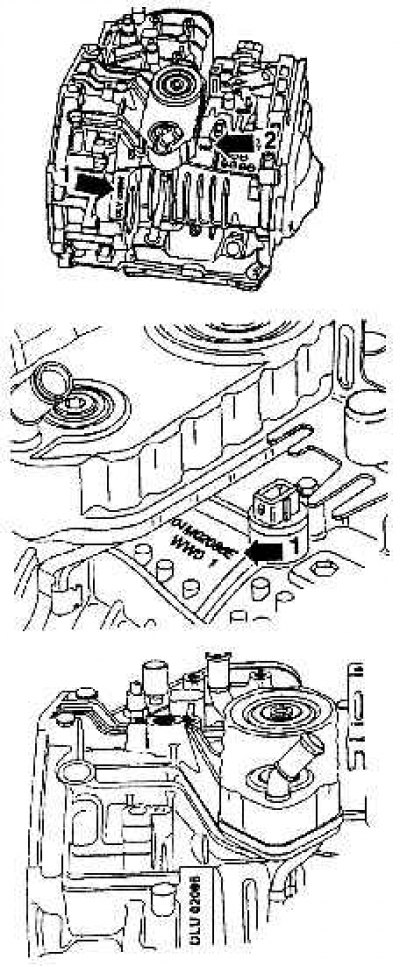
Example of identification designation:
- DLU - code;
- 02 - day;
- 08 - month;
- 6 - year (1996) of manufacture.
Automatic transmission with the crankcase partially removed for clarity
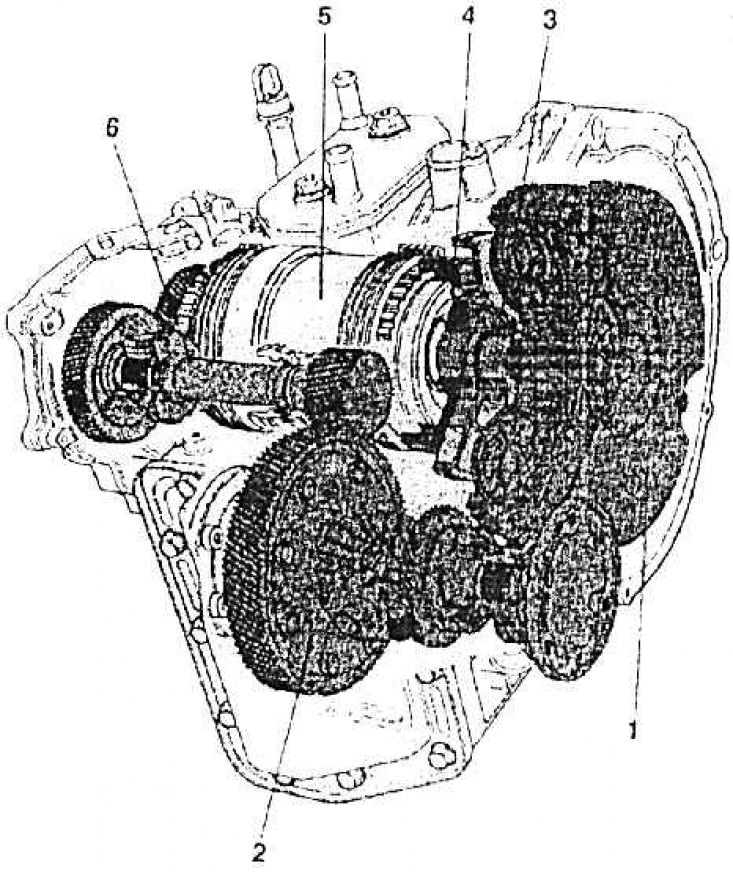
1 – torque converter; 2 – differential with constant reduction gear; 3 – oil pump; 4 – guide support gear; 5 – planetary gearbox; 6 – shaft with intermediate gear
Automatic transmission detailing
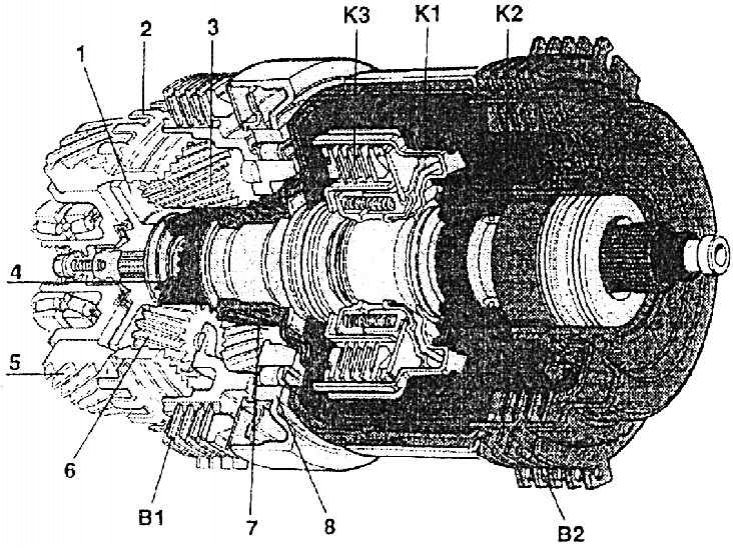
1 – planetary gear holder; 2 – speedometer gear; 3 – planetary gear of the first planetary gearbox; 4 – central gear of the second planetary gearbox; 5 – intermediate gear drive gear; 6 – planetary gear of the second planetary gearbox; 7 – central gear of the first planetary gearbox; 8 – roller overrunning clutch; B1 – first gear planetary gearbox brake; B2 – planetary gearbox brake second; K1, K2, KZ – couplings
Technical data
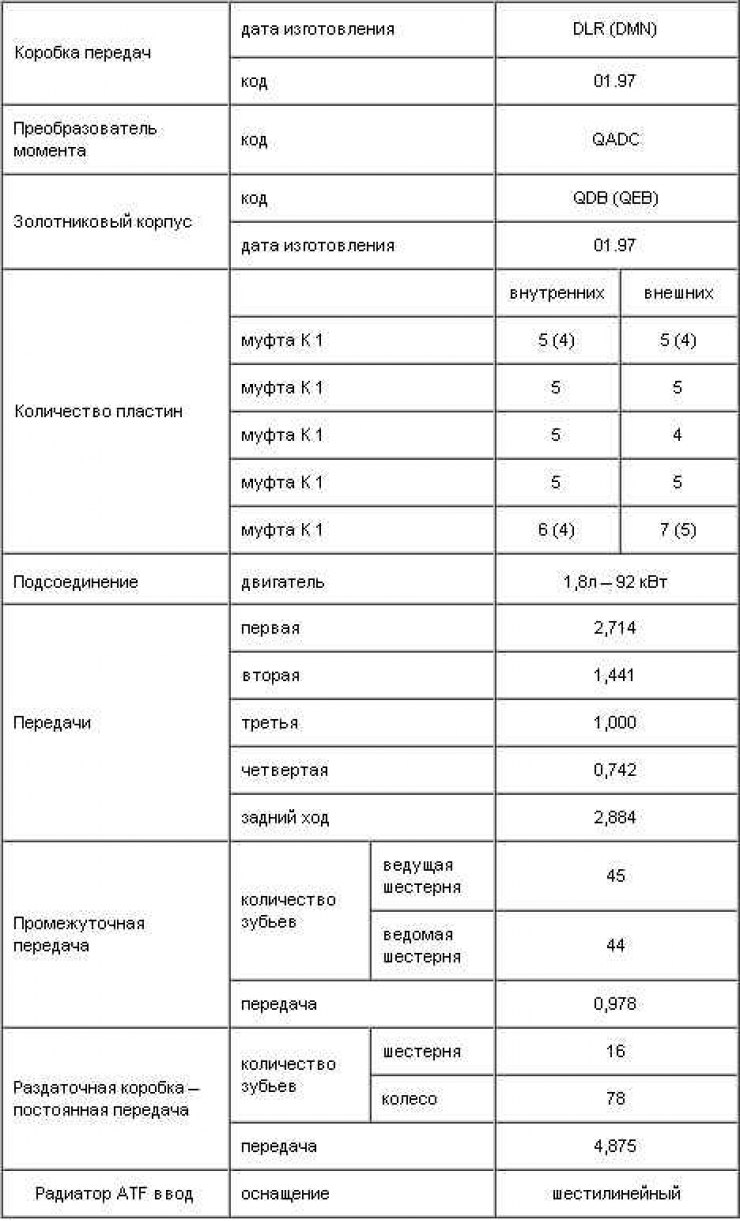
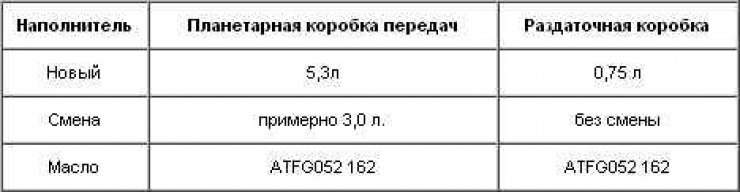
Automatic transmissions installed on Skoda Octavia cars are four-speed with bypass of the torque converter. Electric control – the control unit – is formed on the basis of regularly recorded and processed movements of the gas pedal, the so-called fuzzy algorithm. This is an individual program corresponding to the driver's driving style. The box does not have the usual simple switching of two programs (sports - economical). This greatly increases the comfort of driving.
The automatic transmission is controlled by an electrohydraulic system. The automatic transmission control unit (J217) receives input information from the units that control the shifting, and simultaneously works together with the engine control unit. It coordinates the engine operating mode depending on the operation of the transmission. Based on the information received, the transmission control unit issues pulses to individual electromagnetic valves of the spool housing. The electromagnetic valves supply oil under pressure from the oil pump to the corresponding clutches or brakes, which is how the transmission is performed. The automatic transmission consists of a hydrodynamic converter and the gearbox itself, which has an independent oil control system (see fig. Automatic transmission with the crankcase partially removed for clarity, fig. Detailed view of the automatic transmission).
The hydrodynamic converter transmits the torque to the drive shaft of the gearbox. It contains its own working fluid. The converter consists of a pump wheel connected to the engine shaft, a reactive element directing the flow of fluid, and a turbine. The turbine receives the torque through the fluid and transmits it via the drive shaft to the gearbox. As the engine speed increases, the turbine wheel, carried away by the fluid, smoothly accelerates up to speeds approximately equal to those of the pump wheel.
Automatic transmission gear arrangement diagram
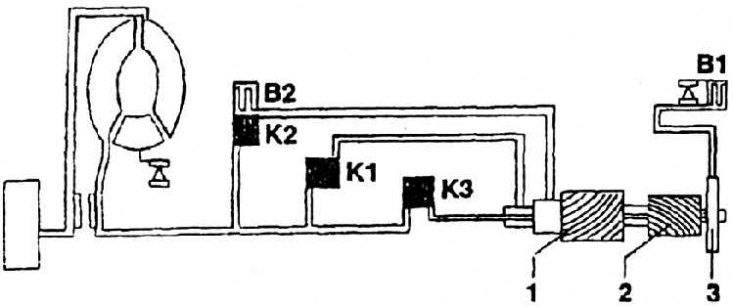
1 – central gear of the first planetary gearbox;
2 – central gear of the second planetary gearbox;
3 – planetary gear holder
The drive shaft in the gearbox rotates the drive elements of the clutches K1, K2, K3 and the brake B2. By turning them on and off in different sequences, mutual braking of individual members of both planetary gearboxes, which are parts of the entire gearbox, is achieved. As has already been said, the clutches and brakes are controlled by oil supplied under pressure through the spools of the electromagnetic valves.
The output shaft of the gearbox is connected to a constant-speed gear wheel. Next comes the bevel differential of the classic design. The automatic gearbox has its own diagnostics of the control unit. The concept of its own diagnostics applies to electrical and electronic control. The control unit is equipped with a so-called error memory, which stores the malfunction that has occurred. It can then be identified using a diagnostic device. The control unit of the automatic gearbox also has a safety function. In the event of serious malfunctions while driving, the control unit switches its control function to emergency operation mode, but without interrupting the movement. If a malfunction occurs when the shift lever is in position "D", "3" or "2", the third gear is engaged. If the control unit does not receive a signal from the speed sensor and speedometer, a single speed transition (Kick-down 4 → 3) will occur, the gearbox will switch to "N". If a malfunction occurs when the shift lever is in position "1", "P", "N" or "R", the corresponding gear stage is activated in emergency mode. In case of deviations that cause switching to emergency mode, the gearbox remains in this mode until the ignition is switched off. After restarting the engine, if the fault remains, a hydraulic switch to third speed occurs if the shift lever is in position "D", "3" or "2". Third speed will be engaged constantly until the fault is eliminated.