



Functional diagram of the Mono-Motronic system
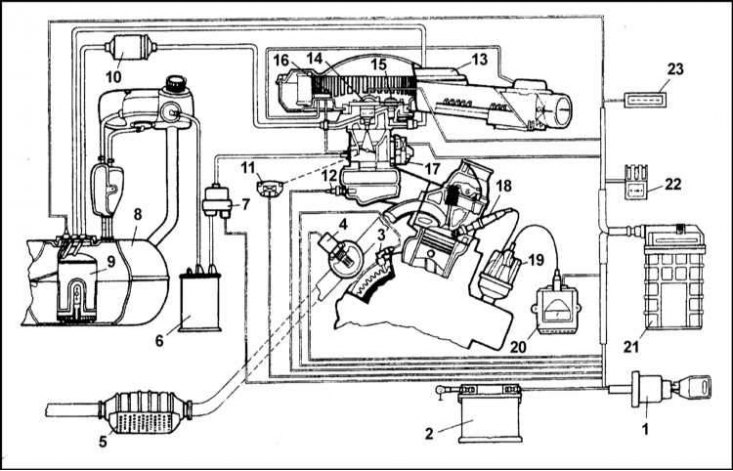
1 - Ignition switch; 2 - Battery; 3 - Crankshaft speed and position sensor; 4 - λ-probe; 5 - Catalytic converter; 6 - Carbon adsorber; 7 - Evaporative Emission Control System Solenoid Valve; 8 - Fuel tank; 9 - Electric fuel pump; 10 - Fuel filter; 11 - Throttle position sensor; 12 - Coolant temperature sensor; 13 - Air purifier; 14 - Fuel injection injector; 15 - Fuel pressure regulator; 16 - Air temperature sensor; 17 - Idle speed system stepper motor; 18 - Spark plug; 19 - Ignition distributor; 20 - Ignition control ECU; 21 - ECU injection system; 22 - Fuses and relays; 23 - Diagnostic connector
Functional diagram of the injection injector and fuel pressure regulator
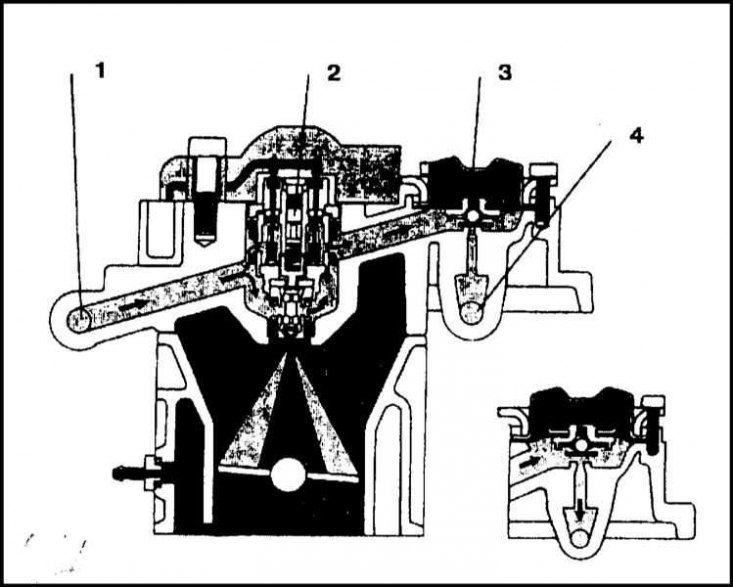
1 - Fuel supply from the fuel pump; 2 - Injector; 3 - Fuel pressure regulator; 4 - Returning fuel to the tank
The Bosch Mono-Motronic system belongs to a family of closed-loop engine management systems. Such systems control both the fuel injection itself and its ignition.
The functional diagram of the Mono-Motronic system is shown in the illustration. The main components of the injection system include: a fuel tank with a submersible electric fuel pump installed inside it, a fuel filter, fuel supply and return lines, a throttle body with an electronic fuel injection injector built into it, and an electronic control unit (ECU) complete with information sensors, actuators and connecting wiring.
The fuel pump provides a continuous supply of fuel through a cartridge filter into the throttle body under slight excess pressure. The fuel pressure regulator built into the throttle body provides constant pressure on the injection injector. Excess fuel is returned to the fuel tank via the return line. This continuous supply system allows for a reduction in fuel temperature and prevents its evaporation.
The injector is opened and closed by the ECU command, which calculates the injection moment and duration based on the analysis of incoming information signals about engine speed, position and speed of the throttle valve, intake air temperature, coolant temperature, vehicle speed, exhaust gas composition, etc. The illustration shows the operation diagram of the injection injector and fuel pressure regulator.
The air sucked into the engine passes through the air cleaner, inside which a replaceable filter element made of thick paper is installed. The temperature of the sucked air is regulated by means of a vacuum valve installed inside the intake hose of the air cleaner and allowing the outside air to be mixed with the air coming through the heater casing located above the exhaust manifold. The position of the valve flap is controlled by a temperature-sensitive switch installed inside the air cleaner.
Information about engine speed is sent to the ECU from the Hall sensor, which is mounted on top of the gearbox housing and records the flywheel speed.
The temperature of the air entering the throttle body is measured by a sensor mounted directly above the injection injector. The information is sent to the ECU, which, based on its analysis, determines the current engine needs in terms of injection timing and air-fuel mixture composition.
The engine idle speed is controlled partly by the electronic throttle position module mounted on top of the throttle body, and partly by the ignition system, by changing the ignition timing settings. In view of the above, there is no need for manual speed adjustments and the system design does not provide for this. Information about the position and speed of the throttle valve is supplied to the ECU by a special sensor, sometimes also called a throttle potentiometer. The sensor is located on the left wall of the throttle body.
The oxygen content in the exhaust gases is continuously monitored by the ECU via the λ-probe installed in the front section of the exhaust system. By analyzing the incoming information, the ECU issues commands to adjust the ignition timing and injection duration, thereby forming an optimal air-fuel mixture. As a result, there is no need to manually adjust the CO content in the exhaust gases. The standard equipment of all models considered in this Manual includes a catalytic converter.
In addition to the functions listed above, the ECU controls the operation of the fuel evaporative emission system.
It should be noted that diagnostics of Bosch Mono-Motronic system failures is possible only with the help of a special electronic reader. The diagnostic connector for connecting the reader is located on the right side of the car's instrument panel. In case of any malfunctions of the system, you should immediately contact the specialists of the Skoda brand service center, who will read and decipher the codes of faults detected by the self-diagnosis system recorded in the ECU memory unit.
The procedure for replacing failed system components is described in the following Sections of the Chapter.
Precautionary measures
Warning! Gasoline is a highly flammable liquid. Special precautions must be taken when servicing fuel system components!
Do not smoke and do not approach the work site with an open flame source/unprotected lampshade carrier! Do not perform maintenance of power system components in rooms equipped with natural gas-powered heating devices and equipped with a control torch. Make sure that a loaded fire extinguisher is always at hand.
Avoid contact of fuel with eyes and exposed skin. Wear protective gloves and goggles. Wash off any accidental splashes with soap and water.
Remember that fuel vapors are no less, if not more, dangerous than the liquid fuel itself. Don't forget that empty gasoline containers continue to contain fuel vapors, which are not only highly flammable, but also potentially explosive!
Many of the procedures described in this Chapter involve disconnecting fuel lines, which inevitably results in fuel spills. Try to have all the necessary materials available to collect spilled fuel in advance.
Remember that residual pressure continues to be present in the fuel system path long after the engine has been stopped. This pressure must be safely relieved before removing or disconnecting any fuel system component (see section Relief of residual pressure in the fuel system).
When servicing the fuel system components, pay special attention to maintaining cleanliness - dirt getting into the fuel line can lead to a disruption in its flow, leading to interruptions in engine operation and even spontaneous stops.
In the interests of the personal safety of the operator and the safety of the equipment, many of the procedures described in this Chapter should be performed only after disconnecting the negative cable from the battery. This precaution first of all eliminates the possibility of a short circuit, and secondly, it allows you to avoid voltage surges in the circuits of the electronic part of the engine control system, many of whose components (such as ECU, sensors and actuators) are extremely sensitive to the overloads associated with such surges.
Note, however, that the system has a certain flexibility, allowing it to adapt to changes in engine characteristics associated with its wear during vehicle operation. Such adaptability is associated with the presence of certain parameters in the ECU memory. When the battery is disconnected, this information is erased and after the engine is started, its restoration requires a small investment of time. The rehabilitation period may be accompanied by a violation of the stability of engine speed, a decrease in sensitivity to changes in the position of the throttle valve, a slight increase in fuel consumption, etc. The duration of the recovery process is determined by the frequency of use and operating conditions of the vehicle.