



Contents: Brake lights ⬇ Handbrake application indicator light ⬇ Brake fluid level indicator light ⬇
Brake lights
1. The brake light circuit is closed by a plunger-type switch mounted on the brake pedal bracket (see photo).
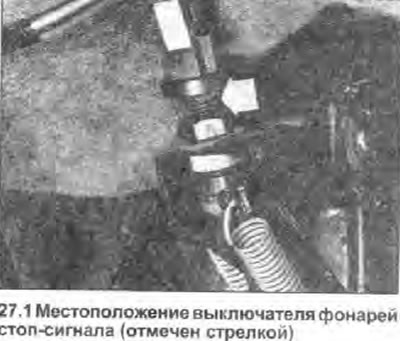
2. Check and adjust the switch setting as described in Chapter 26 this Section.
3. If you suspect that the switch is faulty, check it by disconnecting the wires and connecting a multimeter to its contacts (in resistance measurement mode). The switch circuit should close only when its plunger is extended. Replace the faulty switch.
4. To remove the switch, disconnect its wires and loosen the lock nut, then press back the rubber seals (as needed), to release the switch from the pedal bracket.
5. Install in the reverse order of removal. Finally, adjust the switch setting (see Chapter 26).
Handbrake application indicator light
[Data taken from this portal: SKODABOOK.ru]
6. The handbrake application indicator lamp circuit is closed by a plunger-type switch installed at the base of the handbrake lever so that the lamp lights up whenever the lever is pulled (see photo).
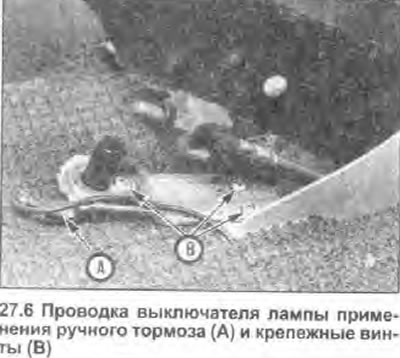
7. Release the plastic cover of the handbrake lever from its mountings to gain access to the switch (see Section 1).
8. The switch cannot be adjusted, it is secured with a screw to a mounting bracket, which in turn is held in place by two screws. To remove the switch, unscrew the screws and disconnect the wiring.
9. To check the switch for proper operation, use the method described in step 3. Make sure that the switch circuit is closed only when its plunger is extended. If the switch is faulty, replace it.
10. Install in the reverse order of removal. Position the switch rod directly under the handbrake lever, then tighten the mounting screws.
Brake fluid level indicator light
11. The circuit of the fluid level indicator lamp is closed by a float-type sensor located in the filler cap of the master cylinder reservoir. The lamp lights up whenever the fluid level drops below a certain mark.
12. This lamp also lights up whenever the ignition key is turned to position "II" (engine start), which serves as confirmation of its serviceability. If the lamp does not light when the engine is started, first check the lamp itself, then its wiring and fix the problem (see Section 12).
13. To check the sensor for proper operation, remove it and use the method described in step 3. Make sure that the sensor circuit is closed only when the float is at the bottom of its stroke.
14. The sensor is sold only together with the filler cap of the master cylinder reservoir; if the sensor is faulty, this assembly must be replaced.