Note: Before you begin, please refer to the Warning given at the beginning Chapters 21.
Removal
1. Jack up the rear of the vehicle, support it securely on axle stands, then remove the wheel.
2. Using chalk or paint, make alignment marks on the drum and hub.
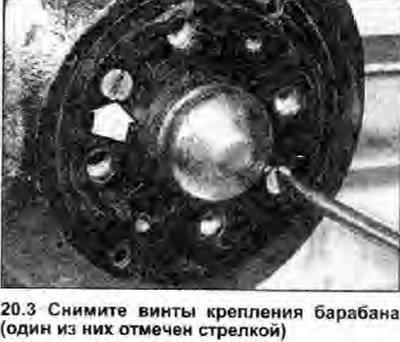
3. Tighten the handbrake to prevent the drum from rotating. Loosen the drum mounting screws (see photo). Release the handbrake completely and remove the drum.
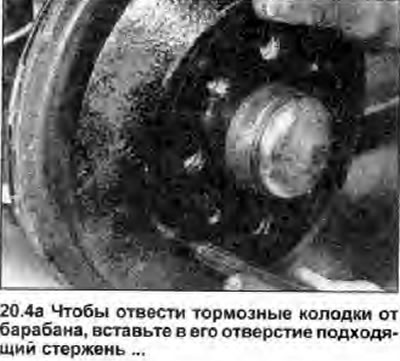
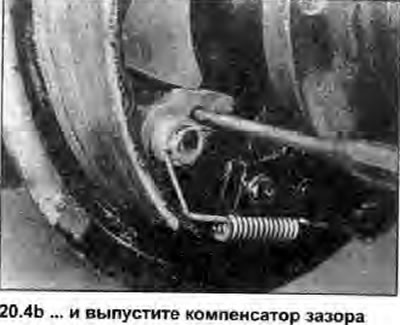
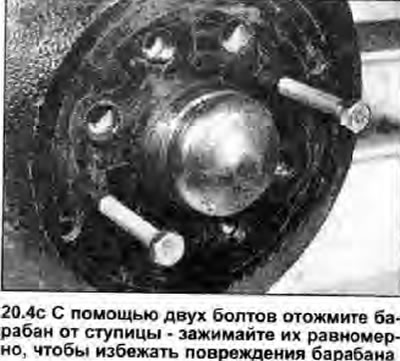
4. If the drum is stuck, first make sure the handbrake is fully released, then insert a suitable rod into one of the holes closest to the outer edge of the drum and press on the toothed segment of the self-adjusting slack adjuster to push the brake shoes away from the drum. If the drum still cannot be removed, it is probably due to corrosion. Either tap the drum gently off the hub with a mallet, or screw it into the holes in the drum (not in the hub!) two bolts with a thread size of 8 mm and tighten them evenly and carefully to thus press the drum away from the hub (see photo).
 |
 |
Text obtained from the website: SkodaBook
 |
Inspection
Note: If one drum requires replacement, REPLACE BOTH DRUMS to ensure equal and effective braking.
5. Carefully (see Warning given in Chapter 21) remove from the drum all traces of dust resulting from wear of the pads.
6. Clean the outside of the drum and inspect it for signs of wear and damage such as cracks around the wheel bolt holes. Replace the drum if necessary.
7. Carefully inspect the inside of the drum. Light scratches on its rubbing surface are quite acceptable, but if deep grooves are found, the drum must be replaced. Usually, a ridge consisting of a mixture of rust and dust forms on the inside edge of the drum. Such a ridge should simply be scraped off, and then the surface should be cleaned with fine (grain size 120-150) sandpaper. If, however, the protrusion is due to wear on the working surface, the drum must be measured as described below. Provided that this does not increase the drum more than specified in Specifications maximum diameter, you can have a specialist resharpen the drum (together with the second drum, because they must have the same diameter). This will help eliminate minor wear or damage; otherwise the drum must be replaced.
8. If you suspect that the drum is excessively worn or has become oval, measure its inside diameter in several places using a bore gauge, both inside and outside the area covered by the brake shoes. The measurements should be taken on perpendicular axes so that by comparing them, you can check the drum for ovality. If the drum is worn in any place to the specified Specifications maximum, or if its out-of-roundness exceeds the maximum permissible value, both drums must be replaced.
Installation
9. Install in the reverse order of removal, paying attention to the following:
- a) When installing a new brake drum, use a suitable solvent to remove any protective coating that may be applied to its inner surface.
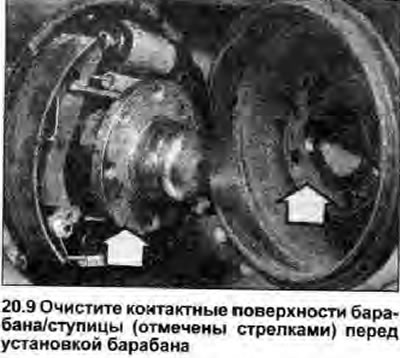
- b) Using a clean wire brush, remove all traces of dirt, corrosion, and dust from the contact surfaces of the drum and hub (see photo), then apply a small amount of anti-lock compound to them (for example Holts Copaslip).
- c) Align the marks made before removal.
- d) Tighten the drum mounting screws and wheel bolts to the specified tightening torque Specifications (see also Section 1 Specifications).
- e) Press the brake pedal several times to return the brake cylinder components and shoes to their working position and restore normal pedal travel.
- f) Check and correct, if necessary, the adjustment of the handbrake (see Section 1). Make sure the wheels rotate freely - only a very slight rustling of the brake shoes against the drum is acceptable.