



Selecting inserts
1. To select the required main bearings, you will first need to determine the size group of the crankshaft main journals. To do this, measure the diameters of the main journals and, based on the measurements obtained, Specifications determine their size group (for details see Chapter 14).
2. The crankshaft journal size group can be determined in another way. Measure the thickness of the old bearings using a suitable micrometer, then compare the obtained values with the data in the table below (see illustration). It is still preferable to use the crankshaft journal dimensions, since the bearings are more difficult to measure accurately and are likely to be worn.
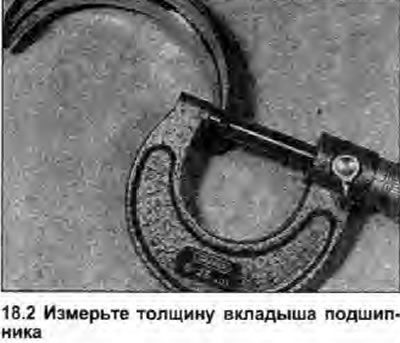
3. Once the main journal size group is known, the correct bearings can be selected using the table below:
| Size group of the root neck | Thickness of the liner |
| Nominal | 2.495 mm |
| 1st repair | 2.620 mm |
| 2nd repair | 2.745 mm |
| 3rd repair | 2.870 mm |
Please note that all new liners have acceptable manufacturing tolerances of +0.000 to -0.010 mm.
Checking the main bearing clearance
4. Clean the back of the bearings and their seats in the cylinder block/crankcase and covers.
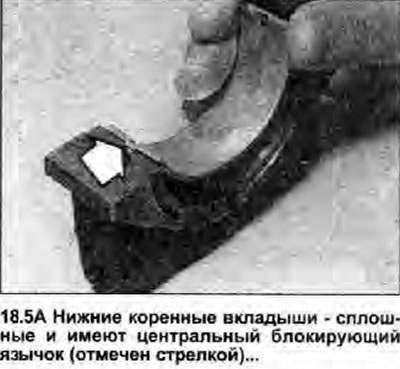
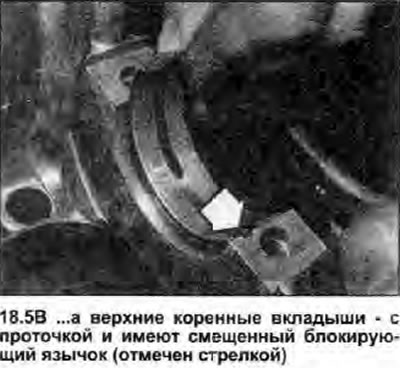
5. Insert the bearings into their places, making sure that the tongue on the bearing fits into the corresponding recess in the cylinder block or cover. Please note that it is impossible to mix up the upper and lower main bearings, as their locking tongues are offset (see illustrations).
 |
 |
6. If the old main bearings are used, they must be installed strictly in the old place in the cylinder block and covers.
7. Check the main bearing clearance if there is any doubt about the degree of crankshaft wear, if the crankshaft has been reground and is installed with non-original repair liners. The clearance can be checked in one of two ways.
8. First method (which is difficult to use without a bore gauge set or expanding calipers); install the main bearing caps together with the liners into the cylinder block/crankcase. Tighten the cap mounting bolts with the specified tightening torque Specifications, measure the inner diameter of each pair of liners and the diameter of the corresponding crankshaft journal. The difference in diameters will be the working clearance of the main bearing.
9. The second method (more accurate): using an American product known as a special tool Plastigage. It is made in the form of a fine-grained plastic wire of absolutely round cross-section, which is clamped between the bearing shell and the journal. After removing the shell, the width of the crushed plastic can be compared with the scale on a piece of cardboard included in the kit. The working clearance is determined by this scale. The procedure using Plastigage is as follows.
10. Place the upper main bearings back into the crankcase, carefully replace the crankshaft into its working position. Do not use grease; the crankshaft journals and bearings must be completely clean and dry.
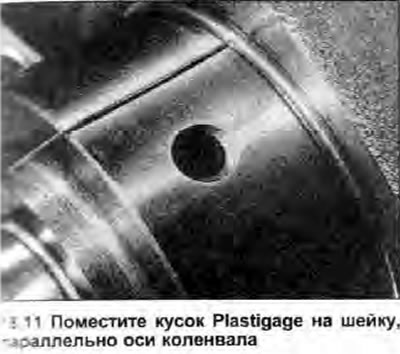
11. Cut three pieces of Plastigage to the appropriate size (they should be slightly shorter than the width of the main bearings) and place them on the crankshaft journals parallel to the axis (see illustration).
12. Install the main bearing caps with liners in place and tighten the mounting bolts with the specified tightening force Specifications. Work very carefully to avoid dislodging the Plastigage, and do not rotate the crankshaft during this step.
13. Carefully unscrew the bolts and remove the bearing caps, being careful not to disturb the position of the Plastigage or turn the crankshaft.
14. Compare the width of the deformed thread with the scale. The working gap is indicated on the scale (see illustration). Compare the obtained result with the data given in Specifications.
Article reprinted from the website: SKODABOOK.RU
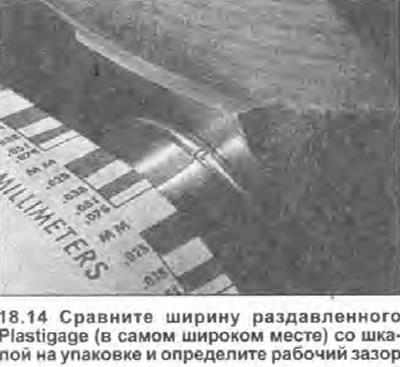
15. If the gap is too large, the bearings are of the wrong size or are excessively worn (if old liners are reused). Before assuming the crankshaft is worn, make sure there is no dirt or oil between the bearing shells and the caps or block when measuring the clearance. If one end of the Plastigage is wider than the other, the crankshaft journal may be tapered.
16. If the main bearing operating clearance is excessive even with new liners of the correct size, the crankshaft must be reground to the next oversize and the appropriate oversize main bearings must be installed (see Chapter 14).
17. If all is well, carefully clean all traces of Plastigage from the crankshaft and bearings.
Final installation
18. Carefully lift the crankshaft out of the cylinder block.
19. Place the bearings in their seats as described in steps 4-6 above. If new bearings are being installed, wipe off any protective grease. Liberally grease each bearing in the cylinder block/crankcase.
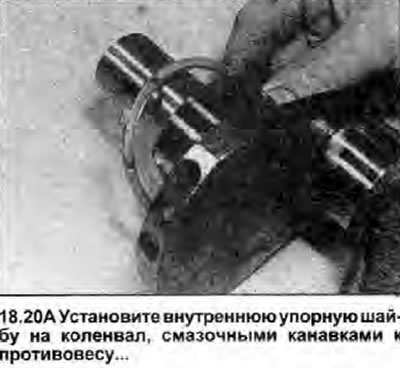
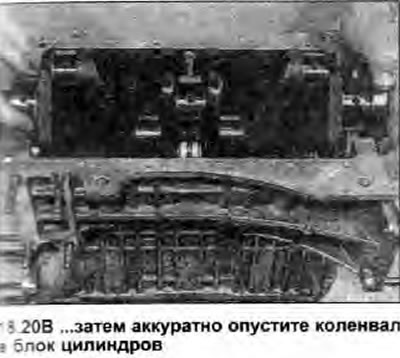
20. Place the inner thrust washer on the right end of the crankshaft with the oil grooves facing the crankshaft counterweight. Carefully lower the crankshaft into its operating position in the block, then coat the bearings and crankshaft journals with engine oil. Position the locking tab of the thrust washer so that it faces upward; this way it will align with the slot in the bearing cap (see illustrations).
 |
 |
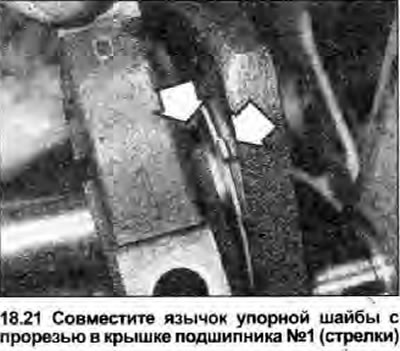
21. Install the main bearing caps in their original positions. Align the tongue of the thrust washer with the slot in the cap of the outer right bearing, and press the thrust washer into the recess (see illustration).
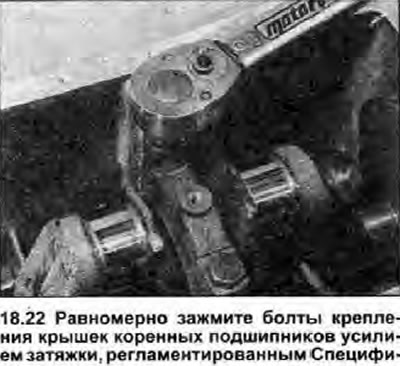
22. Install the main bearing cap mounting bolts and tighten them evenly to the specified tightening torque Specifications (see illustration).
23. Make sure the crankshaft turns freely, then check the axial play as described in Chapter 11. Make sure that the locking tabs of the thrust washers are properly positioned in the grooves on the cover before tightening the crankshaft pulley bolt.
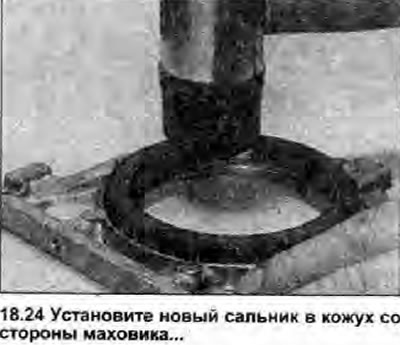
24. Remove any traces of gasket or sealant from the mating surfaces of the cylinder block and the seal housing on the flywheel side. Carefully remove the old seal from the housing and insert the new one. If necessary, use a mallet to hammer the seal into place (see illustration). The sealing edge of the gland must face inward.
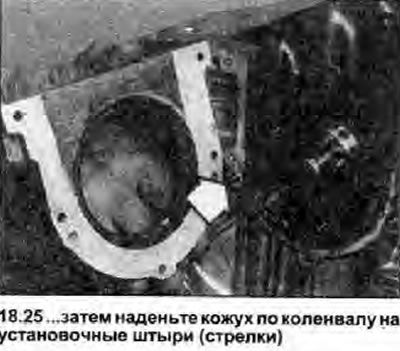
25. If a gasket was used on the oil seal housing, install a new one onto the pins in the cylinder block. If there was no gasket, apply a thin layer of sealant to the contact surface of the housing. Install the oil seal onto the end of the crankshaft, taking care not to damage its sealing lip. Slide the housing into its working position on the cylinder block so that it fits onto the installation pins (see illustration). Insert the cover mounting screws and tighten them securely. If a gasket was installed, use a sharp knife to trim off any ends that protrude outward on the mating surface of the pan.
26. Install the connecting rod assemblies as described in Chapter 19.