



Selecting inserts
1. To select the required connecting rod bearings, you will first need to determine the size group of the crankshaft connecting rod journals. To do this, measure the diameters of the connecting rod journals and, based on the measurements obtained, Specifications determine their size group (for details see Chapter 14).
2. The crankshaft journal size group can be determined in another way. Measure the thickness of the old bearings using a suitable micrometer, then compare the obtained values with the data in the table below. It is still preferable to use the crankshaft journal dimensions, since the bearings are more difficult to measure accurately and are likely to be worn.
3. Once the crankpin size group is known, the correct bearings can be selected using the table below:
| Crankpin size group | Thickness of the liner |
| Nominal | 1.490 mm |
| 1st repair | 1.615 mm |
| 2nd repair | 1.740 mm |
| 3rd repair | 1.865 mm |
Please note that all new liners have manufacturing tolerances of +0.000 to -0.007 mm.
Checking the working clearance of the connecting rod bearing
4. Be guided Chapter 18, paragraph 7. The gap can be checked in one of two ways.
5. First method (which is difficult to use without a bore gauge set or expanding calipers): install the connecting rod bearing caps together with the liners in the working position. Tighten the cap mounting bolts with the tightening force specified Specifications. measure the inner diameter of each pair of liners and the diameter of the corresponding crankshaft journal. The difference in diameters will be the working clearance of the connecting rod bearing.
6. The second method (more accurate): using an American product known as a special tool called Plastigage (see Chapter 18, paragraphs 9-17).
Final installation
7. Please note that the following procedure assumes that the cylinder liners are installed in the crankcase and clamped in the operating position as described in Chapter 12, and that the crankshaft and main bearing caps are also installed in the operating position. The piston/connecting rod assemblies should be attached to the crankshaft (see Chapter 18).
8. Clean the back of the bearings and the bearing surfaces in the connecting rods and caps. If new bearings are being installed, wipe off any protective grease.
9. Insert the bearings into their seats, making sure that the tab on each bearing fits into the notch in the connecting rod or cap. Note that the old bearings must be installed in their original locations.
10. Lubricate the cylinder walls, pistons and piston rings, then place each piston/connecting rod assembly in the appropriate position.
11. Starting with assembly #1, position the piston ring cuts as described in Chapter 17, then clamp the rings with a special compressor.
12. Insert the piston/connecting rod assembly into the top of the No.1 cylinder bore. The arrow on the piston head or near the piston pin hole should point toward the front of the engine (fuel pump side), and the oil channel on the connecting rod should be facing the rear of the engine. Using a wooden block or hammer handle, hit the piston head to drive the assembly into the sleeve (see illustration).
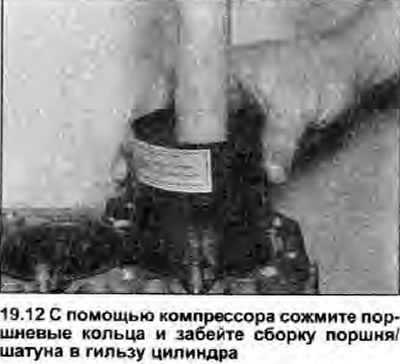
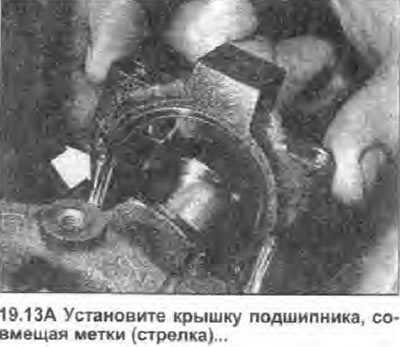
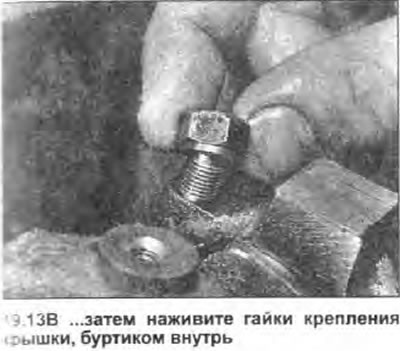
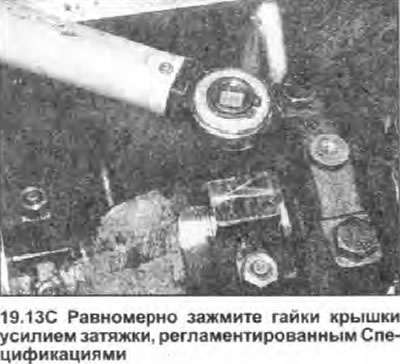
13. Make sure the bearing has not moved, then generously lubricate the crankshaft journal and both bearings. Being careful not to scratch the inside surface of the cylinders, insert the piston/connecting rod assembly down onto the crankshaft journal. Install the connecting rod cap with the bearing, orienting it correctly. Fit the cap nuts and tighten them evenly to the specified torque Specifications (see illustrations). After this, make sure the crankshaft rotates freely and then proceed to the next assembly.
 |
 |
 |
14. Repeat the procedure for the remaining three piston/connecting rod assemblies.
15. Once all assemblies are installed, check that the crankshaft rotates freely. The new components will be slightly stiff, but should not be felt.