



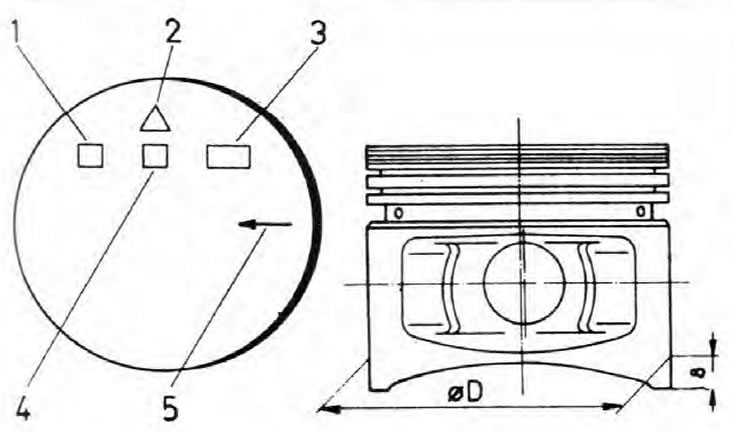
Fig. 2B.4. Marking on the piston head and the location of diameter measurement
1. Manufacturer's number
2. Manufacturer's mark
3. Piston size class (diameter)
4. Date of production
5. Arrow (points to the front of the cylinder block)
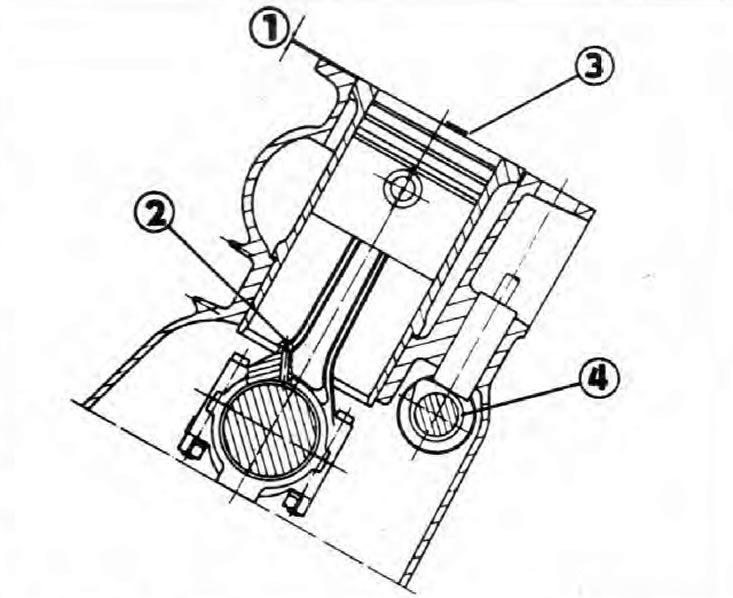
Fig. 2B.5. Cylinder block with installed crankshaft, piston, connecting rod and camshaft
1. Protrusion of the sleeve above the surface of the cylinder block
2. Connecting rod lubrication channel
3. Arrow on the piston head (points to the front of the cylinder block)
4. Camshaft
Disassembly
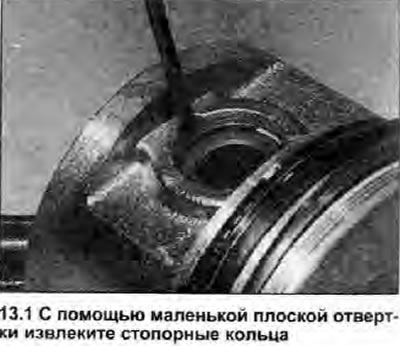
1. Using a small flat-head screwdriver, carefully remove the snap rings from the piston pin hole and discard them (see illustration). Note the position of the piston arrow and the connecting rod oil groove (see point 11).
2. Push the piston pin out of the piston, then separate the piston from the connecting rod. If the piston pin is tightly seated in the piston, it will be easier to remove if you warm the piston up a little.
Inspection
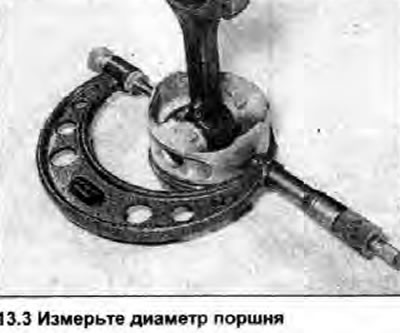
3. Check all pistons for out-of-roundness, abrasions, scratches and signs of wear in the ring grooves. Using a micrometer, measure the piston diameter at a distance of 8 mm from the base of the skirt perpendicular to the axis of the piston pin. Check the stop between the piston and the cylinder wall as described in Chapter 12 (see illustration).
Material is available on the website: SkodaBook.ru
4. Replace the piston if it is worn more than specified in Specifications tolerances for its size class. As mentioned in Chapter 12, all cylinder liners and pistons must have the same size class. The piston class is imprinted on its head (see Fig. 2B.4).
5. If new rings are to be installed on the same pistons, remove the old ones from them (see illustration).
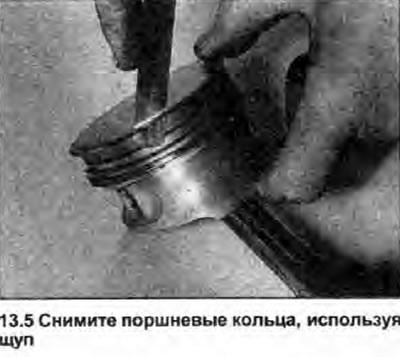
6. After the piston rings have been removed, check the condition of the piston grooves and clean them from carbon deposits using an old ring. Be careful, the edges of the ring can be very sharp.
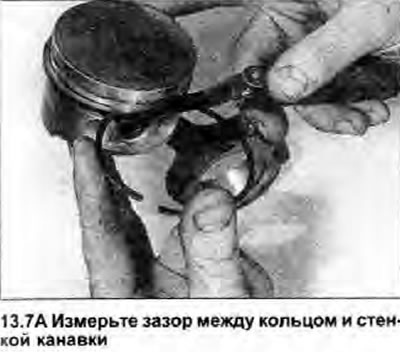
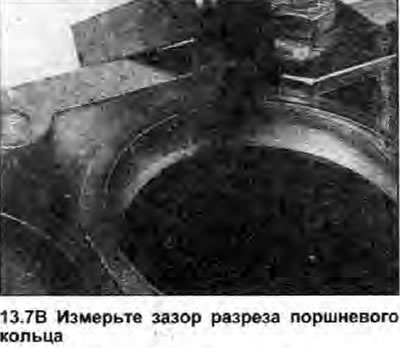
7. Check the clearance between the ring and the groove wall by inserting each ring together with a feeler gauge between the top side of the ring and the groove wall. Check the gaps of the ring cuts by inserting the ring into the cylinder bore and pushing it with the piston head approximately 15 mm from the top edge, and then measure the gap with a feeler gauge (see illustrations). The desired clearance values for all rings are given in Specifications.
 |
 |
8. Inspect the connecting rods for damage and make sure they are not bent. If any connecting rod shows signs of damage or is bent, replace it. The connecting rods are divided into two groups by weight. The weight class is indicated by a coloured dot on the connecting rod bearing cap: light connecting rods are marked with a yellow dot, and heavy rods with a blue dot. Skoda states that all four connecting rods must be of the same weight class. If the weight mark is not visible, contact a Skoda dealer, where the connecting rod can be identified by direct weighing.
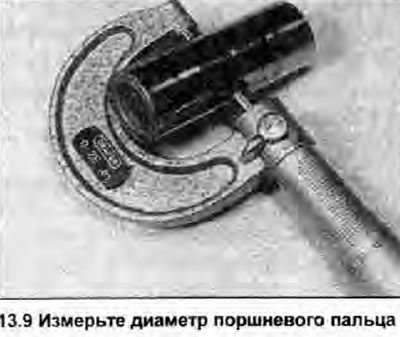
9. Inspect the piston pin and bushing in the small connecting rod head for signs of wear and abrasion. Insert the pin into the bushing and check that there is no visible play between them. If the necessary measuring tools are available, the condition of the bushing and piston pin can be determined by direct measurement; subtract the outer diameter of the pin from the inner diameter of the bushing - you get the value of the backlash (see illustration). If any part is worn or any of the measurements exceed the data in Specifications permissible deviations, the piston pin and bushing should be replaced as a matched pair. To replace the connecting rod upper head bushing, contact a Skoda dealer who is equipped with the necessary tools to perform this work.
Assembly
10. Install a new snap ring into one of the grooves in the piston pin bore. Lubricate the bore and insert the piston pin from the opposite end of the piston.
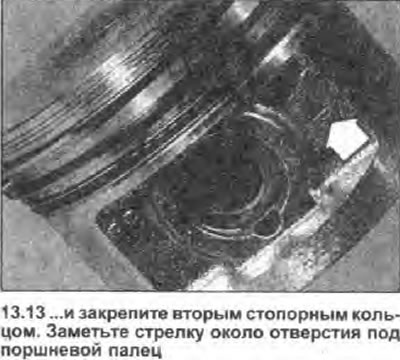
11. Insert the connecting rod into the piston, making sure that the arrow on the piston (on the head or near the piston pin hole) pointed in the opposite direction from the oil channel on the connecting rod, i.e. so that the arrow points to the front of the cylinder block. and the oil channel of the connecting rod - to the rear (see Fig. 2B.5).
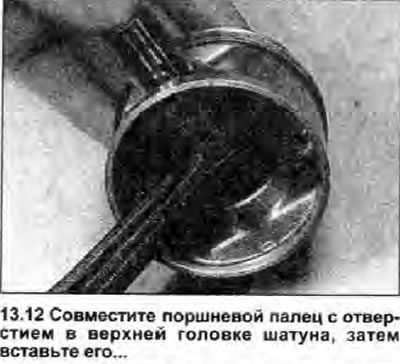
12. With the piston and connecting rod aligned as described above, align the hole in the upper connecting rod head with the piston pin and insert the pin fully into the piston until it rests against the retaining ring (see illustration).
13. Make sure the connecting rod rotates freely on the piston pin, then secure the pin with the second circlip (see illustration).
14. Install the piston rings as described in Chapter 17.