



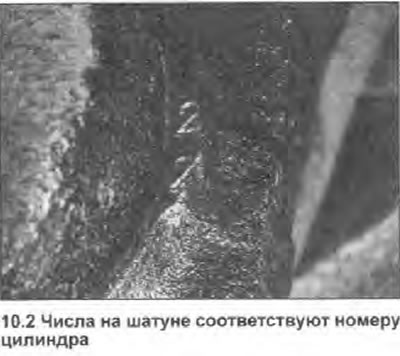
2. Before removing the cranks, note the two numbers that are stamped on one side of each assembly, one on the cap and one on the crank (see illustration). These numbers indicate the cylinder number the assembly is installed in. Cylinder #1 is on the right end (near the drive chain). If the numbers are not visible, make your own marks using a hammer and punch (or paint).
3. With the connecting rods installed on the crankshaft, use a feeler gauge to check the axial clearance between the caps and the crankshaft counterweights. If the clearance greatly exceeds the values specified in Specifications permissible deviations, then the connecting rods should be replaced.
4. Turn the crankshaft until the pistons of cylinders No.2 and 3 are at BDC.
5. Unscrew the connecting rod bearing cap nuts and remove the cap together with the bearing shell. If it is necessary to check the bearing shells, move the connecting rod away from the crankshaft journal and remove the upper bearing shell from it. Keep the cap, nuts and bearing shells together.
6. Similarly, remove the connecting rod covers of cylinders No.1 and 4.
7. Remove any carbon deposits from the top of each cylinder bore. Push out the piston/rod assemblies and remove them through the top of the cylinders. Be careful not to scratch the cylinder walls with the connecting rod lower heads. Install the caps, bearings and nuts on the connecting rods immediately so that all assemblies are stored as a matched set.