



Contents: Cleaning ⬇ Inspection ⬇
Cleaning
1. For a complete cleaning, remove the liners (see point 19 below), lube channel plugs, and all external components and electrical switches/sensors.
2. Clean the cylinder block and crankcase from any remaining gasket, being careful not to damage the surfaces.
3. If any part of the crankcase is extremely clogged, clean it with steam.
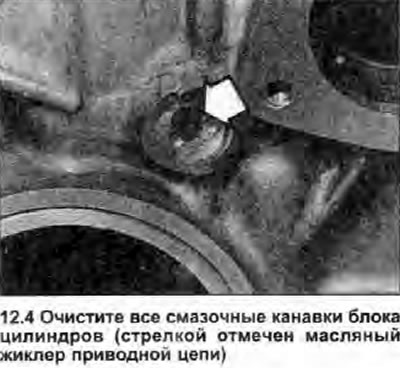
4. Then clean all the lubrication holes and channels again. Rinse all the internal channels with warm water, then dry thoroughly and apply a thin layer of oil to all surfaces to prevent corrosion. To speed up the drying process, and blow out all the lubrication holes and channels, use compressed air (see illustration).
5. If the crankcase is not very dirty, it can be cleaned with hot soapy water and a stiff brush.
6. All tapped holes must be clean to ensure accurate tightening torques during assembly. Use a tap of the appropriate size to clean and renew the threads. If possible, use compressed air to blow out any debris from the holes caused by the tap.
7. Install new sealing washers on the oil channel plugs. Then install the plugs into the cylinder block and tighten them to the specified tightening torque Specifications.
8. If the engine is not to be reassembled immediately, cover it with a large plastic bag and protect the bearings from corrosion as described above.
Inspection
9. Check the crankcase for cracks and corrosion. Look for stripped threads in the threaded holes. If there is an internal coolant leak, it is recommended to contact a specialist for a comprehensive inspection of the cylinder block and crankcase using special equipment. If defects are found, eliminate them if possible, or replace the block.
10. Remove the cylinder liners as described in point 19, and check each cylinder for nicks and notches. The liners are divided into three sizes; the size group is printed on the side of each of them.
11. Measure the diameter of the cylinder liners just below the ridge formed by wear at the top of the cylinder, in the middle and at the base of the cylinder. Take measurements parallel and perpendicular to the crankshaft axis.
12. Compare the results with Specifications according to the size class of the cartridge case; if any measurement exceeds the tolerances specified in the Specifications, the cylinder liner must be replaced.
13. To determine the clearance between the piston and the cylinder wall, measure the diameters of the cylinder and the piston skirt as described in Chapter 13, and subtract the skirt diameter from the cylinder diameter. Another method can be used. Insert each piston into its corresponding cylinder liner, select a feeler gauge and insert it into the space between the cylinder and piston on one of the thrust surfaces in the base.
14. If the clearance is large, a new piston is required. If the piston gets stuck at the bottom end of the cylinder and is released when moving up, the cylinder is tapered. If the piston and feeler gauge get stuck when rotating in the cylinder, there is ovality.
15. Repeat this procedure for the remaining pistons and cylinder liners.
16. If the cylinder liner walls are badly damaged or excessively worn, oval or tapered, purchase new cylinder liners and new pistons. Skoda states that all pistons and liners installed in the engine must be of the same size class. The liner class is stamped on its outer surface, and the piston class is stamped on its head (see Chapter 13).
17. If the cylinders are in good condition and not worn to the values specified in Specifications limit values, and if the gaps between the piston and the cylinder wall are within acceptable limits, then only the piston rings will need to be replaced.
18. Before assembling the engine, it is necessary to hone the cylinder bores. This will require a special tool. As a result of honing, the bearing surface of the piston rings increases, and accordingly, the tightness between the piston and the cylinder improves. There are two types of honing tools. driven by an electric drill. "Bottle brush" - a hard, cylindrical brush with hard stones glued to the bristles. And a more ordinary brush with hard stones mounted on spring-loaded supports. For an inexperienced mechanic, satisfactory results can be obtained using a "bottle brush". Honing is done as follows; You will need the tool described above, a wrench, a drill, a clean rag, honing oil and safety glasses. Mount the tool in the drill. Lubricate the cylinder bores with honing oil, insert the tool into the bore, squeezing the stones. Turn on the drill and move it up and down in the bore. Ideally, the honing lines should intersect at an angle of 60°, although some piston ring manufacturers may specify a different angle. Use oil when honing. Do not remove more material than necessary. When finished, do not remove the tool from the bore while it is rotating; slide it down until the attachment stops, then remove the tool by rotating it manually in the normal direction.
19. To remove the liners, turn the cylinder block/crankcase upside down and support it on wooden blocks, then use a wooden drift to knock out the liners from the crankshaft side. When all the liners are loosened, turn the cylinder block/crankcase on its side and remove the liners from the cylinder head side. Remove the sealing washers from the base of the liner and measure its thickness. The washers come in different sizes and are used to adjust the height of the liner protruding above the cylinder block (see point 22); For each sleeve, purchase new washers of the appropriate thickness. If the sleeves do not require replacement, stick them on their right sides (facing the drive chain) pieces of sticky tape on which you need to write the cylinder numbers.
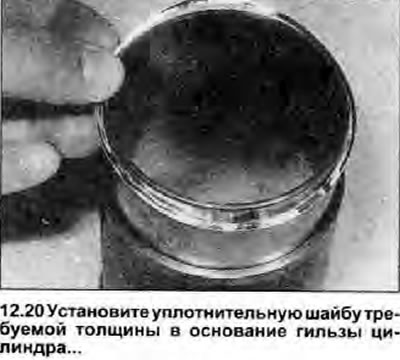
20. Before installing the cylinder liners, thoroughly clean the contact surfaces, using fine-grained sandpaper remove burrs or sharp edges that could damage the sealing washer. Clean and wipe dry all liners, then install new sealing washers of the required thickness at the base of each (see illustration). Apply a thin layer of engine oil into the cylinder bore.
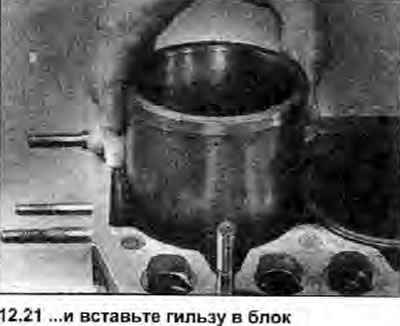
21. If the old liners are being installed, use the marks made before removal so that they can be correctly oriented and installed in the old cylinders. Insert the liners into the cylinder block/crankcase, being careful not to disturb the washer, and press them in as far as possible by hand (see illustration). Using a hammer and block of wood, lightly tap each sleeve to seat it onto the locating collar.
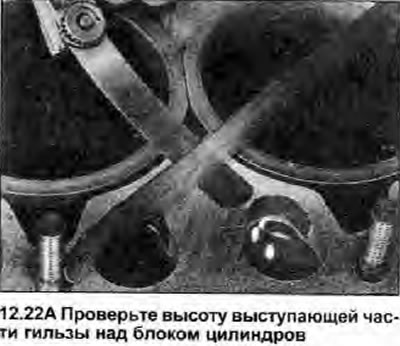
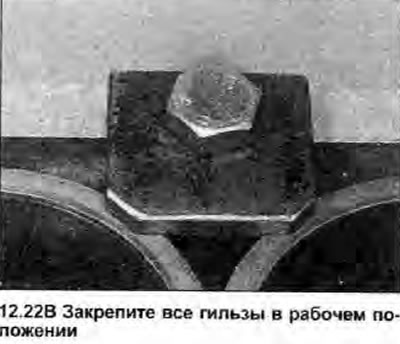
22. After all four liners have been installed, check with a micrometer or a ruler and feeler gauge that their height above the cylinder block surface is within the limits given in the Specifications and that the maximum difference between any two liners is not exceeded. If this is not the case, the relevant liner must be removed and another sealing washer of the required thickness must be purchased. There are three classes of washers depending on the thickness: 0.10 mm, 0.12 mm and 0.14 mm. Install the required washer, then insert the liner into the cylinder block and recheck its height of protrusion. When everything is in order, securely fasten the liners in the working position (see illustrations).
(The original article can be found on the resource: SkodaBook.ru)
 |
 |