



Contents: General information ⬇ General instructions ⬇ Lap seat belt ⬇ Automatic seat belt tensioners ⬇ Transportation of children ⬇
General information
It has been proven that seat belts provide sufficiently reliable protection for the driver and passengers of vehicles in emergency collisions. In most countries, the use of seat belts is required by law.
Warning: Seat belts must be used on every trip (on the motorway, or in the city).
Pregnant women should also wear seat belts.
The efficiency of seat belts directly depends on their correct installation.
In a head-on collision, unbelted occupants of a vehicle are thrown forward, uncontrollably striking obstacles (steering wheel, instrument panel, windshield, etc.).
The widespread belief that during a light impact you can hold on by braking with your hands is a profound misconception due to the extremely high accelerations that occur during sudden braking or changing direction of movement, even at low speeds.
Rear passengers are also required to wear seat belts to avoid being thrown into the front half of the cabin.
General instructions
- The seat belt should not be pinched, twisted or rub against cutting edges;
- No more than one person should be wearing the same seat belt at the same time (including children);
- Maximum effectiveness of seat belt protection is achieved with the correct body position of the occupant;
- The belt should not be placed over hard or fragile objects placed in pockets (including pencils, pens, keys, etc.);
- Layers of loose outerwear negatively impact the effectiveness of the protection provided by seat belts;
- It is prohibited to use various types of clamps that allow you to adjust and fasten the belts, adjusting them to the particular body structure of the person sitting;
- The seat belt buckle must only snap into the buckle intended for that belt;
- It is necessary to monitor the cleanliness of the seat belts - contamination can disrupt the proper functioning of the return device;
- The seat belt buckle receptacle must not be blocked by any foreign objects (such as scraps of paper, coins, etc.);
- Damaged seat belts, as well as belts that have been subjected to increased loads in an accident, must be replaced. The condition of the belt anchors should also be checked;
- Three-hanker inertia type safety belts.
Inertia-type seat belts do not at all restrict the freedom of movement of the persons wearing them.
When braking sharply or maneuvering the car, the drum of the return device is automatically blocked and the ability of the occupant to move is limited.
Caution! Do not tilt the front seat backs too far back, as this will significantly reduce the effectiveness of the lap section of the three-anchor belt in holding the occupant's body.
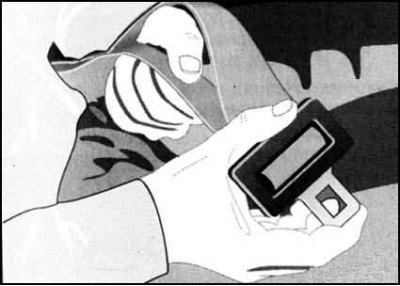
Pull the belt by the sliding buckle and move the shoulder section across your chest. The waist section of the belt should cover your upper hips. Insert the buckle into the buckle slot and click the buckle into place. Check that the buckle is working properly by tugging the belt.
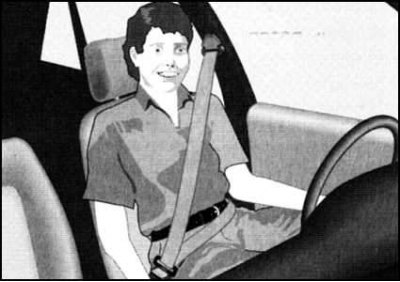
The shoulder section of the belt should pass through the middle of the occupant's shoulder and tightly compress the chest. The waist section should provide fixation of the pelvic region of the body, located as high as possible on the occupant's hips.
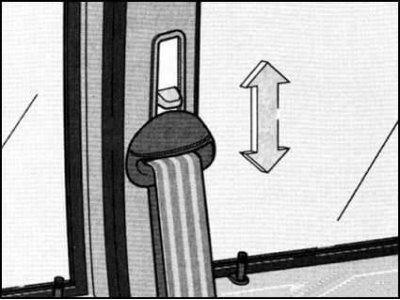
The height-adjustable top anchor allows you to adjust the belt to the height and body size of the person sitting.
To adjust the mounting height, press the locking lever, then move the floating anchor bracket in the appropriate direction.
Note: The shoulder section of the belt should pass through the middle of the occupant's shoulder, but never across the neck.
Once the mounting height has been adjusted properly, use a short tug to check that the floating bracket is securely fastened.
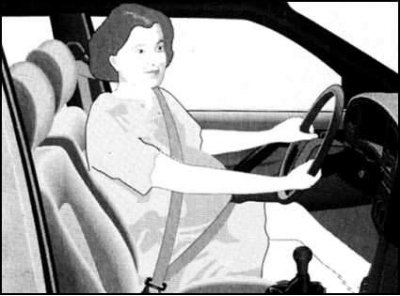
Pregnant women must also wear a seat belt. The lap section of the belt must be positioned as high as possible on the seated woman's hips and must never cover the stomach from above.
To remove the belt, press the red release button of the lock built into the buckle. The tongue of the floating bracket of the lock will be pushed out of the buckle under the force developed by the spring. The unfastened belt will be wound onto the drum of the return device automatically. If necessary, you can adjust the sliding bracket of the lock by hand. The plastic stop of the bracket will ensure that the tongue of the lock is in a position ready for use.
Lap seat belt
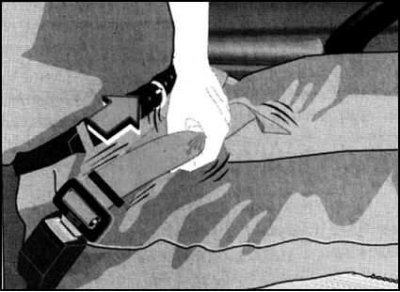
The central place in the rear seat of the car is equipped with a lap belt. The principle of operation of the lock of the two-anchor lap belt is completely identical to that of the three-anchor type belts.
The length of the waist belt is adjusted by changing the position of the locking bracket. The fastened belt should tightly squeeze the upper part of the seated person's thighs, providing reliable support for the pelvic section of the body. The free end of the belt is secured by threading it through the plastic frame.
Automatic seat belt tensioners
In order to increase the level of safety for the driver and passenger, the three-anchor seat belts of the front seats of the car can be equipped with automatic tensioners.
The devices are activated by strong frontal impacts. Under the influence of overload, the tensioner drum drive pyropatrons explode and the belts are tightened, providing more reliable support for the occupant's body.
Light overloads do not cause the tensioners to operate.
Attention! Any maintenance of tensioners should be entrusted to car service specialists.
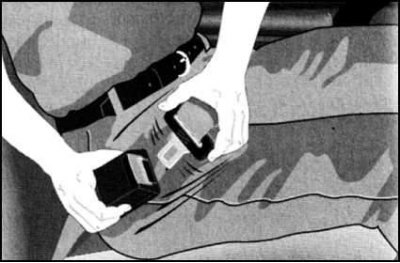
When the tensioners are activated, slight smoke may occur, which should not be a cause for concern.
The devices are designed for single operation only and must be replaced after that (together with belts).
Disposal of tensioners must be carried out with special precautions (consult with car service specialists).
Transportation of children
Transportation of children of younger and middle age must be carried out using special devices installed on the car seat and secured together with the occupant by seat belts. For advice, contact specialists of branded service centers of car manufacturers, as well as sellers of branded car accessories.