
Company vehicles Hyundai Company vehicles Kia Company vehicles Lada Company vehicles Mazda Company vehicles Mercedes-Benz Company vehicles Opel Company vehicles Mitsubishi
English Русский
Български
Беларускі
Український
Српски
Hrvatski
Română
Polski
Slovenský
Magyar
Articles   
Bookmark Contacts Sitemap
SkodaBook.ru


Fabia Rapid Octavia Superb Kodiaq Yeti Others
Favorit (1987-1994) Felicia (1994-2001)

Suspension and steering drive (Skoda Felicia)

  • Main
  • Skoda
  • Felicia (1994-2001)
  • General information
  • Maintenance (petrol)
  • Suspension and steering drive
0
Contents: Front suspension and steering drive ⬇ Rear suspension ⬇ Suspension struts and shock absorbers ⬇

Front suspension and steering drive


1. Jack up the front of the car and place it on supports.
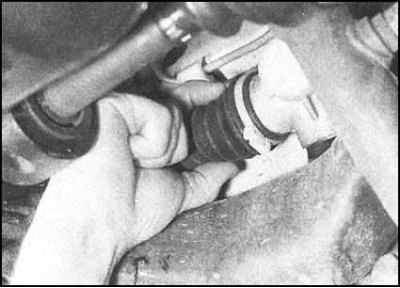
2. Visually inspect the condition of the ball…


2. Visually inspect the condition of the ball joint dust boots and steering rack housing protective covers. Replace worn or leaking covers - dirt or moisture getting inside the dust boots will accelerate the wear of the ball joints and rack and pinion components.

3. On models equipped with a power steering system, check the condition of the PAS hoses. Inspect the hydraulic line unions and steering gear housing boots for signs of leaks. Oil leaking through the protective boots when the pressure inside the steering rack housing increases usually indicates wear of the seals.
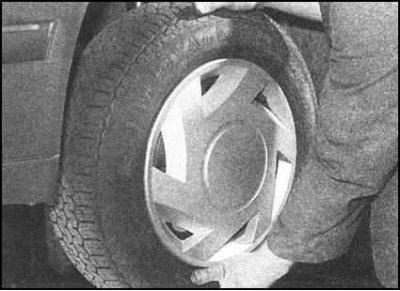
4. Grasp the front wheel of the car at the 12 and…


4. Grasp the front wheel of the car at the 12 and 6 o'clock positions and jerk it sharply. The presence of the slightest noticeable play requires an investigation into the causes of its occurrence. While continuing to jerk the wheel, ask an assistant to press the foot brake pedal. If the play disappears or noticeably decreases, then the hub bearings are worn. Otherwise, you should check the condition of the hinges and supports of the suspension components.


5. Now grab the wheel at the 9 and 3 o'clock positions and check again. The play may again be due to wear of the hub bearings. The second possible cause of slack is wear of the steering rod ends. When the outer ends are worn, there is usually visual play in the wheel. To assess the degree of wear of the inner end joint, place your hand on the protective cover of the rack and pinion housing, and grab the rod with your other hand. If you now tug on the wheel, you will be able to feel play in the worn joint.

6. Using a crowbar or a large screwdriver, assess the degree of wear on the suspension support bushings: move the lever between the corresponding component and its support point. The presence of a small amount of play is quite natural and is explained by the elasticity of the rubber inserts, but excessive slack indicates wear of the support. At the same time, visually assess the condition of all accessible rubber cushions and inserts. Pay attention to defects such as cracks, delamination, tears, signs of aging of the material, etc.

7. Lower the car to the ground and have an assistant turn the steering wheel approximately 1/8 of a turn in each direction. The delay in the steering wheel response to the steering wheel rotation (play) should be very small, and ideally absent altogether. Otherwise, check the condition of the joints and supports of the suspension and steering components. Assess the degree of wear of the cardan joints of the steering column, as well as the components of the rack and pinion itself.


Rear suspension


1. Support the front wheels with chocks, then jack up the rear of the car and place it on supports.

2. Proceeding as described above for the front suspension, assess the degree of wear of the wheel bearings, suspension bushings, and, if equipped, the shock absorber strut supports.

Suspension struts and shock absorbers


1. Check the shock absorbers for signs of hydraulic fluid leaks on the housing, rubber boot and through the piston rod. Leaks indicate an internal defect in the shock absorber and the need for replacement.

Note: Strut assemblies/shock absorbers are always replaced in pairs for a given suspension axle.


2. The effectiveness of the strut assemblies can be checked by pressing each corner of the car in turn. When you release the corner, the body should return to its original position without rocking. Otherwise, the corresponding shock absorber requires more detailed attention. Do not forget to evaluate the degree of wear of the components of the upper and lower shock absorber mounts.
This article is available at russian, bulgarian, belarusian, ukrainian, serbian, croatian, romanian, polish, slovak, hungarian
Article verified: Ekaterina Blinova
Share with friends:
◀ Previous
Skoda Felicia: Maintenance (petrol)
Next ►

Checking the condition of the protective covers of the drive shafts
Checking the condition of the hoses and identifying sources of leaks
Checking and adjusting valve clearances (1.3L models)
Checking the engine management system for proper operation
Checking the condition of the front brake pads and discs
Checking the exhaust system components
Checking the condition of the coolant
Lubrication of locks and hinges
Checking the composition of exhaust gases
Checking windshield wipers/washers/headlight lenses
Read similar articles on other Skoda models

➧ Steering column adjustment Skoda Fabia 1 (1999-2007)
➧ Adjusting the position of the steering wheel Skoda Rapid 1 (2012-2022)
➧ Mounting the drive unit in the body Skoda Octavia 1 (1996-2004)
➧ Checking the condition of suspension and steering components Skoda Superb 2 (2008-2015)
➧ Front Suspension Subframe Assembly — removal and installation… Skoda Kodiaq 1 (2016-2024)
➧ Checking the condition of suspension and steering components Skoda Yeti (2009-2017)
Link to this article in various formats
Reviews and comments of visitors
No comments yet


Add two numbers: 30 + 21


Favorit (1987-1994) 
  • General information
  • Maintenance
  • Troubleshooting
  • Power unit
  • Engine in car
  • Engine overhaul
  • Cooling and heating
  • Fuel and exhaust system
  • Fuel injection system
  • Ignition system
  • Transmission
  • Clutch
  • Manual gearbox
  • Drive shafts
  • Chassis (running gear)
  • Brake system
  • Car suspension
  • Steering
  • Body and interior
  • Exterior (external elements)
  • Interior (salon)
  • Electrical equipment
  • Equipment and devices
  • Power devices
  • Electrical circuits
Felicia (1994-2001) 
  • General information
  • Introduction to guide
  • User manual
  • Maintenance (petrol)
  • Maintenance (diesel)
  • Power unit
  • Petrol engine 1.3 l
  • Petrol engine 1.6 l
  • Diesel engine
  • Engine overhaul
  • Cooling system
  • Fuel system (carburetor)
  • Central injection (SPFI)
  • Multipoint injection (MPFI)
  • Diesel power system
  • Decreased toxicity
  • Engine electrics
  • Transmission
  • Clutch
  • Car gearbox
  • Drive shafts
  • Chassis (running gear)
  • Brake system
  • Car suspension
  • Steering
  • Body and interior
  • Exterior (external elements)
  • Interior (salon)
  • Doors, locks and windows
  • Electrical equipment
  • Equipment and devices
  • Headlights and lighting
  • Electrical circuits
SkodaBook.ru © 2018–2026 | Mobile version | Articles on Skoda | Sitemap EN BG BY UA RS HR RO PL SK HU | Feedback | Site search | Bookmark
Fabia 1 (1999-2007) | Fabia 2 (2007-2014) | Rapid 1 (2012-2022) | Octavia 1 (1996-2004) | Octavia 3 (2013-2019) | Superb 2 (2008-2015) | Kodiaq 1 (2016-2024) | Yeti (2009-2017) | Favorit (1987-1994) | Felicia (1994-2001) |
By continuing to use the site, you agree to the use of cookies.