



Engine accessories
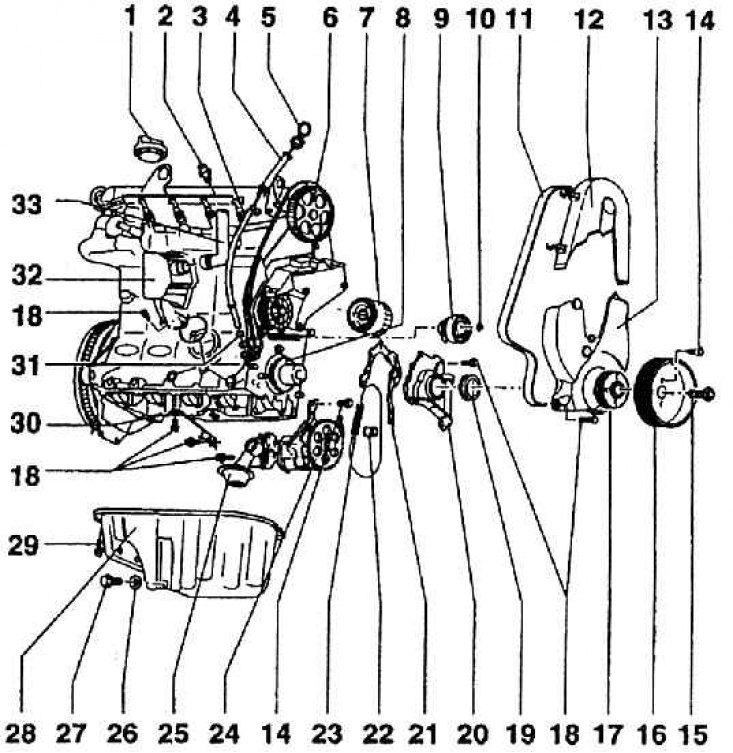
1 – filler cap; 2 – oil pressure sensor (baroscope); 3 – oil dipstick guide tube; 4 – guide part of the dipstick tube; 5 – oil dipstick; 6 – camshaft belt drive pulley; 7 – oil filter; 8 – oil pump drive sprocket; 9 – timing belt tension roller; 10 – tension roller fastening nut; 11 - timing belt of the gas distribution mechanism; 12 – toothed belt protective cover (upper part); 13 – toothed belt protective cover (lower part); 14 – bolt for fastening the multi-groove belt pulley; 15 – toothed belt pulley mounting bolt; 16 – multi-belt pulley; 17 – belt pulley of toothed belt transmission on crankshaft; 18 – casing mounting bolt; 19 – sealing washer; 20 – flange; 21 – flange seal; 22 – sealing insert; 23 – oil pump drive chain; 24 – oil pump; 25 – oil suction screen with excess pressure relief valve; 26 – sealing washer; 27 – oil drain bolt from the crankcase (20 Nm); 28 – crankcase; 29 – crankcase mounting bolt (15 Nm); 30 – bracket; 31 – washer; 32 – oil separator; 33 – engine crankcase breather hose
Oil pump
The plastic intake manifold is assembled on the back side of the head. It has four branches with independent terminals corresponding to the intake holes in the cylinder head. Each branch of the manifold is sealed with rubber washers.
The fuel pad, into which individual steel indirect injection nozzles are inserted, as well as the connectors for the electrical connection of the injector mechanisms to the control unit, is fixed on the intake manifold from above. This pad also contains the pressure-reducing valve, which operates depending on the air pressure in the intake manifold. The valve simultaneously regulates the amount of fuel and returns the excess through the return line to the tank.
In the middle of the intake manifold, between the second and third branches, there is a flange for fixing the housing with the air supply neck, the throttle valve and its control. The throttle valve is controlled by a cable from the gas pedal, then (on the back side) an electronic control unit that regulates the throttle valve closing speed, idle speed and deceleration mode according to the nature of the operating mode.
On the side of the pipeline there is a sensor for the temperature and pressure of the incoming air (dual sensor). On the reverse side of the pipeline there are holes for sucking fuel into the fuel pad by means of pressure control, as well as an outlet for supplying vacuum to the brake booster.
The engine assembly also includes the following units and subassemblies: (see fig. Engine accessories).
The bracket for the alternator, power steering pump, and air conditioning compressor are located on the left side of the engine (on the front side in the direction of travel). The brackets vary in shape for engines with different equipment. In all cases, the threaded holes for fastening are the same for all types of brackets.
Information published on the website: SkodaBook.ru
The coolant pump is inserted into the cavity of the block on the side of the timing gears and is driven by a toothed belt together with the timing gears. The pump is a compact assembly unit and as a unit it is replaced by the service as a whole in case of damage. The impeller of the pump is of the turbine type. It is attached to the engine block by a flange, which is part of the pump, screwed with two M8 bolts, which simultaneously hold the protective cover of the pulley of the toothed belt drive of the pump. In the block, the pump is sealed with a rubber washer. The pump bearings have permanent consistent lubrication.
The engine is lubricated by forced circulation with full oil filtration. The replaceable oil volume is 3.5 l. The recommended oil is given in the MAINTENANCE INSTRUCTIONS, it should only be added that the engine oil must meet the TL 52 107 standard (VW 50000 or VW 50101, ACEA A2). The steel oil dipstick is inserted into a tube sealed into a hole in the engine block and is secured at the top of the intake module.
The lubrication system includes a pressure sensor - a baroscope, which acts as a reverse-action sensor. If there is no pressure on its contacts, the sensor is closed, which means that the control lamp lights up. The working range of the baroscope is from 0.015 to 0.035 MPa. (When monitoring the oil pressure with a pressure gauge, the manufacturer sets a minimum pressure of 0.2 MPa at an engine speed of 2000 1/min and an oil temperature of 80°C).
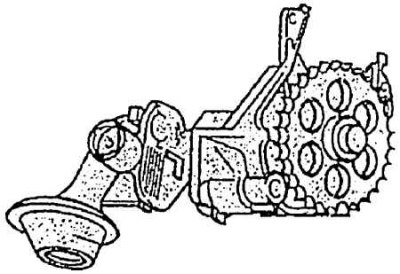
The oil separator is combined with a breather. It is made of plastic and is fixed to the engine block under the intake manifold. The oil separator is connected to the air cleaner tube by a hose. This is how oil vapors get into the intake air. Oil pump (see fig. Oil pump) is a mounting unit connected to the suction screen (located in the volume between the crankcase partitions) hose. The pump is gear-driven and is driven by a roller chain from the crankshaft sprocket. At a pump speed of 1000 1/min. and an engine oil temperature of 80°C (oil 20 SAE) pumped oil quantity – 7.1 l (those. approximately 6 kg) per minute at a pressure of 0.4 to 0.5 MPa.
The oil filter is disposable. It should always be changed at the same time as the engine oil. The filter is full-flow (M = 15–20 Nm).
The engine crankcase is made of aluminum die-casting. The crankcase is attached to the engine block with twenty M6 bolts. A sealing mastic is applied between the bearing surfaces of the block and crankcase. The oil drain plug has an M 14x1.5 thread and a 19 mm hexagon. The plug is sealed with a metal washer. The washer must be replaced each time the plug is installed.
The crankcase has partitions that reduce oil overflow. The oil pump suction screen is installed between them.