



Front section exhaust system components
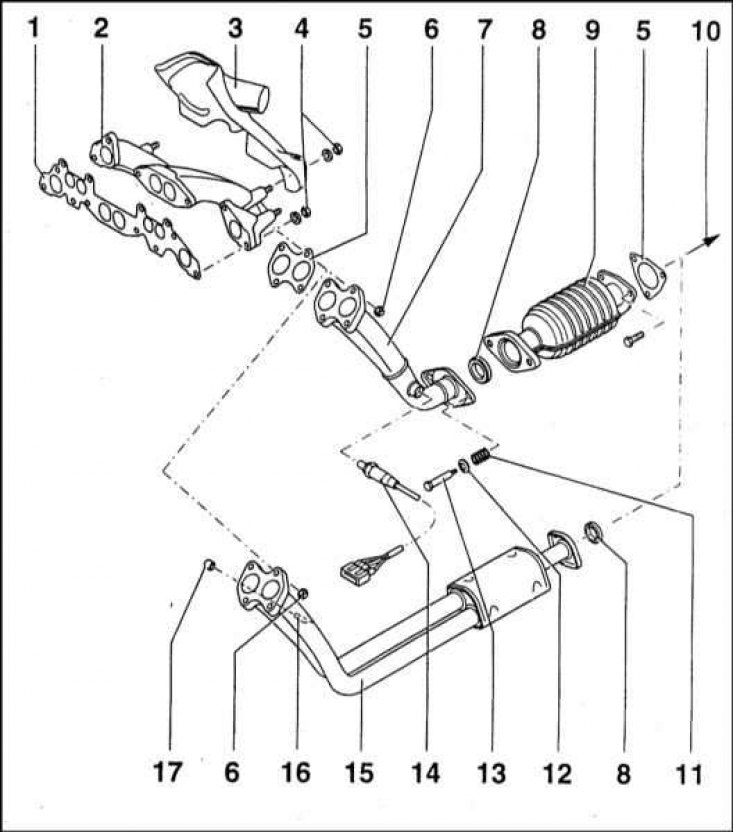
1 - Sealing gasket; 2 - Exhaust manifold; 3 - Intake air heater housing; 4 - Nut; 5 - Sealing gasket; 6 - Nut; 7 - Intake pipe (fuel injection models); 8 - Sealing ring; 9 - Catalytic converter (fuel injection models); 10 - To the middle section of the exhaust system; 11 - Spring; 12 - Spring plate; 13 - Bolt; 14 - λ-probe (fuel injection models); 15 - Intake pipe (carburetor models); 16 - Gas analyzer for determining CO levels; 17 - Cork
Components of the middle and rear sections of the exhaust system
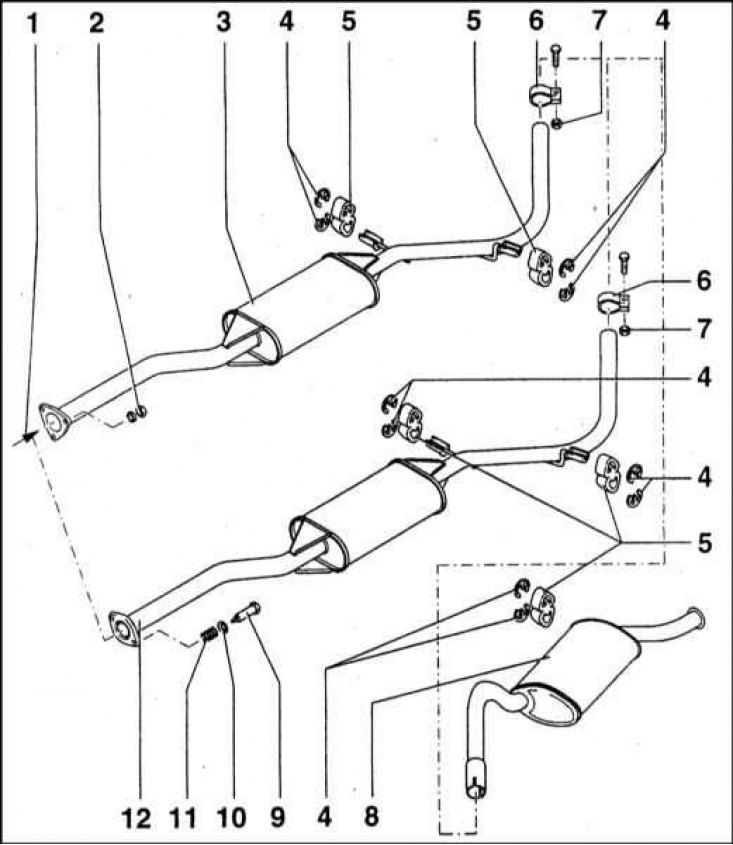
1 - Mounting flange to the inlet pipe/catalytic converter; 2 - Fastening nut; 3 - Middle section with central muffler (fuel injection models); 4 - Lock washer; 5 - Rubber suspension; 6 - Clamp; 7 - Nut; 8 - Rear muffler; 9 - Bolt; 10 - Spring plate; 11 - Spring; 12 - Middle section with central muffler (carburetor models)
General information
The exhaust system of all models consists of a downpipe, a catalytic converter (if such is provided), central section with front muffler and exhaust section with rear muffler.
Note. On diesel models and 1.6L petrol models, the catalytic converter can be mounted in the system's intake pipe; on 1.3L models, it is a separate section. Carburetor models are not equipped with a catalytic converter. The illustrations show the designs of the exhaust systems used on the vehicles in question.
The sections of the system are suspended along its entire length from the bottom of the car using rubber loops that are attached to metal brackets.
Removal
Attention! Start work only after the system has completely cooled down. Particular attention should be paid to the condition of the catalytic converter, whose operating temperature is very high. For complete safety, perform all procedures in protective gloves.
1. Each section of the exhaust system is removed individually.
2. To remove any of the system sections, jack up the rear or front of the vehicle, respectively. Alternatively, you can drive the vehicle onto a ramp or park it over an inspection pit.
Intake pipe (1.3 l models)
1. Remove the λ-probe (see section Removal and installation the λ-probe).
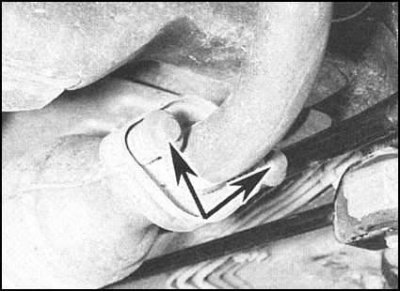
2. Support the catalytic converter. Loosen the two mounting bolts of the flange connecting the inlet pipe to the converter section. Remove the washers and locking springs. After dismantling the flange connection, remove the sealing ring - try to remember its installation direction (flat side first).
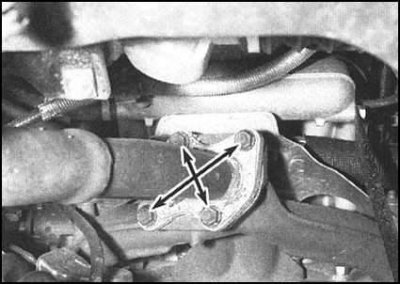
3. Support the receiving section and loosen the four nuts securing it to the exhaust manifold in several steps. Lower the section and remove it from under the car.
Catalytic converter (1.3 l models)
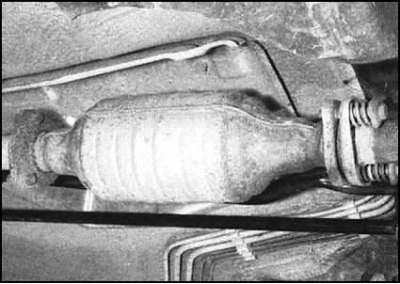
1. Support the catalytic converter. Loosen the three nuts of the rear flange connection of the section, remove the bolts, and remove the washers.
2. Remove the two bolts of the front flange joint, washers and locking springs. After separating the joint, remove the sealing ring. When reassembling, the ring should be installed with the flat side first. Carefully lower the converter unit to the ground (see section Catalytic Converter - General Information and Precautions) and remove it from under the car.
Assembling the downpipe with a catalytic converter (diesel models and petrol models 1.6 l)
1. Support the front muffler or intake section assembly with wooden blocks. On 1.6L petrol models, remove the λ-probe (see section Removal and installation the λ-probe).
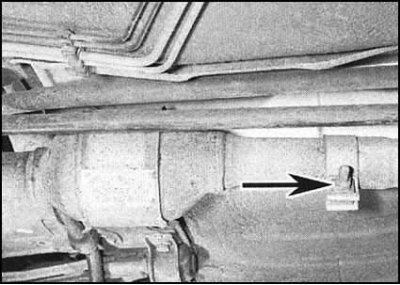
2. Loosen the nut of the clamp bolt securing the downpipe to the center section of the exhaust system. On 1.6L models, remove the washer and spacer sleeve.
3. Loosen the mounting nuts and separate the intake section from the exhaust manifold. Remove the sealing gasket. Separate the intake pipe from the central section of the system (see section Catalytic Converter - General Information and Precautions). And remove it from under the car.
Assembling the center section with the front muffler
1. Support the catalytic converter, then loosen the clamp bolt or flange bolts and separate the front of the center section from the catalytic converter. On 1.3L models, remove the sealing gasket.
2. Loosen the clamp bolt securing the rear of the center section to the exhaust pipe. Remove the suspension loops from the support brackets and remove the center section of the system from under the car. The rubber suspension loops are secured to the brackets using two large clamps, which must first be removed.
Assembling the exhaust section with the rear muffler
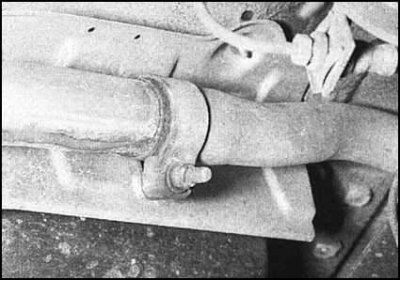
1. Loosen the clamp bolt securing the exhaust section to the central section. Disconnect the sections.
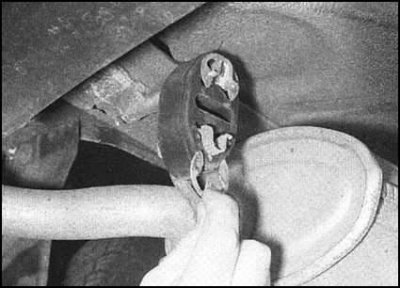
2. Remove the retainers, remove the exhaust section from the support brackets and remove it from under the vehicle.
Heat shield
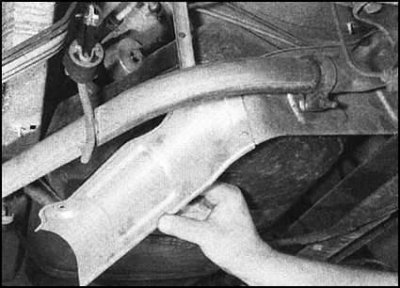
Heat shields are attached to the underbody panels of the vehicle using nuts, bolts and fasteners. Each shield can be removed after dismantling the corresponding section of the exhaust system. If the shield is removed to provide access to the components located underneath, sometimes it is enough to simply release the fastener and slightly tilt the shield shield, which can be done without dismantling sections of the exhaust system.
Installation
Installation is carried out in reverse order. Particular attention should be paid to the following points:
- a) Before joining the system sections, thoroughly clean the mating surfaces from traces of corrosion. It would be correct to replace the tie bolts and nuts of the clamp connections;
- b) Do not forget to check the condition of the rubber loops of the support hangers of the system sections. Defective loops are subject to replacement;
- c) The mating surfaces of the clamp connections should be lubricated with a special sealing paste;
- d) Before final tightening of the fasteners, make sure that the rubber loops of the hangers are seated correctly. Remember that the system should not come into contact with the components of the suspension and the car body;
- e) Tighten the fasteners with the required force evenly in several stages.