



If the windshield wiper leaves uncleared areas, streaks, or gaps on the glass, replace the blades or rubber inserts.
In winter, always check before driving that the wipers are not frozen to the glass. If this does happen, carefully pry the rubber inserts away from the glass.
Caution! Clean dirty rubber brush inserts with a damp cloth. For heavy soiling, use glass cleaner.
Important! You can replace the rubber wiper blade inserts yourself according to the manufacturer's instructions included with the rubber insert kit. It is recommended to replace it twice a year.
Removal and installation windshield wiper blades
1. Move the arms with the brushes away from the glass.
2. Rotate the brush 90° relative to the lever.
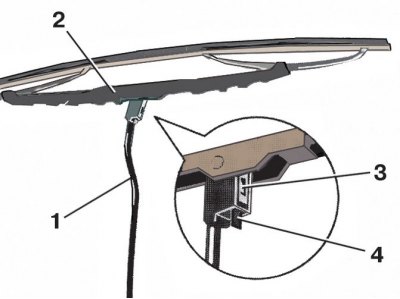
3. Press latch 4 so that locking protrusion 3 on it comes out of the hole in the lever. Slide brush 2 down lever 1 so that it comes out of the hook on the lever and remove it.
4. To install the brush, insert the lever into its hole so that the slot on the latch is directed towards the lever, put the brush on the hook of the lever and move it up the lever until it stops.
Removal and installation the rear window wiper blade
1. Move the arm with the brush away from the glass.
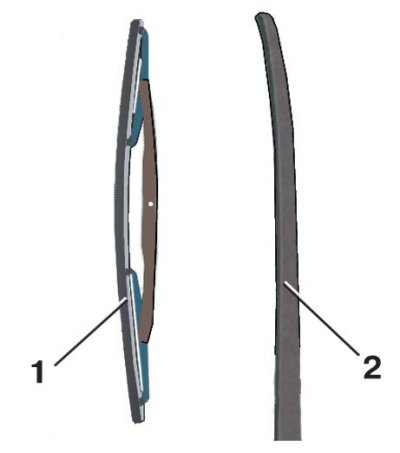
2. Holding lever 2 at the top with your hand, remove brush 1 from it. The brush is attached to lever 2 in its middle part using a clamp, so grab the brush as close to the middle as possible.
3. Install the brush in reverse order, securely fixing it in the lever.
Washers
Location of the washer reservoir
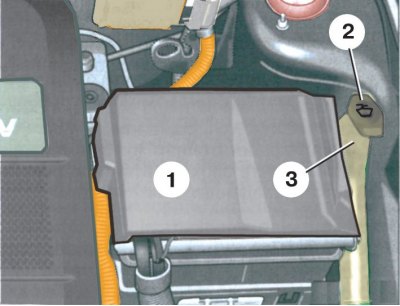
1 – battery; 2 – washer reservoir cap; 3 – washer reservoir
[Article posted on the website: skodabook]
The washer reservoir 3 is located in the engine compartment on the left side.
The capacity of the tank is about 2 liters, for models with headlight washers – about 5.5 liters.
In summer, fill the tank with clean water; in winter, fill it with antifreeze. It is recommended to use antifreeze liquids produced by well-known companies.
Warning: Do not add engine coolant to the windshield washer fluid reservoir, as it is toxic.
To fill the washer reservoir, unscrew its cap. Check the grid. If it is dirty, wash it and put it back in place. Only after this pour the liquid into the tank.
Always make sure that the level in the washer reservoir is sufficient; do not wait until the low fluid level sensor in the reservoir is triggered. Do not turn on the washer if the fluid level has dropped below the pump intake hole inside the reservoir - the washer pump electric motor may fail.
Warning: Take precautions when handling antifreeze.