Cylinder head assembly (assembly scan)

1 – camshaft bearing cover bolt (M=10Nm); 2 – camshaft drive sprocket; 3 – camshaft drive chain; 4 – regulator of the relative position of the camshafts; 5 – rubber-metal seal; 6 – cylinder head; 7 – exhaust valve; 8 – inlet valve; 9 – camshaft sealing washers; 10 – Hall sensor diaphragm; 11 – gasket; 12 – bolt; 13 – Hall sensor housing; 14 – bolt; 15 – timing gear mounting bolt; 16 – Timing mechanism rod; 17 – sealing washer; 18 – oil scraper cap – gufero; 19 – valve spring; 20 – valve plate; 21 – valve crackers; 22 – hydraulic valve tappet; 23 – Intake camshaft bearing cap; 24 – Double camshaft bearing cap; 25 – exhaust camshaft bearing cover; 26 – exhaust camshaft
Installing the cylinder head cover and seal assembly
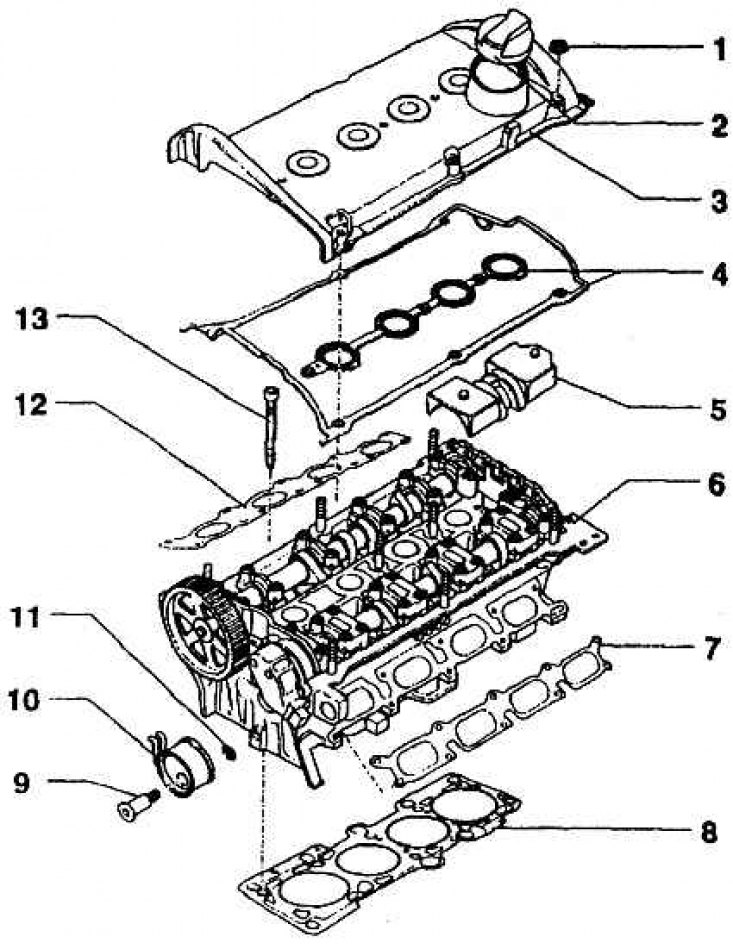
1 – head cover fastening nut (M=10 Nm); 2 – filler cap; 3 – cylinder head cover; 4 – head cover seal; 5 – oil diaphragm; 6 – cylinder head assembly; 7 – suction pipe seal; 8 – cylinder head seal; 9 – tension roller bolt (M = 45 Nm); 10 – tension roller; 11 – gasket; 12 – exhaust pipe seal; 13 – cylinder head bolt
The arrangement of valves in the combustion chamber of the cylinder head
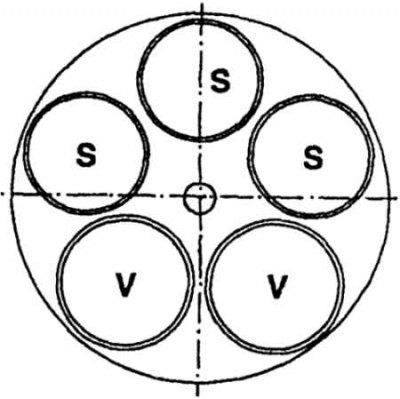
S – intake;
V – graduation
Arrangement of five valves
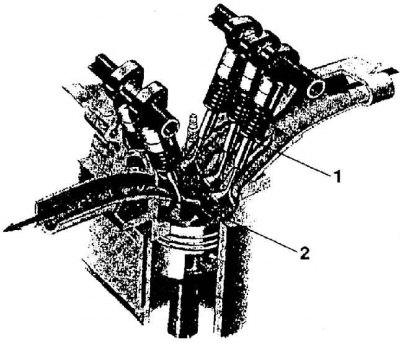
1 – intake valves;
2 – exhaust valves
Cylinder head cross-section (1.8-92 kW engine)
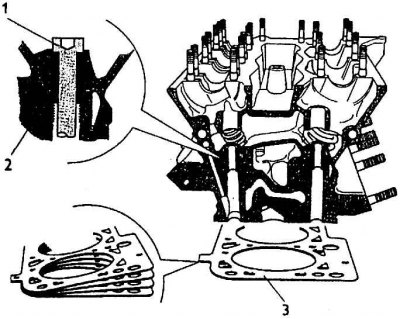
Installing threaded inserts (1) for bolts (2) securing the cylinder head to the engine crankcase.
Detail of the multi-piece metal seal (3) under the cylinder head.
The order of unscrewing and tightening the cylinder head bolts
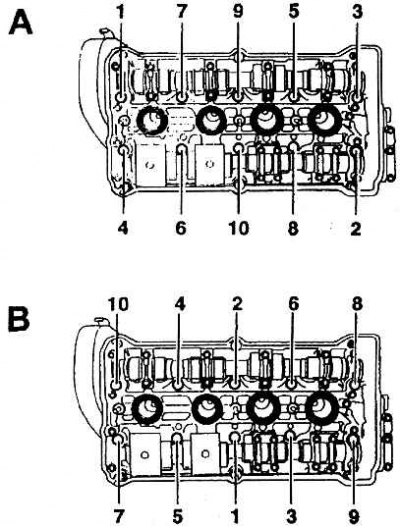
A – the order of unscrewing the cylinder head bolts;
B – the order of tightening the cylinder head bolts.
Timing belt drive for the timing gears and coolant pump
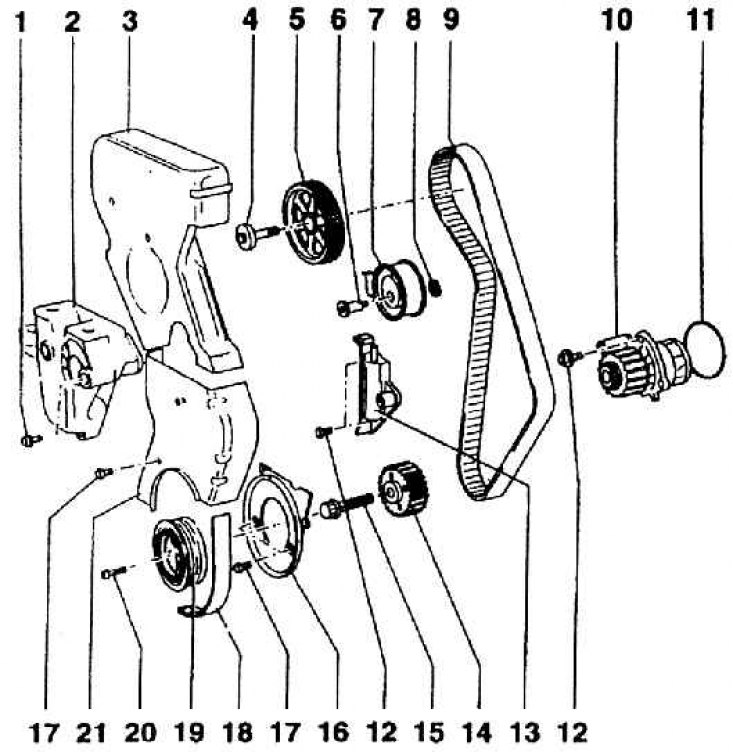
1 – front engine casing mounting bolt (M = 45m); 2 – front engine casing; 3 – toothed belt cover – outer upper part; 4 – camshaft belt drive pulley bolt (M=100Nm); 5 – camshaft drive belt pulley; 6 – tension roller bolt (M = 45 Nm); 7 – belt tension roller; 8 – gasket; 9 – toothed belt; 10 – coolant pump; 11 – pump sealing washer; 12 – pump mounting bolt (M = 15 Nm); 13 – tension roller housing; 14 – timing belt pulley on the crankshaft; 15 – belt drive pulley bolt (M = 90 Nm ±90); 16 – lower inner part of the timing belt transmission casing; 17 – casing bolt (M = 10 Nm); 18 – alternator belt; 19 – outer multi-groove belt pulley; 20 – pulley bolt (M = 20 Nm); 21 – toothed belt cover, outer lower part
Alternator Belt Route
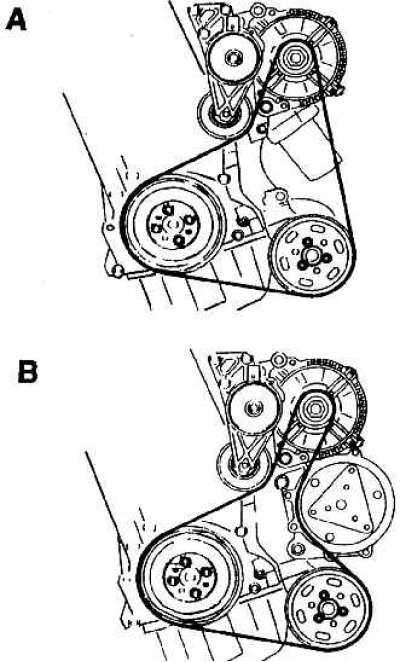
A - in cars without air conditioning;
B - in cars with air conditioning
Intake camshaft timing chain tensioner
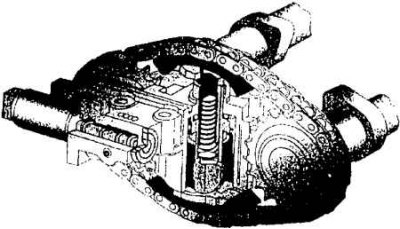
The tensioner allows you to change the rotation of the camshaft and thus the changeability of the intake valves.
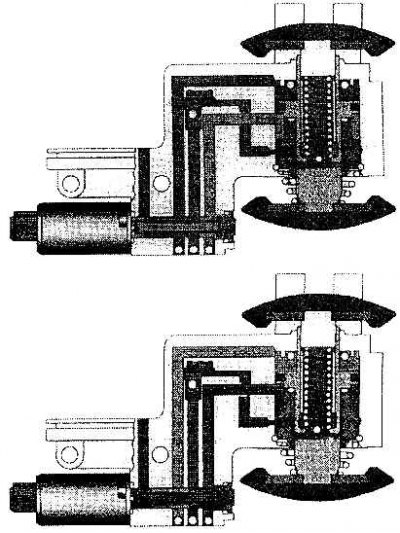
Operating principle of hydraulic chain tensioner
The cylinder head itself is made from a heat-treatable casting of aluminum alloy (Al, Si, Mg) (Fig. Cylinder head assembly (assembly scan), fig. Installing the cylinder head cover and seal assembly). The combustion chambers are not treated. Each combustion chamber contains two exhaust and three intake valves (see fig. Layout of valves in the combustion chamber of the cylinder head, fig. Layout of five valves). The diameter of the exhaust valves is 30 mm, and that of the intake valves is 27 mm. The stroke of the intake valve is 8.4 mm, and the stroke of the exhaust valve is 10.3 mm. The thread for the M 14 spark plug is located in the center of the combustion chamber at an angle of 3. The design of the combustion chamber allows for compact combustion of the mixture.
The cylinder head is centered in relation to the engine block with two pins and is attached to it with ten bolts. Threaded inserts are screwed into the cylinder head for the bolts. The unevenness of the seating surfaces of the head and block does not exceed 0.1 mm. The head seal consists of four thin profiled sheets (see Fig. Cylinder head cross-section (1.8–92 kW engine)).
The order of loosening and tightening the head bolts is shown in Fig. The order of loosening and tightening the cylinder head bolts.
Three inlet valve channels are combined into an oval-section inlet. The design of the channels allows for the so-called "drum" flow of the mixture in the cylinder. The channel also allows for the coordinates of the dual-beam injectors to be set, which direct fuel injection to the three inlet valves.
The outlet channels from both valves are reduced to a round outlet. The coolant flow in the cylinder head is directed transversely. Approximately two-thirds of the amount of liquid exits the cylinder block on the side of the exhaust ports and near the spark plug bosses. The outlet of the liquid flow from each cylinder is located behind the spark plug well to the longitudinally oriented central cavity. The remaining third of the amount of coolant flows from the side of the inlet ports above the combustion chambers to the collecting cavity. The location of the spaces for the flow of coolant is the same for all cylinders and the amount of liquid is also the same for individual cylinders, which is determined by the size of the holes in the cylinder head seal. The coolant leaves the cylinder head on the front side of the head through a plastic neck; via a pipeline located under the suction pipeline, it is fed into the radiator. For completeness, it should be added that from the radiator the liquid flows through the thermostat housing into the pump and from there into the engine block-crankcase (the thermostat sleeve is inserted into the coolant pump housing). The flow through the heating element of the heater or air conditioner is constant.
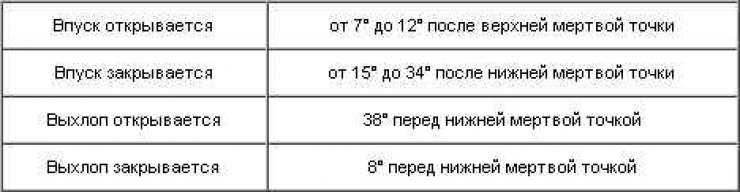
Both camshafts are placed in the cylinder head in bearings without bushings. The camshaft of the intake valves uses a double bearing cover. The drive of the camshafts is designed in such a way that the timing gear, driven by a toothed belt from the crankshaft gear, is mounted on the camshaft that controls the exhaust valves. In order to maintain constant belt tension regardless of thermal expansion of the head and engine block, a pneumatic tension roller is installed (see fig. Timing mechanism gear and coolant pump drive by toothed belt, fig. Generator belt route). The camshaft for the intake valves is driven by a chain from the camshaft for the exhaust valves. The chain is constantly tensioned by a tensioner, which has the function of setting the rotation of the intake valves using the chain of the driven camshaft - this is about changing the timing of the intake valves (see fig. Intake camshaft drive chain tensioner, fig. Operating principle of the hydraulic chain tensioner). To save weight, the camshafts are hollow and the valve stems are only 6mm in diameter.
The valves have single springs. The movement and force transfer between the shaft cams and the valves is carried out by hydraulic tappets, which automatically set the operating valve clearance (see Fig. Hydraulic tappet diagram). The seating surfaces of the tappets are nitrocarburized.