


Front suspension and steering
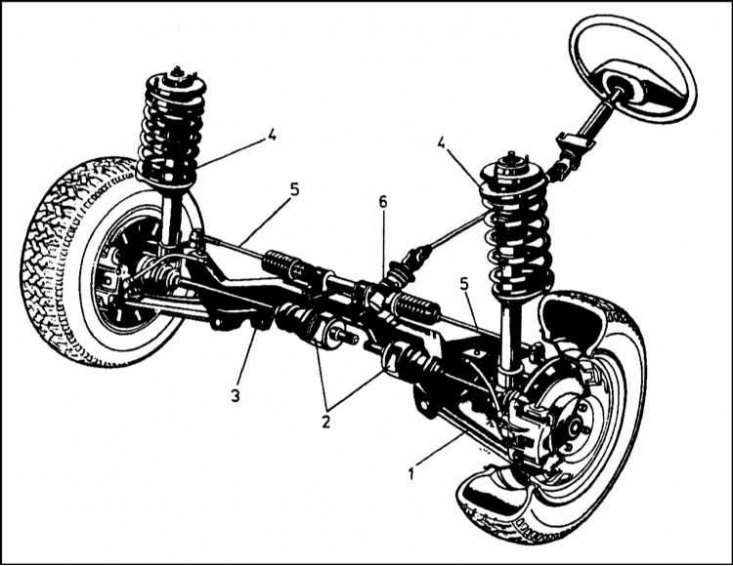
1 - Lower arm; 2 - Drive shaft assemblies; 3 - Cross beam; 4 - MacPherson struts; 5 - Tie rods; 6 - Rack and pinion
Rear suspension
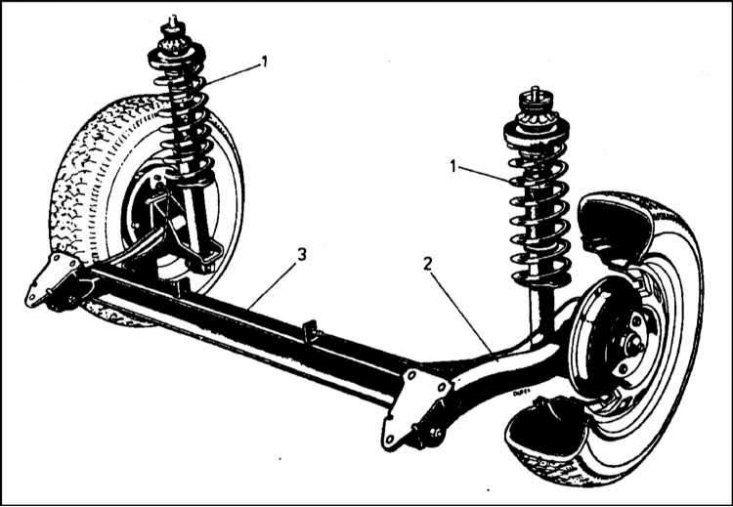
1 - Suspension strut with spring; 2 - Suspension arm; 3 - Cross beam
All models use MacPherson strut independent front suspension, equipped with coil springs and telescopic shock absorbers. Racks are attached to the transverse lower suspension arms. The inner end of the lower arm is equipped with rubber-metal bushings, the outer end - with a ball joint. A disc and a brake caliper are hung on the hub assemblies of the front wheels. The assemblies themselves are bolted to the MacPherson struts and connected to the lower suspension arms by means of ball joints. Most models are equipped with a front anti-roll bar. The stabilizer bar is attached to the subframe by means of rubber mounts and is connected to the lower suspension arms by two struts.
The main element of the rear suspension is a continuous axle. At the front, the axle assembly is attached to the vehicle by means of rubber-metal bushings. At the rear there are two trailing arms on which the suspension struts are mounted. Opposite ends of the rack are attached to the car body. The axle assembly is equipped with an anti-roll bar, the bar of which is attached to both trailing arms.
The steering column is connected to the intermediate shaft, equipped with cardan joints at both ends. The lower hinge is attached to the rack and pinion drive gear by means of a coupling bolt.
The rack and pinion steering mechanism is mounted on the front subframe and is connected to the steering levers protruding backward from the hub assemblies with two steering rods equipped with ball tips. The tips have a threaded fit, which allows you to adjust the length of the rods in order to adjust the angles of the vehicle's front wheels. Power steering models have a steering pump driven by a belt drive from the crankshaft pulley.