



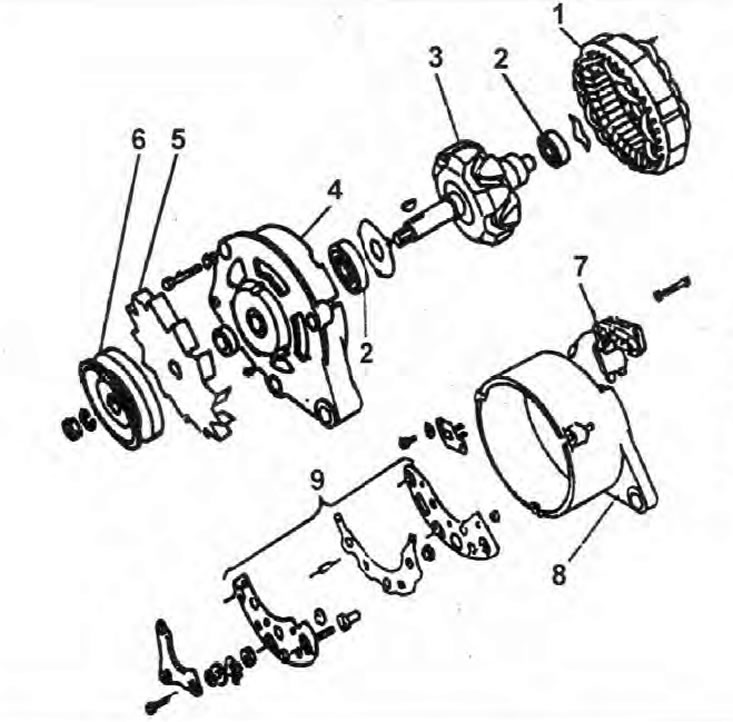
Fig. 12.1. Generator
1. Stator frill; 2. Bearing; 3. Assembling the rotor; 4. Body - front part; 5. Generator fan; 6. Pulley; 7. Assembling the voltage regulator and brush holder; 8. Body - rear part; 9. Assembly of the rectifier.
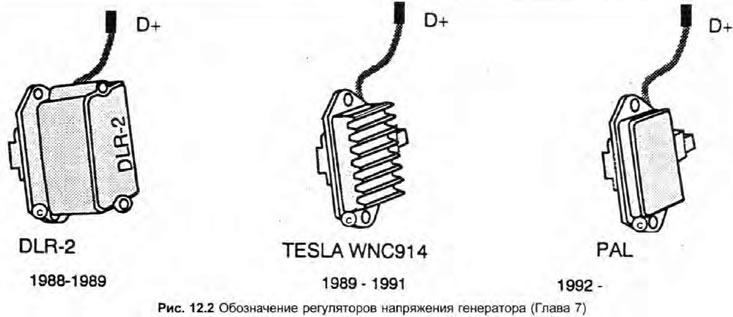
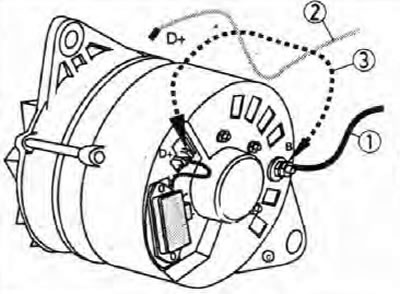
Fig. 12.3. Changing the polarity of the generator rotor connection
1. Wire B+ of the main harness; 2. Wire D+ of the main harness; 3. Connect for one second.
(Information presented on the website: skodabook)
Note: Most alternator problems are caused by the voltage regulator or brushes. If the problem persists after replacing either of these assemblies, consult a professional; in most cases, the best solution is to replace the generator.
1. Although it is possible to remove the voltage regulator and brush holder assembly without removing the alternator from the vehicle, we still recommend removing the alternator (Chapter 6).
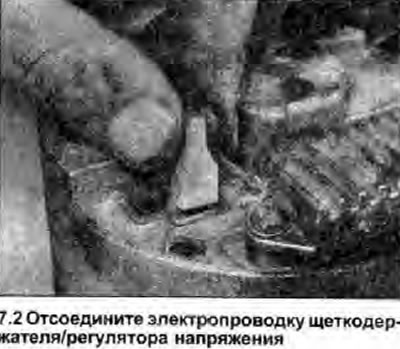
2. Disconnect the brush holder/voltage regulator wiring (photo).
3. Unscrew the two screws and remove the voltage regulator and brush holder assembly from the generator (photo).
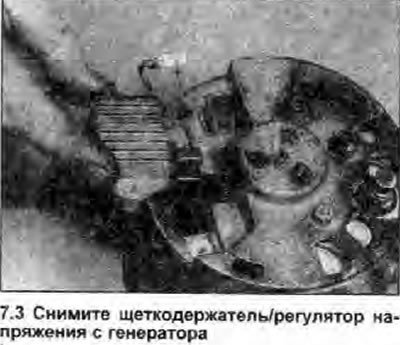
4. In most cases, the brushes have wear limit marks in the form of grooves engraved on them; if these marks are no longer visible, the brushes are considered worn. If there are no marks, measure the height of the brush protrusion from the brush holder. No values are defined by the manufacturer, but roughly the height should be at least 5 mm. If the brush is worn to the limit specified above, replace the brush holder and voltage regulator assembly.
5. If the brushes are still serviceable, clean them with a cloth dampened with solvent. Make sure that the brushes are evenly spring loaded and pressed securely against the alternator rings. If there is any doubt about the condition of the brushes and springs, compare them with new components.
6. Inspect the rings through the window of the brush holder in the generator. Clean the rings if they are dirty. If the rings are damaged or badly burnt, the generator must be replaced or a specialist must be contacted for restoration.
7. Install in the reverse order of removal. But note that if the voltage regulator has been replaced, it may be necessary to change the polarity of the rotor connection, as described in the following points.
Changing the polarity of the rotor connection after replacing the voltage regulator
8. Three types of voltage regulators can be used on generators. Those installed on earlier models (before 1991) are labeled "DLR-2" or "Tesla". Installed on later models (since 1992) are marked " RAE " (Figure 12.2).
9. The "DLR-2" and "Tesla" regulators are interchangeable without problems. If a "PAL" regulator is installed on an early type generator, or vice versa, it is necessary to change the polarity of the generator rotor connection as follows.
10. With the assembled alternator mounted to the engine, connect the alternator main wire (B+) and connect the battery. Connect the regulator D+ wire to the alternator, but do not connect the wiring harness D+ wire yet.
11. Using a jumper wire, connect the B+ and D+ terminals on the alternator for one second (Fig. 12.3). Be careful not to touch the bare wire end to any other metal. Remove the jumper wire.
12. Connect the old D+ wire to the generator.
13. Start the engine and make sure the generator is producing the correct voltage.
14. If the polarity reversal process is not performed, no harm will occur, but the generator will not charge the battery.