



Contents: Jacking up ⬇ Towing ⬇
Jacking up
The jack supplied with the vehicle is intended for wheel changing procedures only. For any other repair or maintenance work, the vehicle must be lifted using a hydraulic (or cart) jack and must be installed on special supports placed under the load-bearing points of the bottom. If there is no need to remove the wheels, the car can be driven into an inspection pit or overpass.
To jack up the car, park it on a flat horizontal surface, preferably with a hard surface. If there is the slightest slope, take precautions against rolling back. Try not to go far from the jacked up car, especially if there are children nearby.
Before jacking up the front of the car, remember to firmly set the parking brake. When jacking up the rear, support the front wheels with wedges and engage first gear.
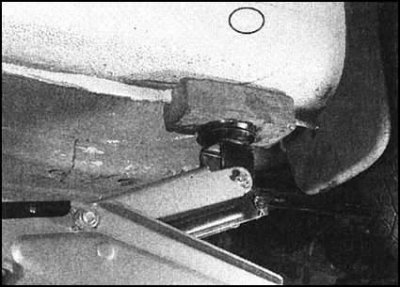
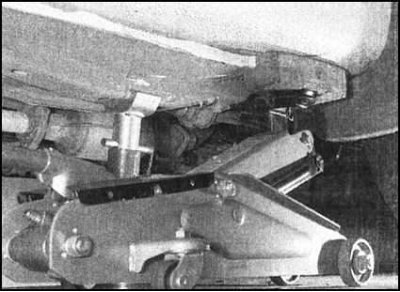
The jack should be inserted into specially designed reinforced points in the front or rear part of the thresholds (the points are marked with special signs applied to the panel of each threshold). It is better to place a wooden block with a special groove between the jack head and the threshold panel to distribute the load. Put the block with the groove on the edge of the threshold panel and support it from below with the jack head.
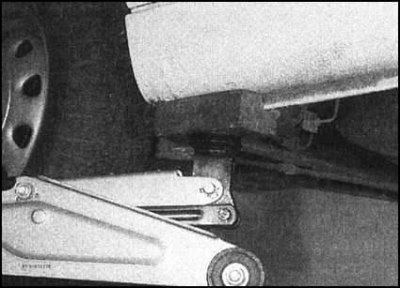
When carrying out more serious repair work than changing a wheel, special supports are usually installed under the car in addition to the jack. The supports can be installed under the jacking points of the thresholds themselves, with the same block with a groove laid, or under any of the load-bearing elements of the bottom as close as possible to the jacking points of the thresholds.
Caution! Never place the jack under other points of the sills, oil pan, floor panels or directly under steering or suspension components!
Do not perform any repair work under a vehicle that is supported in a raised position using only a jack! Be sure to use supports!
Towing
To move a broken down vehicle over long distances, you should contact a towing service. If the destination is not too far away, the vehicle can be towed using any other vehicle, taking the necessary precautions:
- When towing a damaged vehicle, use only a towing strap designed specifically for this purpose, which can be purchased inexpensively at almost any auto accessory store. A warning sign with the appropriate content must be installed on the rear window of the towed vehicle.
- Do not forget to turn the ignition key of the towed vehicle to the ON position, otherwise the steering column will inevitably lock. In addition, when the ignition is on, the turn signals and brake lights are also activated.
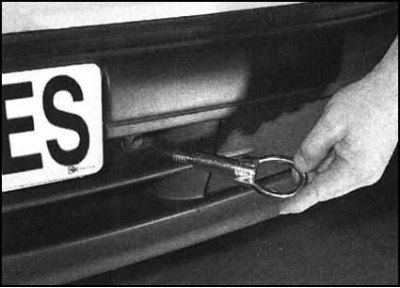
- The rear towing eye on Skoda Felicia cars is covered with a decorative cover and is located under the bumper cover. The removable front eye is stored together with the tools in the spare wheel well, is equipped with a left-hand thread and is screwed into a special hole near the front license plate.
 |
 |
- Before you begin towing, remember to release the parking brake and shift the transmission into neutral.
- Remember that when the engine is off, the car's braking efficiency is significantly reduced due to the brake booster ceasing to function. In this case, you should press the foot brake pedal with a little more force than usual.
- On models equipped with power steering, more force will have to be applied to the steering wheel when maneuvering.
- The driver of the towed vehicle must try to keep the towing strap taut at all times to avoid jerking or the wheels running into the strap.
- Before starting to move, drivers of both vehicles (towing and towed) the route should be agreed upon among themselves.
- Movement should be carried out only at moderate speeds and along the shortest route. Avoid sudden braking, acceleration and maneuvering.