



Warning! Remember that dust generated during wear of friction linings may contain asbestos, which is extremely harmful to human health! Never blow off dust with compressed air. Do not use petroleum-based solvents to clean clutch components - use only a special brake cleaner or pure methyl alcohol. Used cleaning rags should be placed in a hermetically sealed container.
Although some new friction materials are asbestos-free, clutch service procedures should assume that they contain asbestos.
Removal
1. If the power unit is not removed from the vehicle and not disassembled, access to the clutch assembly can be provided by dismantling the gearbox.
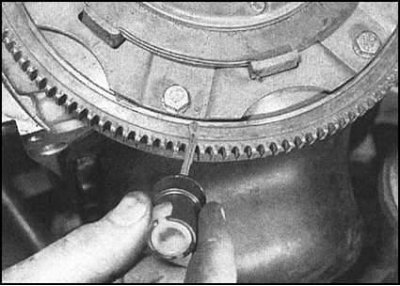
2. Before disassembling the clutch, mark the mounting position of the clutch basket on the flywheel with chalk or a marker.
3. Moving diagonally, in several steps (half a turn per approach) evenly loosen the bolts that secure the basket to the flywheel until you can unscrew them manually.
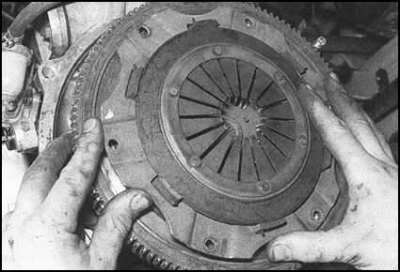
4. Using a pry bar, remove the basket assembly from the guide pins,...
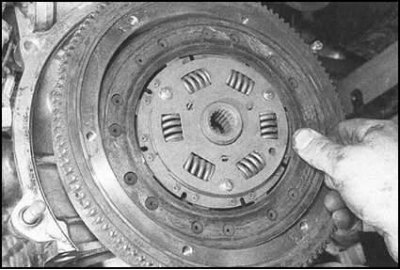
...then remove the friction disc. Try to remember the correct installation position of the friction disc.
Checking the status
Note: Due to the labor-intensive nature of the assembly removal and installation procedures, it is common practice to replace the friction disc, basket, and release bearing as a set, even if only one component is worn. Strictly speaking, it is reasonable to replace the clutch assembly as a preventative measure every time the gearbox/engine is removed.
1. Remove the clutch assembly.
2. Before cleaning components, read the warning at the beginning of this Section. Working in a well-ventilated area, or preferably outdoors, thoroughly clean components by wiping them with a clean cloth dampened with a special brake component cleaner or methylated spirits.
[Data Copied from the portal: SkodaBook.ru]
3. Assess the degree of wear of the friction linings, check them for signs of mechanical damage or traces of oiling. If cracks, traces of overheating, deep scratches, oil stains or other defects are detected, the friction disc must be replaced as an assembly. Car manufacturers (skoda company) does not put forward any limits on the thickness of the friction linings of the clutch disc. It is generally accepted that the rivet heads should be recessed below the surface of the linings by at least 3 mm.
4. If the friction linings are in working order, assess the degree of wear of the disc hub splines, check the condition and tightness of the torsion springs and rivets. If defects are detected, the disc must be replaced.
5. If the friction linings are contaminated with oil, check the condition of the left crankshaft oil seal. In addition, the source of oil leaks may be the joint of the oil pan with the engine block, as well as the primary shaft of the gearbox. Replace defective sealing components before installing a new friction disc.
6. Check the basket assembly for signs of mechanical damage. Shake the pressure plate, checking the tightness of the rivets. Make sure there are no signs of overheating of the shells that attach the pressure plate to the basket. If damage, signs of wear or weakening of the developed force of the diaphragm spring are detected, replace the basket assembly.
7. Check the condition of the contact surfaces of the flywheel and friction disc - they must be absolutely flat, clean and free of cavities, deep scratches and burrs. Minor defects can be eliminated by treating the surface with fine-grained sandpaper. In more serious cases, replace the defective component.
8. Check the freedom of rotation of the release bearing. Assess the condition of its working surface. If deep scratches, cavities, scoring and other damage are detected, replace the bearing.
Installation
1. When assembling, make sure that the contact surfaces of the friction disc and flywheel are in good condition. Carefully remove any traces of preservative from new components.
2. Lubricate the splines of the clutch friction disc with a thin layer of high-temperature grease such as Kluber Microlube GL202, GL261 or GL262, or Mobil lithium 932 or 933. Try not to let the grease get on the friction linings. Remove excess grease.
3. Install the friction disc with the spring side of the hub away from the flywheel. Some discs have special markings that allow you to determine which side of the disc should be installed toward the flywheel.
4. Install the clutch basket assembly. When installing the old basket, make sure that the mounting marks made during dismantling are aligned. Screw in the mounting bolts and tighten them, but only by hand for now, so that there is still room to adjust the position of the assembly.
5. Now it is necessary to center the friction disc so that when installing the gearbox, the splines of the primary shaft journal fall into the center of the disc hub.
6. To center, insert a screwdriver or other suitable rod into the hole in the end of the crankshaft. Now the friction disc can be centered in relation to the shaft. Alternatively, you can use a special tool, which allows you to significantly reduce the time associated with fitting. The tool can be made at home from a suitable metal rod or wooden block that fits tightly into the hole in the end of the crankshaft. At the point where the rod is inserted into the hub, tape should be wound around it, ensuring a tight fit in the hub hole.
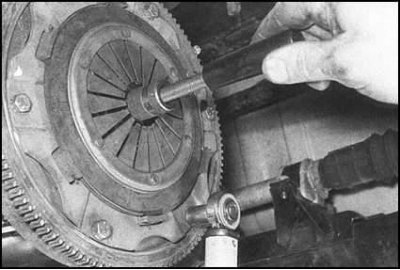
7. Once you have finished centering the friction disc, tighten the basket mounting bolts to the required force - work in a diagonal order, tightening evenly, in several steps.
8. Reinstall the gearbox assembly (see section Removal and installation the gearbox).