



Contents: Removal ⬇ Installation ⬇
Removal
Note: New mounting bolt nuts and new drive shaft inner joint retaining rings will be required for reassembly.
1. Support the rear wheels of the vehicle. Set the parking brake, then jack up the front of the vehicle and place it on stands. Remove both front wheels.
2. If equipped, unscrew the mounting screws and remove the crankcase guard.
3. Drain the transmission oil. After replacing the sealing washer, screw the drain plug back in and tighten it to the required torque.
4. On 1.3L models, remove the Hall sensor from the transmission. On models with central fuel injection, also remove the air cleaner housing from the throttle body.
5. On all models, remove the starter.
6. Loosen the union nut with the knurled screw and disconnect the drive cable from the speedometer drive mechanism at the rear of the manual transmission (see section Removal and installation the speedometer drive mechanism).
7. Loosen the clutch cable adjusting nut to the maximum. Disconnect the cable from the clutch release lever and release it from the support bracket. Move the cable away from the gearbox. Disconnect the spring and remove it from the upper end of the clutch release fork pivot shaft.
8. Remove the clamp installed on the transmission side of the gear selector shaft to provide access to the retaining roll pin.
Note. It would be better to replace the standard factory clamp with a more practical screw or worm type during assembly. Using a punch and a hammer, knock out the pin and disconnect the rod from the gearbox shift fork axle. Throw away the old pin - it must be replaced during assembly.
9. Remove the bolt securing the shift rod to the gearbox. Disconnect the rod and remove the washers.
10. Disconnect the wiring from the reverse light switch sensor (one or two connectors).
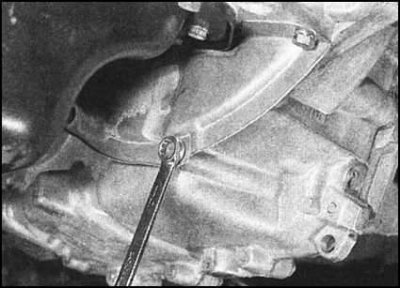
11. Remove the mounting bolts...
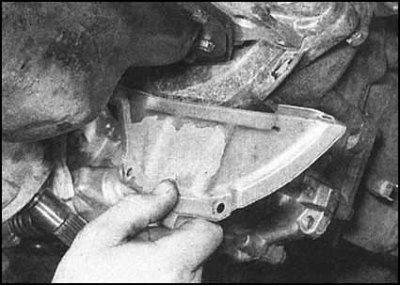
... and remove the lower flywheel cover plate from the base of the clutch dome.
12. Release the inner end of the left drive shaft from the differential. Without loosening the shaft mounting nut on the hub, tie it with wire to the suspension elements.
13. With the shaft free, insert a length of metal rod or pipe approximately 26 mm in diameter into the shaft seat and push it through the differential side gear hole, leaving the end protruding from the housing. If necessary, secure the rod to the outside of the gearbox housing with tape.
Attention! If you do not take care to fix one of the side gears in the event of simultaneous dismantling of both drive shafts, both gears may fall inside the differential box and to extract them you will have to make a manual transmission and deliver it to a car service workshop.
14. Having securely fixed the left side gear of the differential, disconnect the right drive shaft from the box. Tie the shaft with wire to the suspension elements.
15. Support the engine with a jack (to distribute the load between the jack head and the oil pan, place a wooden block). Alternatively, the power unit can be suspended from above using a winch or beam (first, you will have to install lifting eyes on the engine). Also jack up the gearbox (don't forget about the block).
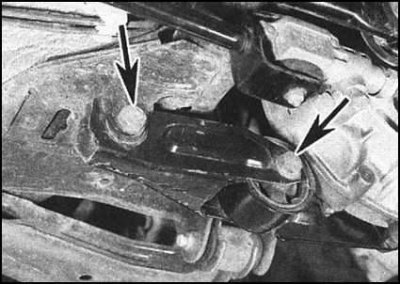
16. Loosen the nuts and bolts securing the rear support cheek of the power unit to the gearbox housing and the car body. Remove the support cheek. The nuts can be thrown away - they must be replaced during assembly.
17. Loosen the nut of the front bolt of the left support mounting plate, then unscrew both bolts and remove the plate. The nut must be replaced without fail.
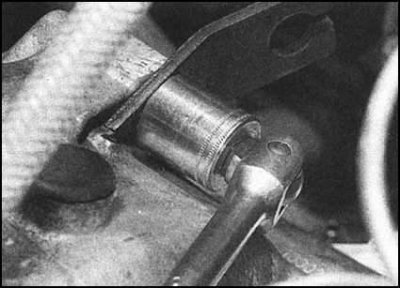
18. Jack up the weight of the gearbox, then loosen the remaining nuts and bolts that secure the gearbox housing to the engine. Try to remember the installation position of each of the fasteners, as well as the brackets and clamps they secure. Make sure one last time that nothing remains connected to the gearbox and does not interfere with its removal.
19. Lower the gearbox slightly and begin to move it to the left, removing it from the guide pins. Having separated the gearbox from the engine, lower the jack and remove the assembly from under the car. Remove the loose guide pins and put them in a safe place.
Installation
1. Lightly lubricate the contact surfaces of the release bearing, clutch release fork and bearing guide sleeve with high-temperature grease such as Kluber Microlube GL202, GL261 or GL262, or Mobil lithium 932 or 933. Try not to let grease get on the friction linings. Remove excess grease. Check the proper functioning of the clutch release mechanism. Lightly lubricate the splines of the input shaft journal as well.
2. Make sure the guide pins are seated correctly in their sockets. Raise the gearbox to its normal position and press it against the engine. Screw in the mounting bolts/nuts - do not forget to install the mounting brackets and brackets secured with the same fasteners. Lightly tighten the fasteners.
3. Lift the manual transmission assembly until the components of the left support are aligned.
4. Install the left support plate, screw in the mounting bolts and tighten them to the required torque. Screw a new mounting nut onto the front bolt and tighten it to the required torque.
5. Install the rear support cheek of the power unit, insert the bolts and screw on new nuts. Remove the jacks from under the box and engine. Rock the power unit assembly to finally settle it, then tighten the nuts of the rear support bolts with the required force.
6. Further assembly is carried out in the reverse order of dismantling. Please note the following points:
- a) Tighten all fasteners to the required torque;
- b) Do not forget to replace the drive shaft seals (see section Replacing oil seals).First install the right shaft, then the left one;
- c) Use a new cylindrical pin to secure the gear selector shaft to the shift fork shaft. The pin should be secured with a screw or worm type clamp;
- d) Before installing the shift rod mounting bolt to the gearbox, thoroughly clean its threads, then lubricate it with fresh locking sealant such as Loctite 270 or Three bond 1305. Lubricate all other bolts with the same sealant;
- e) After connecting the clutch cable, adjust it (see section Removal, installation and adjusting the clutch cable);
- f) Finally, fill the gearbox with the required amount of transmission oil of the required grade and check its level.