



Clutch
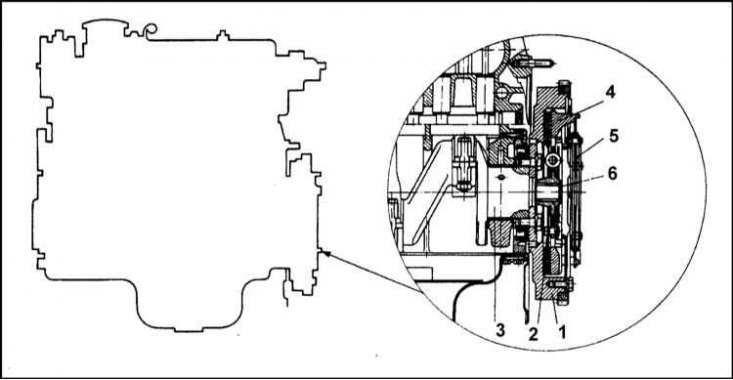
1 - Flywheel; 2 - Clutch disc (friction); 3 - Crankshaft; 4 - Pressure plate; 5 - Diaphragm spring; 6 - Friction disc hub
The clutch consists of a friction disc, commonly referred to as a clutch disc, a basket assembly with a pressure plate, and a release bearing with a clutch release mechanism. All of these components are housed in a large housing made of aluminum alloy, commonly referred to as a clutch dome. The dome is sandwiched between the engine and the gearbox. The clutch release mechanism is operated by a cable drive.
The friction disk is installed between the engine flywheel and the clutch release disk. The disk hub is equipped with splines that allow it to move along the splines of the gearbox primary shaft journal.
The petrol models of cars under consideration are equipped with a clutch manufactured by Fichtel & Sachs or Trnava.
The basket assembly is bolted directly to the flywheel. When the engine is running, rotation is transmitted from the crankshaft to the friction disk, which is firmly clamped between the flywheel and the pressure plate of the basket when the clutch pedal is released, and then to the primary shaft of the manual transmission.
In order to break the connection between the gearbox and the engine, it is necessary to loosen the diaphragm spring of the pressure plate, thereby releasing the clutch disc. When the clutch pedal is depressed, the drive cable, acting on the actuator lever located in the upper part of the clutch release fork, unfolds the latter. Turning, the clutch release fork presses the release bearing to the petals of the diaphragm spring of the pressure plate. Deforming, the spring weakens the clamping force, which leads to the release of the friction disc. The correct functioning of the clutch is guaranteed by the regularity of its adjustments.
The friction disc linings are made of asbestos-free material. The disc should be installed with the side with the more protruding hub outward (towards the casing). The clutch casing (basket) is attached to the flywheel with six M8x16 bolts, which should be replaced each time the assembly is removed. Some models are equipped with a TAZ clutch, which has similar dimensions and differs only in a weaker force developed by the diaphragm spring. Clutch linings of all types used are interchangeable.
Diesel models are equipped with an F clutch&S slightly larger diameter (see Specifications). The assembly design is similar to that described above. The friction linings naturally have a larger contact area. The pressure spring is also reinforced.
The pressure plate is equipped with additional springs to dampen torsional vibrations (as in TAZ assemblies). The flywheel also has a larger diameter and is equipped with mounting pins located at an angle of 120° to each other.
The clutch of diesel models and 1.6L petrol models is equipped with a longer release lever (see Specifications).
Article posted on the website: SKODABOOK