



Contents: Major repairs - general information ⬇ Disassembly and assembly of the…⬇ Removal the gearbox housing cover,…⬇ Removal and installation of the 5th…⬇ Dismantling and installation of the…⬇ Disassembly and assembly of manual…⬇ Adjusting clearances in the primary…⬇ Disassembling and assembling the…⬇ Disassembly and assembly of the gear…⬇ Adjusting the three-arm gearshift…⬇
Gearshift Drive Components
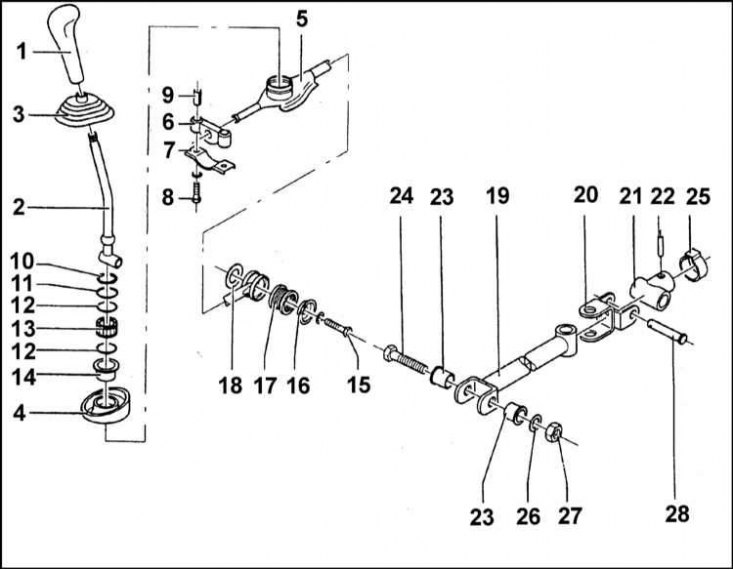
1 - Manual transmission control lever handle; 2 - Manual transmission control lever; 3 - Outer protective cover; 4 - Inner protective cover; 5 - Reactive bar; 6 - Rubber stop; 7 - Fastening clamp; 8 - Bolt; 9 - Spacer sleeve; 10 - Retaining ring; 11 - Distance washer; 12 - Rubber rings; 13 - Spherical joint bushings; 14 - Dust cover; 15 - Bolt M6; 16 - Washer; 17 - Rubber bushing; 18 - Washer; 19 - Gear shift drive rod; 20 - Cardan joint; 21 - Coupling; 22 - Pin; 23 - Plastic bushings; 24 - bolt; 25 - Tie rod clamp; 26 - Spring washer; 27 - Nut M8 (18 Nm); 28 - Pin
Components of the 5th gear assembly of the manual transmission
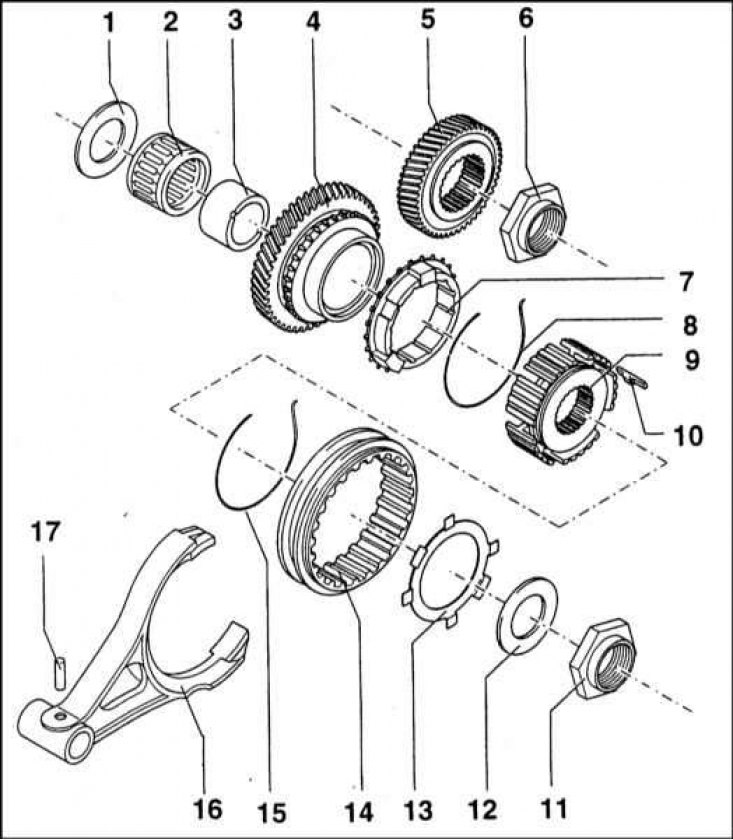
1 - Adjusting washer; 2 - 5th gear pinion needle roller bearing separator; 3 - Inner bearing race; 4 - 5th gear drive pinion; 5 - 5th gear driven gear; 6 - Nut (60 Nm); 7 - Synchronizer locking ring; 8 - Synchronizer spring; 9 - Sliding synchronizer clutch hub; 10 - Sliding synchronizer key; 11 - Nut (60 Nm); 12 - Washer; 13 - Support ring; 14 - Sliding synchronizer sleeve; 15 - Synchronizer spring; 16 - 5th gear engagement fork; 17 - Pin 5x22 (must be replaced without fail)
The order of installation of components of the primary and secondary shaft assemblies of the manual transmission
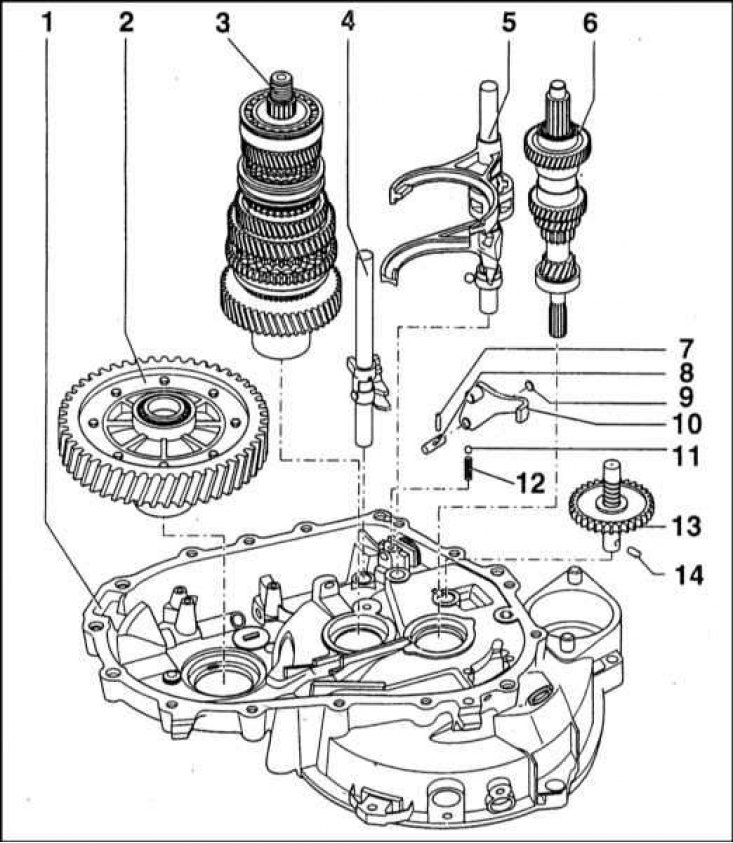
1 - Clutch dome; 2 - Assembling the main gear; 3 - Secondary shaft assembly; 4 - 5th gear shift fork rod; 5 - 1/2 and 3/4 gear engagement fork rod; 6 - Assembling the primary shaft; 7 - Pin 4x7; 8 - Reverse gear lever pin; 9 - Plug; 10 - Reverse gear lever; 11 - Locking ball; 12 - Retaining spring; 13 - Reverse intermediate gear; 14 - Pin
Primary shaft of the gearbox
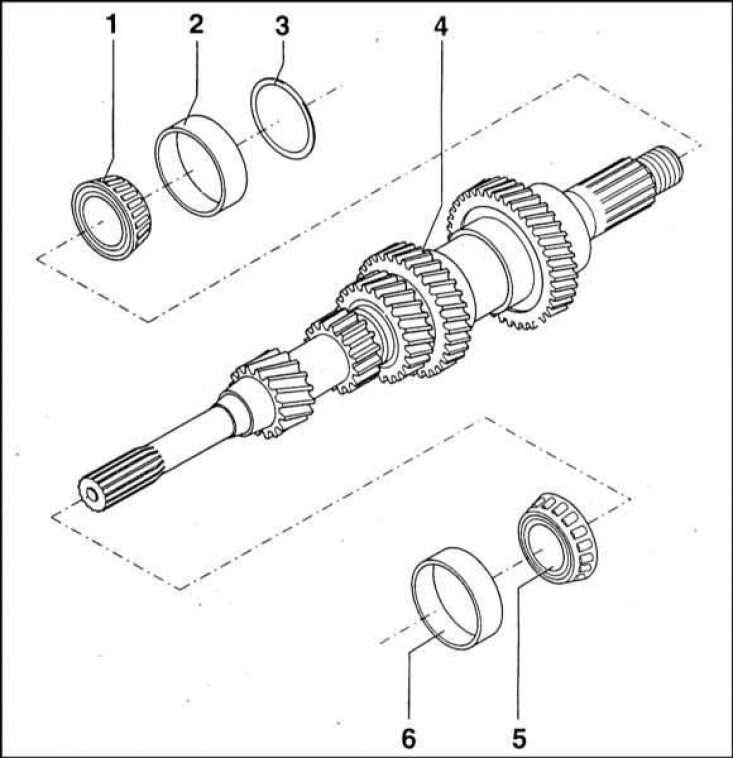
1 - Inner race of tapered roller bearing; 2 - Outer race of tapered roller bearings; 3 - Distance washer; 4 - Primary shaft; 5 - Inner race of tapered roller bearing; 6 - Outer race of tapered roller bearing
Secondary shaft components of the manual transmission
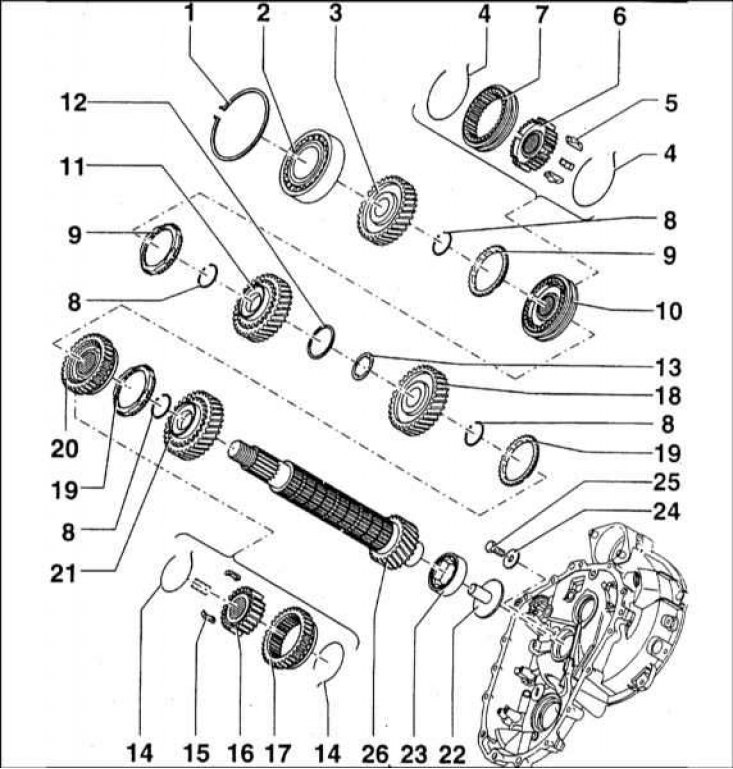
1 - Retaining ring; 2 - Ball bearing; 3 - 4th gear pinion; 4 - Synchronizer spring; 5 - Sliding synchronizer key; 6 - Sliding synchronizer clutch hub; 7 - Sliding synchronizer clutch; 8 - Retaining ring; 9 - Synchronizer locking ring; 10 - Assembly of the 3/4 gear synchronizer; 11 - 3rd gear pinion; 12 - Washer; 13 - Adjusting washer 2/3 gears; 14 - Synchronizer spring
Gear Shift Mechanism Components
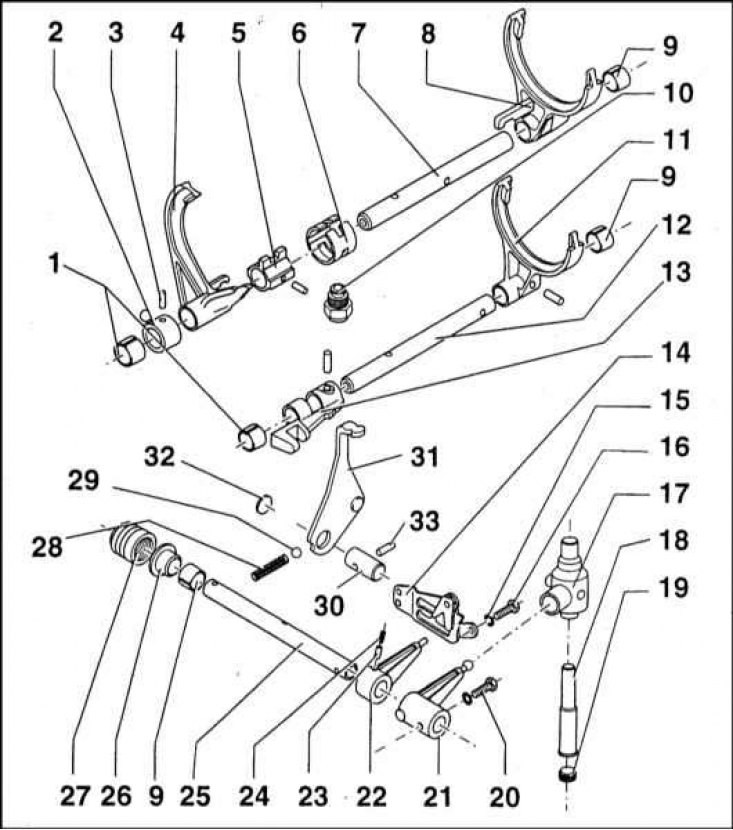
1 - Gear shift fork rod sleeve; 2 - Coupling; 3 - Pin 5x22 (must be replaced during assembly); 4 - 1/2 gear engagement fork; 5 - Gear shift pin; 6 - Retainer cracker; 7 - 1/2 and 3/4 gear engagement fork rod; 8 - 3/4 gear shift fork; 9 - Rod sleeve; 10 - Locking bolt; 11 - 5th gear engagement fork; 12 - 5-1 gear shift fork rod; 13 - 5th and reverse gear shift pin; 14 - Guide link; 15 - Gasket; 16 - Bolt (10 Nm); 17 - Three-arm lever; 18 - Three-arm lever pin; 19 - Hexagon socket head cap screw (30 Nm); 20 - Bolt (17 Nm, lubricate with a sealant such as Loctite before installation); 21 - Gear selection rod actuator lever; 22 - Backstage finger; 23 - Pin with spring; 24 - Pin with spring; 25 - Gear selection rod; 26 - Selection rod sealing ring; 27 - Dust cover; 28 - Retaining spring; 29 - Locking ball; 30 - Reverse gear lever finger; 31 - Reverse gear lever; 32 - Plug; 33 - Pin 4x25
Major repairs - general information
Major repairs of the manual transmission require a high level of qualification from the performer, as it involves precise adjustment of many gaps by selecting adjusting washers and spacer bushings. In addition, the internal components of the gearbox are quite difficult to find on the open market, not to mention their high prices. In view of all that has been said, the authors of this Guide recommend that in the event of problems in the operation of the manual transmission, it should be replaced with a new or refurbished unit.
However, a sufficiently experienced amateur mechanic can easily repair the gearbox on his own, provided he has a special tool. Remember that all procedures must be carried out strictly in the proper order. Do not rush, do not fuss, try not to miss any details.
Special tools, without which repair of the manual transmission becomes impossible, include pliers for extracting external and internal retaining rings, a set of pullers, a hammer with a sliding striker, a set of punches, a plunger-type dial gauge and, if possible, a hydraulic press. In addition, the workplace should be equipped with a large, sturdy workbench with a vice.
During the process of disassembling the gearbox, the installation position of all removed components should be carefully recorded on paper in order to ensure their correct placement during assembly.
Before you start disassembling the manual transmission, you should try to determine for yourself the possible causes of the violations that have occurred. Some problems are quite clearly tied to specific units of the gearbox, which allows you to significantly reduce the time for identifying and eliminating defects.
Disassembly and assembly of the manual transmission control lever
1. The components of the gearshift drive assembly are shown in the illustration. All references below correspond to the numbering adopted in this illustration (unless otherwise specified separately).
2. Remove the control lever handle (1).
3. Release the outer protective cover (3) from the center console panel and remove it from the lever.
4. Loosen the fastening nut and remove the bolt (15) securing the control lever to the gear shift drive rod.
5. Loosen the fasteners securing the reaction rod (5) of the lever to the body and the gearbox housing.
6. Remove the lower protective cover of the lever (4).
7. Lower and remove the torque rod and control arm assembly from the vehicle.
8. Remove the retaining ring (10) and spacer washer (11).
9. Using a suitable pointed tool, pry the edges of the rubber sealing ring (12) out of the groove in the upper sleeve of the spherical joint (13) and cut it with a knife. Then use pliers to remove the cut ring from the groove.
10. Using a screwdriver, remove the rubber boot (14) from below.
11. Remove the lower rubber sealing ring from the bushing assembly.
12. From below, press the control arm assembly together with the hinge bushings out of the reaction rod.
13. Assembly is carried out in reverse order.
Removal the gearbox housing cover, dismantling the support
Note: Removal of the cover can also be done in situ (directly by car).
1. Secure the manual transmission assembly to the mounting stand.
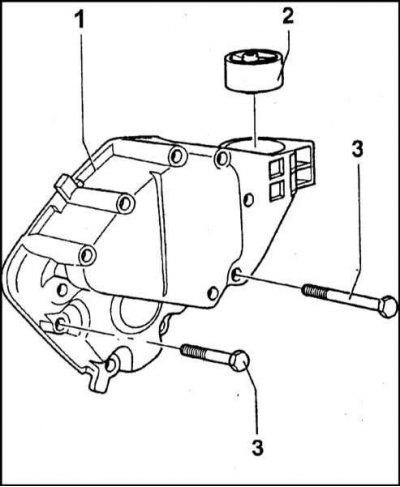
1 - Lid; 2 - Rubber-metal bushing of the power unit support; 3 - Cover mounting bolts (25 Nm)
2. The cover is removed together with the power unit support. Loosen and unscrew the fastening bolts diagonally.
3. Remove the cover assembly with the power unit support from the gearbox housing.
4. Remove the front and rear powertrain mount assembly mounting brackets.
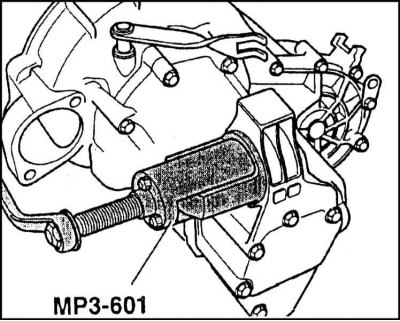
5. Using the MP 3-601 tool, press out the rubber-metal bushing of the manual transmission housing cover support.
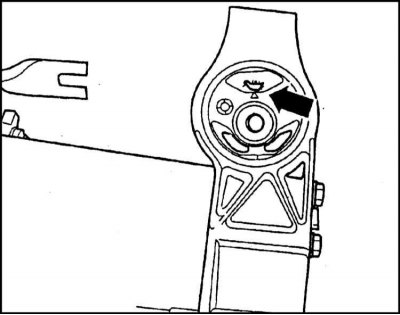
6. When installing, the rubber-metal support should be turned as shown in the illustration.
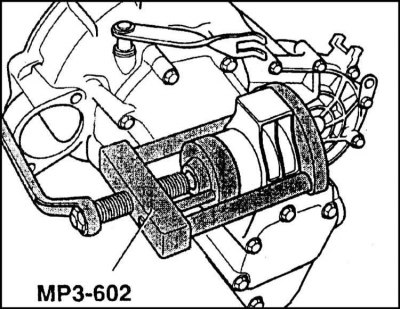
7. The bushing is pressed in using the MP 3-602 device.
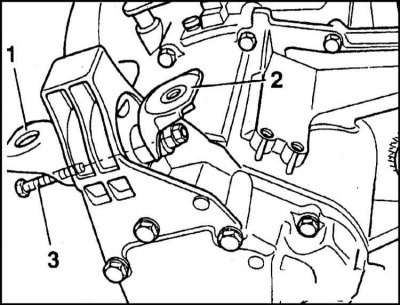
1 - Front support mounting bracket; 2 - Rear support mounting bracket; 3 - Mounting bolt (50 Nm)
8. Install the front support mounting bracket (without welded nuts) from the starter side, and the back (with welded nuts) - from the opposite side. Tighten the mounting bolt so that the mounting brackets are in the upper position and do not turn. The final tightening of the bolt is performed after the gearbox/powertrain is mounted on the vehicle.
Removal and installation of the 5th gear reduction assembly
Note. The 5th gear pinion can be removed without removing the gearbox from the vehicle. In this case, it is necessary to lock the unit using the MP 9-502/1 device.
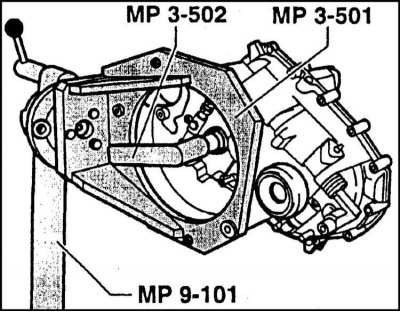
1. Block the manual transmission input shaft from turning using the MP 3-502 device. If the transmission is not removed from the vehicle, the shaft is blocked by engaging 4th gear.
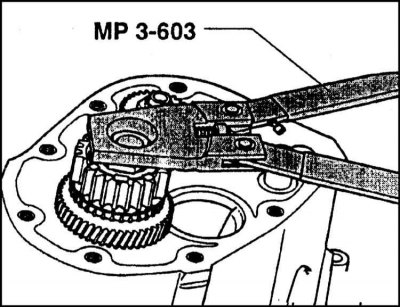
2. Loosen the driven gear mounting nut using the MP 3-603 tool.
Note: The nut must be replaced during assembly.
3. Proceeding in a similar manner, loosen the 5th gear drive pinion mounting nut on the primary shaft.
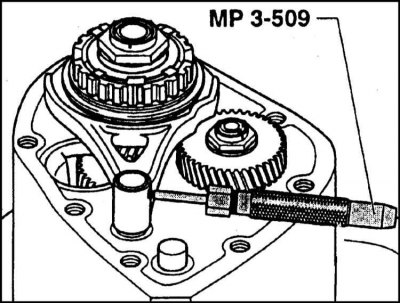
4. Knock out the mounting pin...
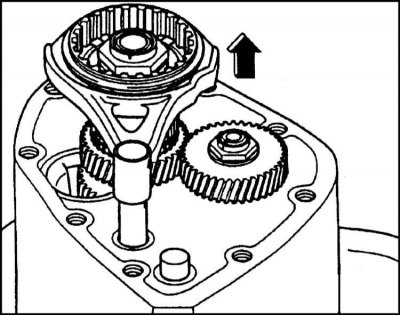
... and remove the 5th gear fork together with the synchronizer sliding sleeve. Try not to drop the sliding keys by immediately removing them from their grooves in the hub.
5. Remove the 5th gear reduction assembly components from both shafts one by one.
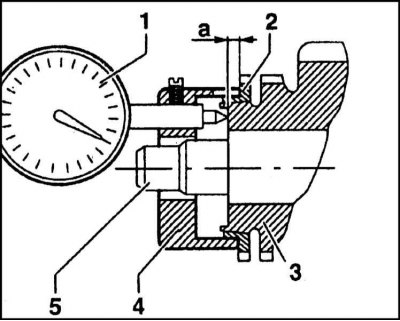
1 - Dial meter; 2 - Synchronizer ring; 3 - Drive gear; 4 - Tool MP 3-535; 5 - Shaft
[Article source: this website www.skodabook.ru]
6. Installation is carried out in the reverse order. When installing the synchronizer, the accuracy of the installation of the dimensions of the sliding clutch hub is of particular importance. The controlled parameter is the size a, which determines the distance from the end of the drive gear to the supporting surface of the synchronizer locking ring. The measurement is carried out using a plunger-type dial gauge, for fixing which on the assembly the MP 3-535 device is used. Synchronizers are produced in three size groups:
- a = 2.75÷3.10 (mm)
- a = 3.11÷3.44 (mm)
- a = 3.45÷3.78 (mm)
Dismantling and installation of the primary/secondary shafts of the manual transmission and the main gear assembly
1. The order of installation of the components of the primary and secondary shafts in the gearbox is shown in the illustration.
2. Remove the 5th gear reduction assembly.
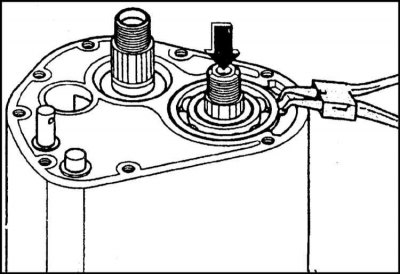
3. Loosen and remove the ball bearing retaining ring. Move the shaft as far as it will go inside the clutch housing.
4. Remove the lock screw.
5. Unscrew the bolts securing the clutch dome to the gearbox housing.
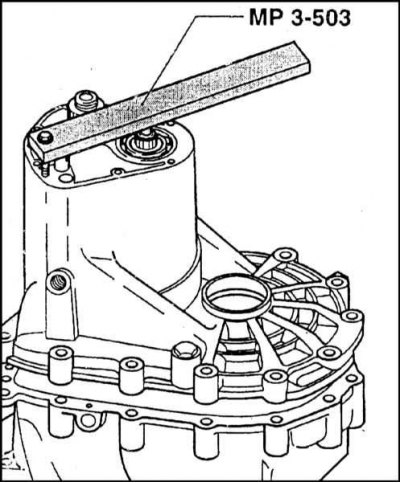
6. Using the MP 3-503 tool, separate the clutch dome from the manual transmission housing and set it aside.
7. By shifting the synchronizer sliding sleeve assembly with the engagement fork, select 4th gear.
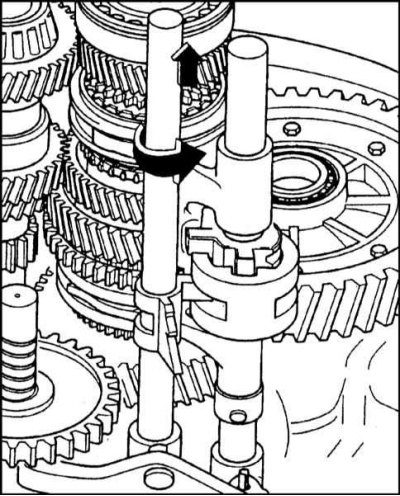
8. Turn the 5th gear fork and reverse gear lever rod approximately 15° counterclockwise and remove it from the assembly.
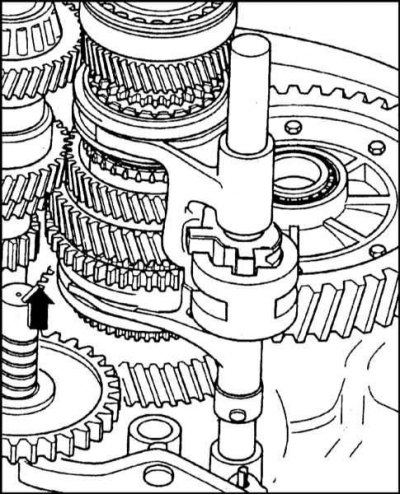
9. Remove the reverse idler gear assembly together with its shaft.
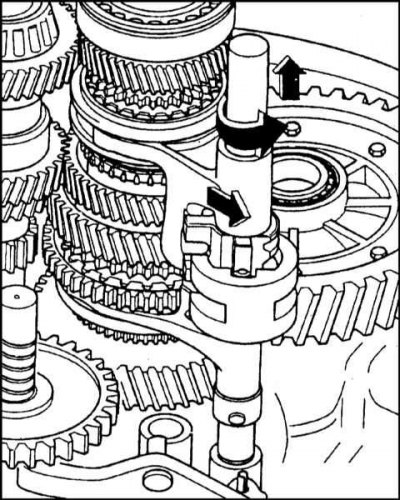
10. By shifting the sliding synchronizer clutches together with the engagement forks, select 2nd and 4th gears.
11. Remove the remaining shift rod assembly with the shift forks.
12. Remove the primary shaft and final drive assembly from the manual transmission housing.
13. Assembly is carried out in reverse order.
Disassembly and assembly of manual transmission shafts
Primary shaft
1. The installation order of the primary shaft assembly components is shown in the illustration.
2. The procedure for dismantling bearings is shown in the illustrations.
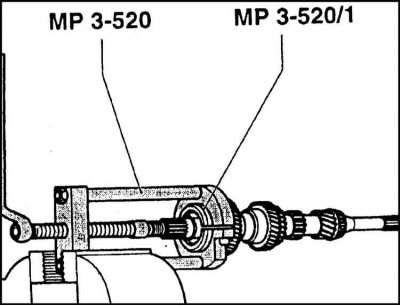
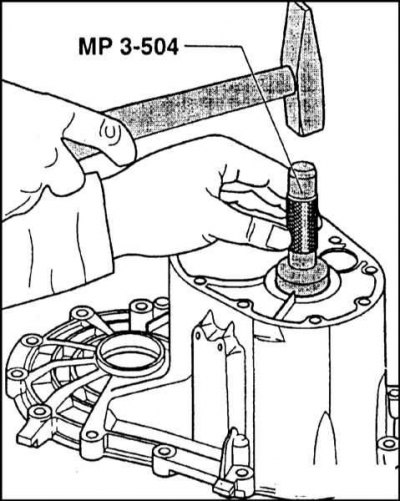
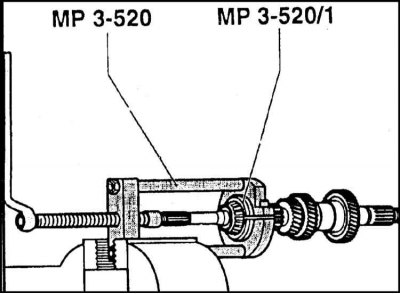
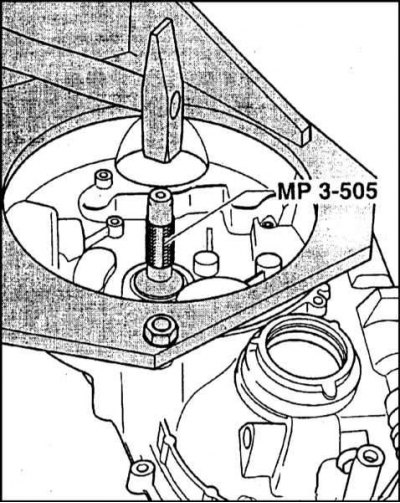
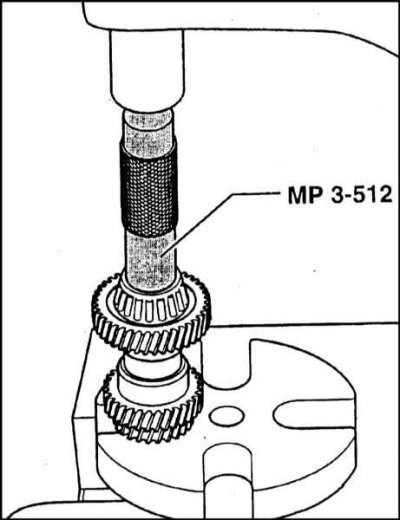
3. Installation is carried out in reverse order.
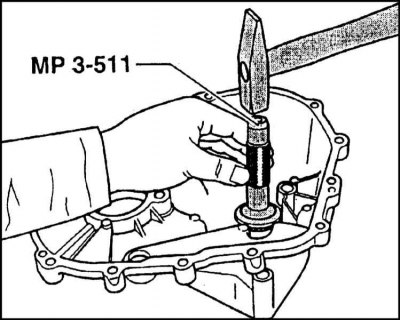
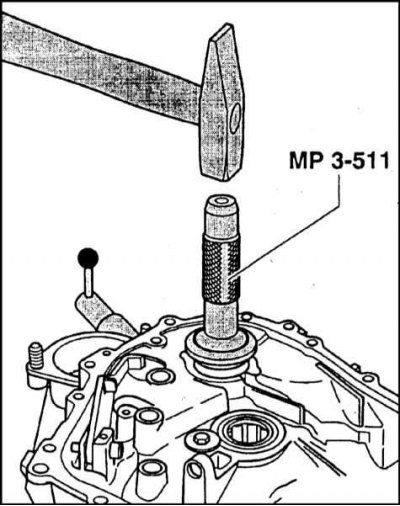
Secondary shaft
1. The installation order of the secondary shaft assembly components is shown in the illustration.
2. The procedure for dismantling the secondary shaft bearings is shown in the illustrations.
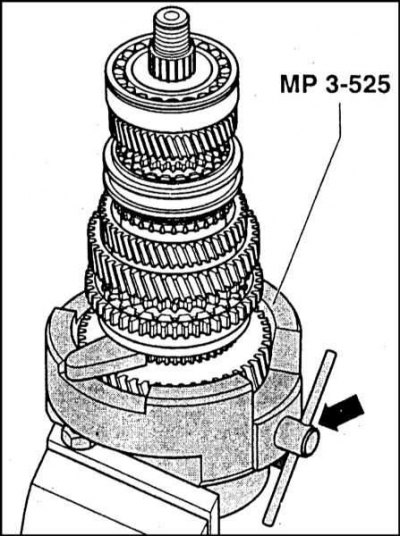
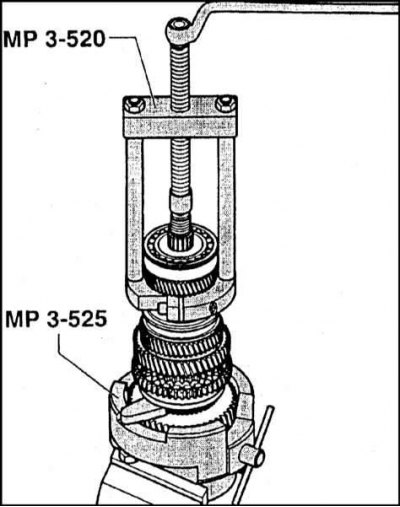
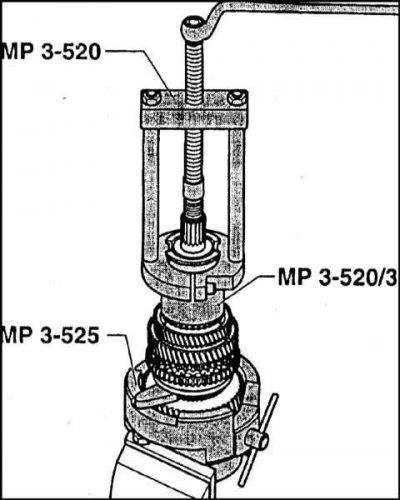
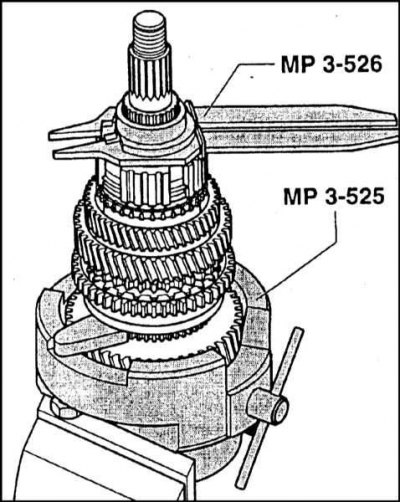
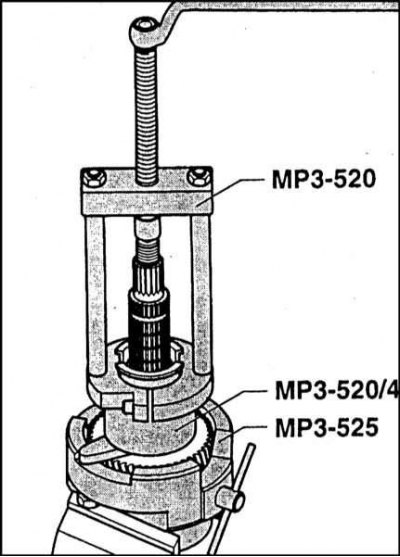
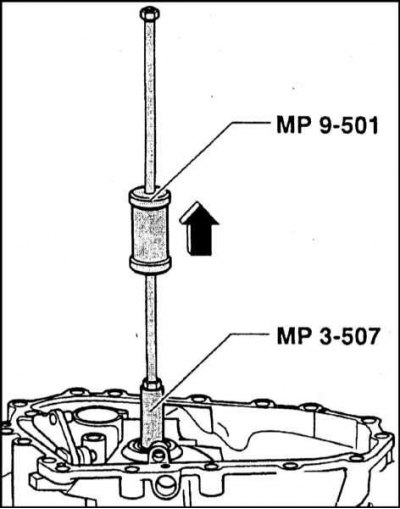
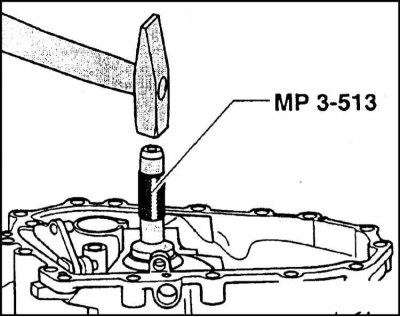
3. Assembly is performed in the reverse order. Pressing in the secondary shaft roller bearing is performed using the MP 3-513 device. Used synchronizer locking rings must be installed on the shaft strictly in their original places. Before installation, the locking rings and bearings should be generously lubricated with transmission oil. Before proceeding with the assembly of the driven gears of 1st÷4th gears, it is also necessary to lubricate their sliding surfaces with a generous amount of oil. Try not to mix up the sliding keys of the synchronizers of 1/2 and 3/4 gears during installation - they are not interchangeable.
Adjusting clearances in the primary shaft and differential bearings
Note: Before installation, the bearings and their mounting surfaces must be thoroughly cleaned of dirt and degreased.
1. Using the MP 3-511 tool, press the outer race of the tapered roller bearing until it stops against the clutch housing.
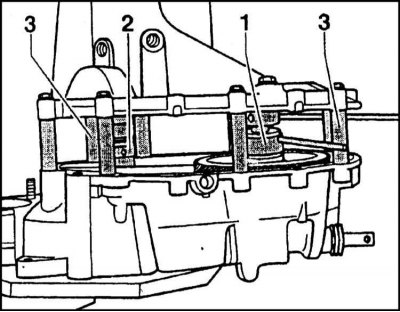
2. Insert the MP 3-503/2 tool into the hole for installing the primary shaft in the clutch housing and place the outer race of the smaller bearing of the primary shaft tapered roller bearing on it.
3. Place the final drive assembly with the inner bearing races pressed into the clutch housing.
4. Place the outer race of the differential tapered roller bearing on the inner and outer ring of the MP 3-530/1 device.
5. Screw the fastening nuts of the MP 3-530/1 and MP 3-530/2 devices until they stop (leaving no gap).
6. Using the MP 3-511 tool, press in the outer race of the larger diameter tapered roller bearing of the primary shaft until it stops against the gearbox housing.
7. Install spacer bushings with a step on the clutch housing flange. The spacers should be installed on opposite sides in a diagonal order.
8. Place the gearbox housing on the spacers and secure it with the bolts and washers supplied with the above-mentioned device.
9. After inserting the remaining spacers, also secure them with screws and washers.
10. Gradually tighten the screws in a diagonal order, tighten them with a force of 25 Nm, thereby fixing the manual transmission housing and the MP 3-530 device.
11. Unscrew the adjusting nut of the MP 3-530/1 and MP 3-530/2 devices so that the differential and primary shaft bearings turn with slight resistance (without axial play).
12. Using blade-type feeler gauges inserted into the clearances of the mounting nuts, determine the dimensions of the necessary adjusting washers for both the main gear and the primary shaft. Adjusting washers are available in the following thicknesses:
- Differential: 2.0÷2.7 mm with a step of 0.1 mm
- Primary shaft: 0.20mm, 0.25mm, 0.30mm, 0.36mm, 0.60mm and 0.80mm
13. Having separated the manual transmission housing from the clutch dome, remove the tools.
14. Install the required number of adjusting washers into the hole for installing the differential bearing in the manual transmission housing, achieving an installation size of +0.20 mm.
15. Using the MP 3-511 tool, seat the outer race of the differential tapered roller bearing until it stops in the gearbox housing.
16. Using the MP 3-505 tool, push the outer race of the larger diameter tapered roller bearing of the input shaft out of the gearbox housing.
17. Insert adjusting washers according to the established size into the hole in the manual transmission housing for the larger diameter tapered roller bearing of the primary shaft.
18. Using the MP 3-531 tool, press in the outer race of the larger diameter bearing of the primary shaft until it rests against the gearbox housing.
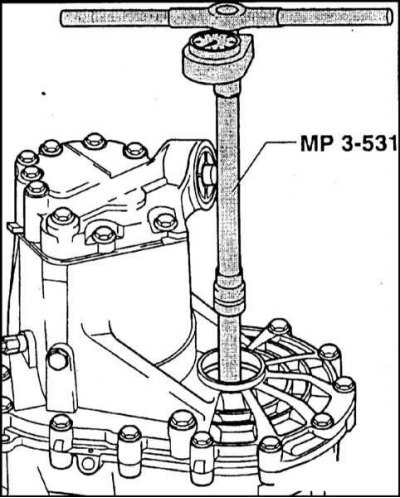
19. Check the differential bearing preload using the MP 3-531 tool and a torque wrench.
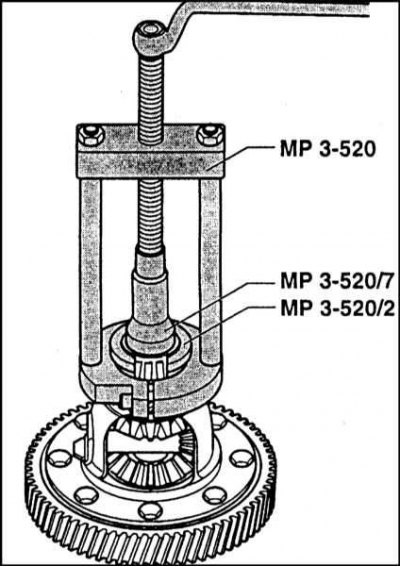
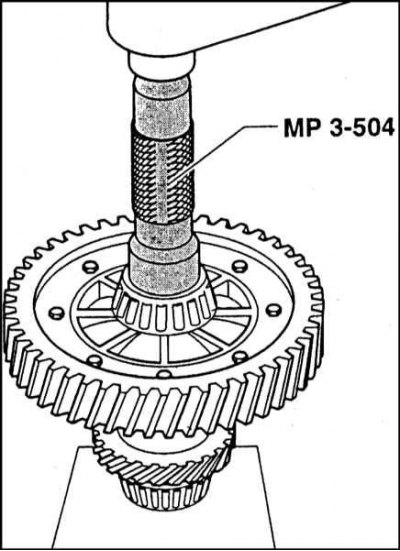
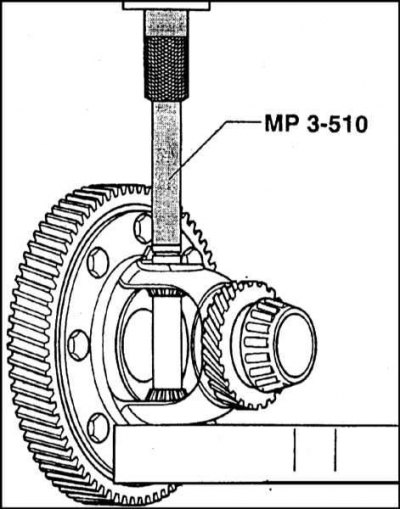
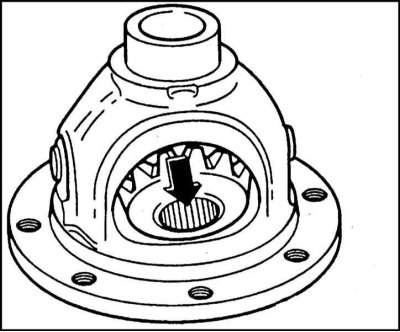
Disassembling and assembling the differential
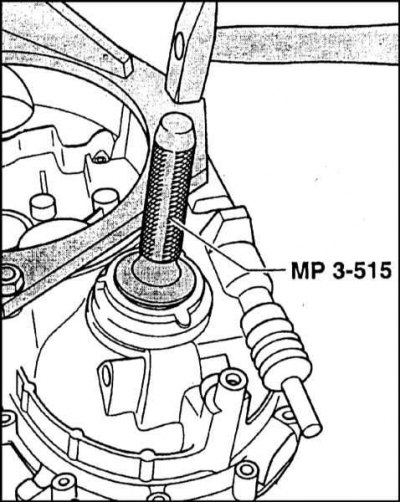
Disassembly and assembly of the differential is performed using special tools.
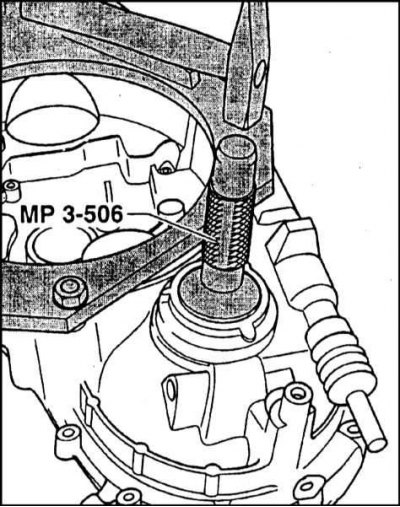
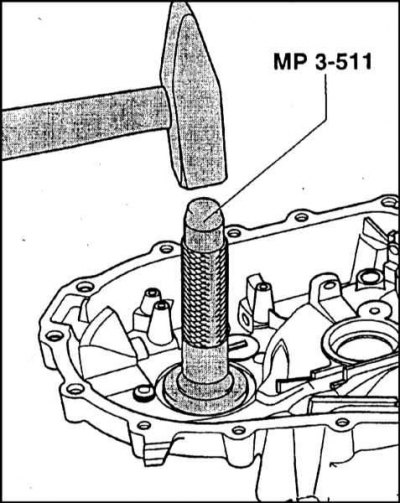
Disassembly and assembly of the gear shift mechanism
1. The installation order of the shift mechanism components is shown in the illustration.
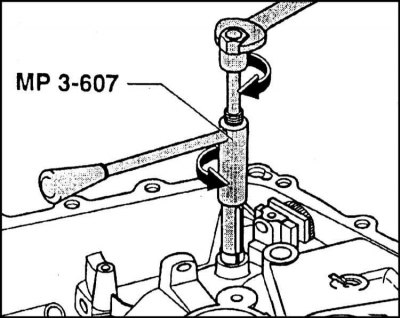
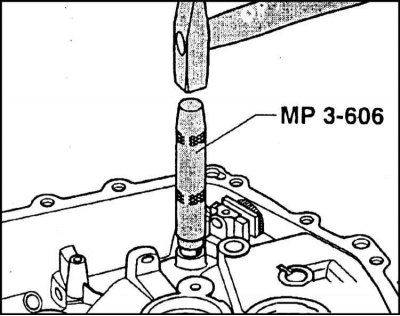
2. Disassembly and assembly of the gear shift mechanism is carried out using special devices.
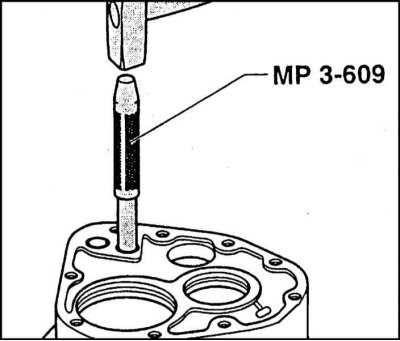
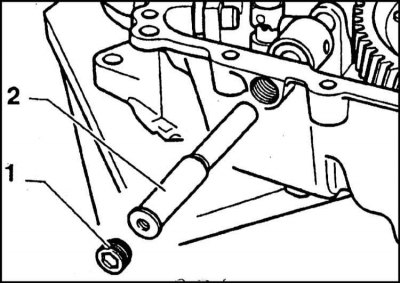
3. Assembly is carried out in reverse order.
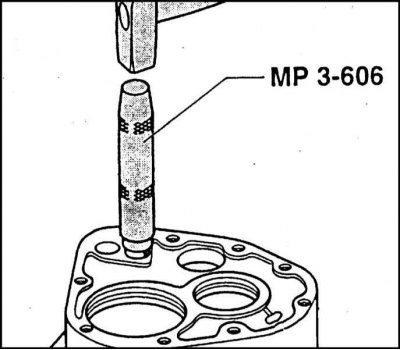
Adjusting the three-arm gearshift lever
Note: The recess of the hole in the fork rod for fixing the actuator lever must be directed upward. The end of the linkage pin must not touch the linkage when moving the fork rod (achieved by the position of the actuator lever)
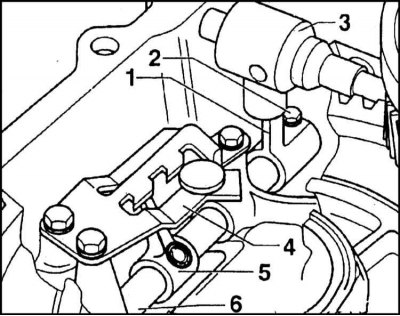
1 - Gear selection rod actuator lever; 2 - Bolt; 3 - Three-arm lever; 4 - Guide link; 5 - Backstage finger; 6 - Shift fork rod
1. Loosely screw in the bolt (2), previously lubricated with a sealant such as Loctite.
2. Adjust the position of the end of the slider pin to prevent it from touching the slider when the fork steerer moves.
3. Tighten the bolt (2) to 14 Nm.
4. The gearshift pin must be replaced during assembly if the bore for the pin with the spring is squeezed out.