



Scheme of sensors and active elements
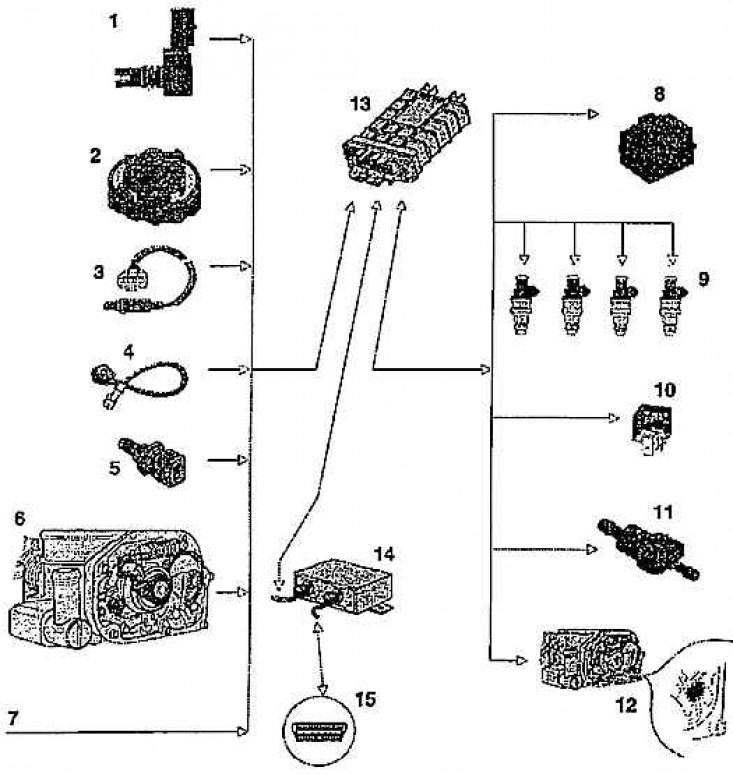
Sensors: 1 – combined sensor for incoming air pressure (G 70) and its temperature (G 72); 2 – ignition distributor with Hall sensor; 3 – lambda probe (G 39); 4 – knock sensor; 5 – coolant temperature sensor (G 62); 6 – throttle valve potentiometer (G 69); idle contact (F 60); throttle control valve (G 88); 7 – incoming signals
Active elements: 8 – ignition coil with high output stage (N 152); 9 – injectors; 10 – fuel pump relay (J 17); 11 – electromagnetic ventilation valve (N80); 12 – throttle valve regulator (V 60); 13 – control unit (J 382); 14 – immobilizer control unit in the dashboard; 15 – diagnostic connector
Hall sensor and its operation
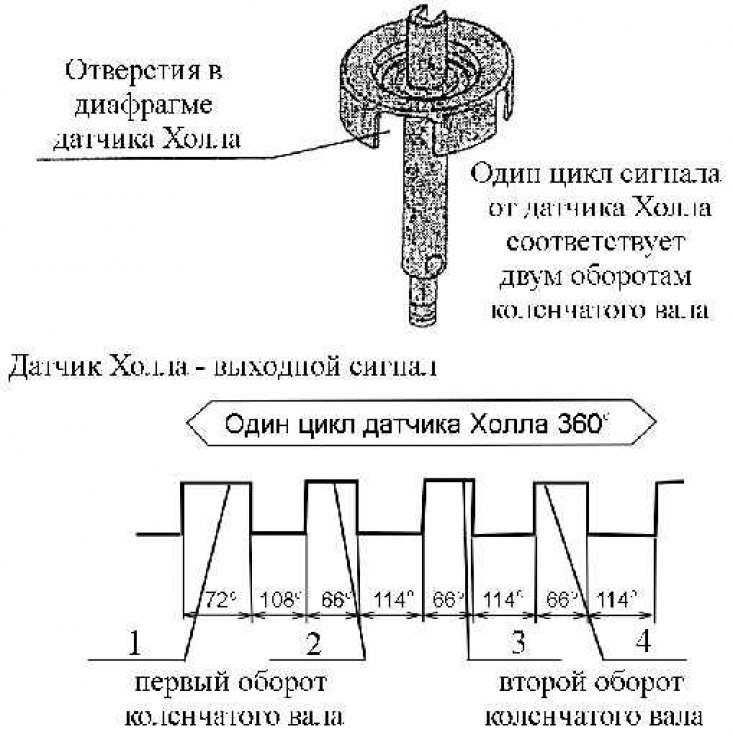
1 – interval for cylinder 1; 2 – interval for cylinder 3; 3 – interval for cylinder 4; 4 – interval for cylinder 2
The Hall sensor is installed in the ignition distributor, which, as already mentioned, is connected to the camshaft. Power to the sensor (voltage 5v) is supplied via the control unit. The Hall sensor determines the top dead center of all four cylinders. The signal is generated by four holes in the diaphragm mounted on the distributor shaft (the number of holes corresponds to the number of cylinders). The hole for the first cylinder is larger than the other three. During engine operation (approximately 7 seconds after the start) a statistical evaluation of the hole for the first cylinder occurs and thus the ignition moment in the first cylinder is set and the ignition moments for the remaining three cylinders are determined and the system switches from synchronous injection to sequential.
Information from the Hall sensor is the basis for calculating the ignition timing, injection start and volume. The ignition advance for the engine start mode is set constant and is 6 before the top dead center. The signal from the ignition distributor is the only information about the crankshaft rotation angle (installation).