



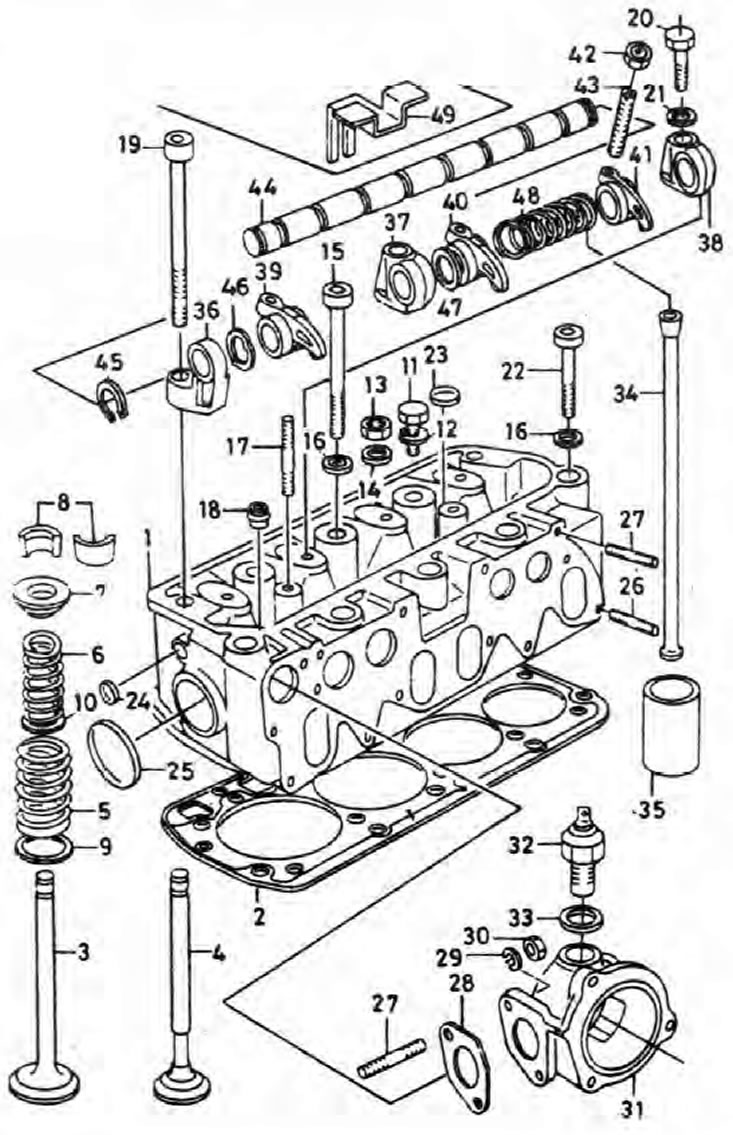
Fig. 2A.3. Cylinder head and components mounted on it
1. Cylinder head; 2. Cylinder head gasket; 3. Inlet valve; 4. Exhaust valve; 5. Outer valve spring; 6. Inner valve spring; 7. Spring support cup; 8. Valve crackers; 9. External spring support; 10. Inner spring support; 11. Generator bracket bolt to cylinder head; 12. Spring washer; 13. Cylinder head fastening nut; 14. Flat washer; 15. Cylinder head mounting bolt; 16. Flat washer; 17. Valve cover stud; 18. Valve guide bushing oil seal; 19. Cylinder head mounting bolt; 20. Bolt-valve mechanism to the cylinder head; 21. Flat washer; 22. Cylinder head mounting bolt; 23. Cork; 24. Cork; 25. Cork; 26. Hairpin; 27. Hairpin; 28. Gasket; 29. Spring washer; 30. Thermostat housing nut to cylinder head; 31. Thermostat housing; 32. Coolant temperature gauge sensor; 33. Sealing washer; 34. Push rod; 35. Pusher; 36. Support of the riveted mechanism; 37. Valve mechanism support; 38. Valve mechanism support; 39 Rocker; 40. Rocker; 41. Rocker; 42. Rocker arm adjusting screw lock nut; 43. Rocker arm adjusting screw; 44. Rocker arm axle; 45. Retaining ring; 46. Bent washer; 47. Flat washer; 48. Spring; 49. Oil shield.
Removal
1. Disconnect the negative cable from the battery.
2. Drain the cooling system as described in Section 1.
3. Remove the air cleaner assembly as described in Section 4.
4. Remove the valve mechanism as described in Chapter 5.
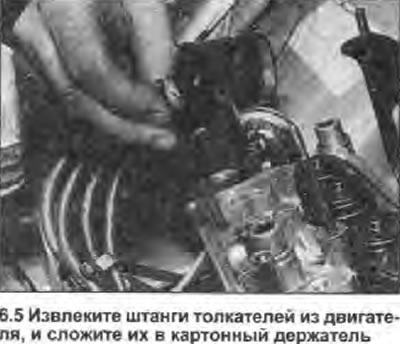
5. Remove the push rods one by one (see illustration) and place them in the correct order in a cardboard holder with numbered holes. When assembling, the rods should be installed in their original places.
6. Please note that in the following description the cylinder head is removed together with the manifolds.
7. Proceed as described in Section 4, disconnect the exhaust outlet pipe from the manifold.
8. Disconnect the following from the fuel system and intake manifold:
- a) Electrical wiring connector.
- b) Accelerator pedal cable.
- c) Brake booster unit hose.
- d) Cooling system hoses.
9. Disconnect the wiring connector from the coolant temperature gauge sensor. Disconnect the upper radiator hose and the expansion tank hose from the thermostat housing (see illustration).

10. Loosen and remove the upper generator mounting bolt and release the generator from the upper bracket.
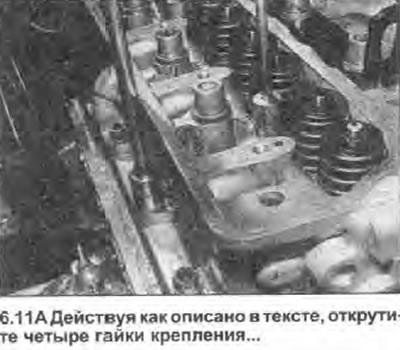
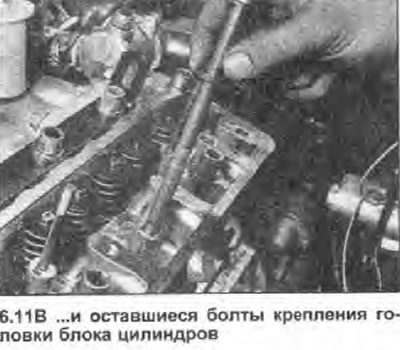
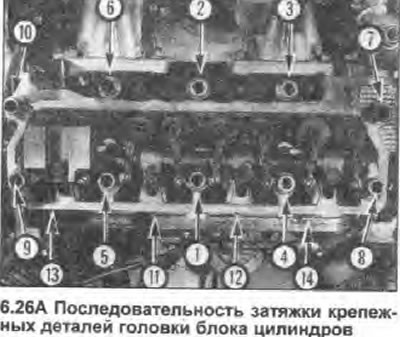
11. Working in the reverse order to that shown in Illustration 6.26A, gradually loosen the four fastening nuts on the front edge of the cylinder head and remove them. In the same order, loosen the eight remaining cylinder head fastening bolts one turn at a time. Remove the bolts with washers (see illustrations), and store them in the correct order. Remember the location of the engine mounting eye, attached with the rear rattling bolts.
 |
 |
12. Now it is necessary to break the connection between the cylinder head, gasket and cylinder block/crankcase without disturbing the cylinder liners; there is a possibility of coolant and foreign particles entering the oil pan if the cylinder head is lifted carelessly. If care is not taken and the cylinder liners are disturbed, there is also a possibility of the lower seal being damaged, which will also cause leaks.
Warning: If the cylinder liner base seal is damaged, the pistons and liners must be removed to install a new seal.
13. To break the connection, use the exhaust manifold as a fulcrum for the lever and carefully pry the cylinder head off from the front of the car.
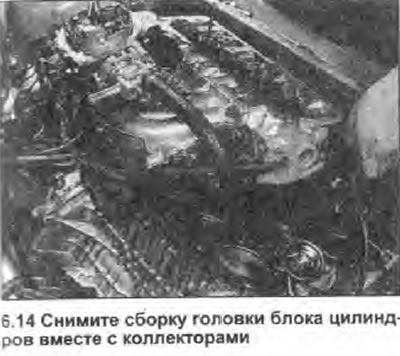
14. Once the connection is broken, lift the cylinder head (see illustration). Remove the gasket - it needs to be replaced.
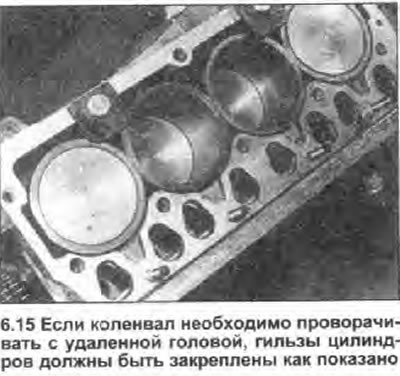
15. Do not attempt to turn the crankshaft with the cylinder head removed. The cylinder liners may become displaced. Operations that normally involve turning the crankshaft (for example cleaning piston heads), must be carried out with great care so that no dirt particles get inside. If it is necessary to turn the crankshaft, the cylinder liners must be secured with a pair of suitable bolts and large flat washers (see illustration).
16. If the cylinder head needs to be disassembled, refer to the relevant Chapters later in this Section.
Preparing for installation
17. Check the condition of the cylinder head bolts, paying particular attention to the threads. Wash and dry all bolts, then inspect each one for wear or damage, replacing suspect bolts if necessary. It is recommended that bolts be replaced as a complete set each time they are removed, regardless of their condition.
18. Before installing the head, clean the mating surfaces of the cylinder head, cylinder liners and crankcase. Use a plastic or wooden scraper to remove any gasket residue and carbon deposits; also clean the piston crowns. Be very careful not to scratch the aluminum surfaces. Also, make sure that no carbon deposits get into the lubrication and cooling passages - this is especially important for the lubrication system, as it can block the flow of oil to engine components. Use masking tape and paper to cover all passages and bolt holes in the cylinder block/crankcase. To prevent carbon deposits from getting between the pistons and cylinders, fill the space between them with a small amount of grease. After cleaning the piston, remove the grease and carbon deposits from the gap using a small brush, then wipe off the remainder with a clean rag. Clean all pistons in the same way.
19. Check the mating surfaces of the cylinder block/crankcase and cylinder head for nicks, deep scratches and other damage. Minor scratches can be removed with a file, and in case of excessive damage, regrinding may be the only alternative to replacement.
20. If it is suspected that the cylinder head seating surface is deformed, then check this by placing a steel ruler on its edge.
Installation
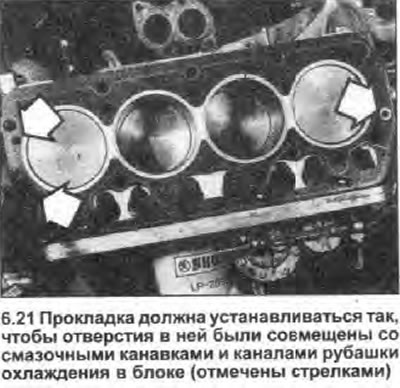
21. Wipe the mating surfaces of the head and cylinder block/crankcase, then place the new gasket on the cylinder block surface. Install the gasket so that the holes in it are aligned with the oil grooves on the left and right ends of the cylinder block (see illustration).
22. Place the cylinder head onto the studs and carefully lower it into place.
23. Maintaining the installation order, wash and dry all cylinder head mounting bolts and washers (if you haven't done so yet), then lightly lubricate the heads and threads of the bolts. Carefully insert the bolts (except for two, which are also used to secure the valve train supports) into the same holes. Remember to install the engine mounting eye. Tighten each bolt by hand as far as possible.
24. Remove the push rods from the cardboard holder and insert them into their original places in the cylinder head.
25. Install the valve mechanism as described in Chapter 5. Tighten the four small inner mounting bolts to Specifications, then hand tighten the two cylinder head mounting bolts.
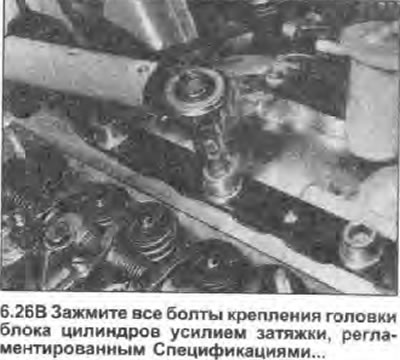
26. Working in the manner shown in the illustration (numbers 1-10) sequences, in several specified in Specifications stages, tighten the cylinder head mounting bolts. To tighten the bolts to the specified Specifications corners, use a felt-tip pen to draw a line between the cylinder head and the outer edge of each bolt head; in the second stage, each bolt is turned by 90° (quarter turn). In the third stage, the bolts are turned 90° again. If any bolt is overtightened past the mark, loosen it 90° and then retighten it (see illustrations).
 |
 |
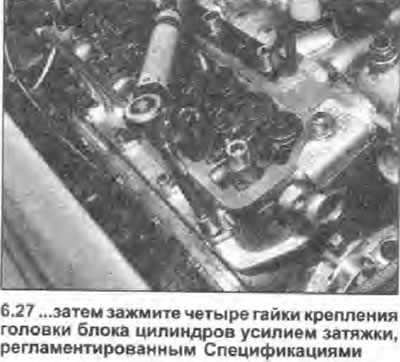
27. After all ten bolts are properly tightened, apply a small amount of engine oil to the cylinder head nuts. Install the nuts and washers onto the studs located on the front edge of the cylinder head. In Illustration 6.26A, (numbers 11-14) tighten the four nuts in the correct order with the specified tightening force Specifications (see illustration).
28. Adjust the valve clearances, then install the valve cover as described in Chapter 4 from this Section.
29. Reconnect all disturbed coolant hoses and connect the coolant temperature sensor wiring. Old Skoda hose clamps are recommended (where are there) replace with standard ones with worm gear clamp.
30. Proceeding as described in the relevant Chapters of Section 4, connect all electrical wiring and hoses to the intake manifold and fuel system components. Connect and adjust the gas pedal cable.
31. Proceeding as described in Section 4, connect the exhaust outlet pipe to the manifold.
32. Install the upper generator mounting bolt and adjust the drive belt tension as described in Section 1.
33. Install the air cleaner assembly as described in Section 4 and connect the negative cable to the battery.
34. Fill the cooling system as described in Section 1.