



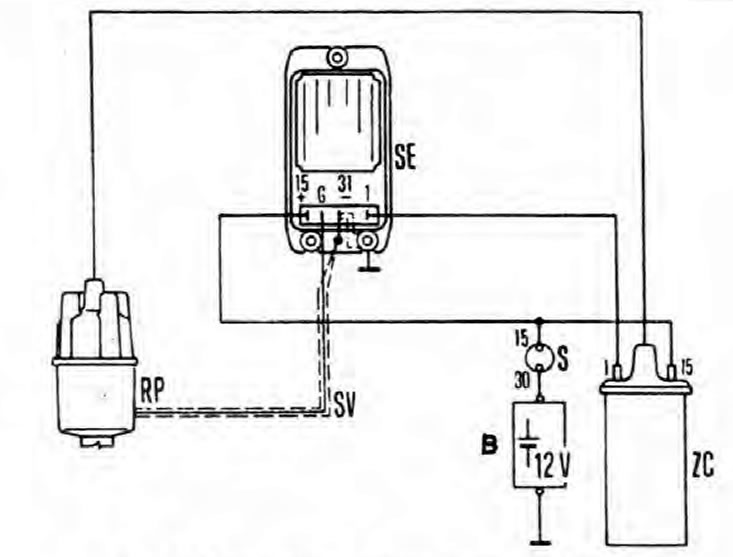
Pic. 5.1. Ignition circuit diagram
B - Accumulator
RP - Distributor
S - Ignition switch
SE - Ignition control unit
SV - Shielded wire
ZC - Ignition coil
Ignition system fully electronic inductive type, includes distributor without interrupter (camshaft driven), ignition control module, spark plugs, high voltage wires, high voltage ignition coil and electrical wiring.
The system is divided into two circuits: primary (low voltage) and secondary (high voltage). The primary circuit includes: battery, ignition switch, primary windings of the ignition coil, ignition control unit, distributor pulsator winding and electrical wiring. The secondary circuit includes: secondary windings of the ignition coil, distributor runner, spark plugs and high voltage wires.
The distributor has devices that change the ignition timing in response to changes in speed and load. This is achieved by blocks of centrifugal (spring-loaded weights increase advance with increasing engine speed) and vacuum (a diaphragm block attached to the distributor body increases the lead with increasing vacuum) corrections.
The winding of the pulsator in the distributor with the ignition on produces a weak magnetic field. As the engine rotates, the pulser poles pass through the magnetic field and a signal is sent to the ignition control unit, where it is used to switch the higher voltage and current needed to operate the ignition coil.
A high voltage for the spark plugs is produced in the ignition coil when the primary current is suddenly interrupted by the control unit. High voltage comes through the high voltage wire to the distributor runner, where it is applied to the corresponding contact in the distributor cap, and through the wire to the spark plug. Finally, a high voltage jumps across the gap between the electrodes of the spark plug and produces the ignition spark needed to ignite the air-fuel mixture in the cylinder.
Warning: The voltages produced by a non-contact ignition system are significantly higher than in conventional systems (with contact breaker). Be extremely careful. operating the system with the ignition on. People with surgically implanted pacemakers should refrain from working with ignition system components and diagnostic equipment.