



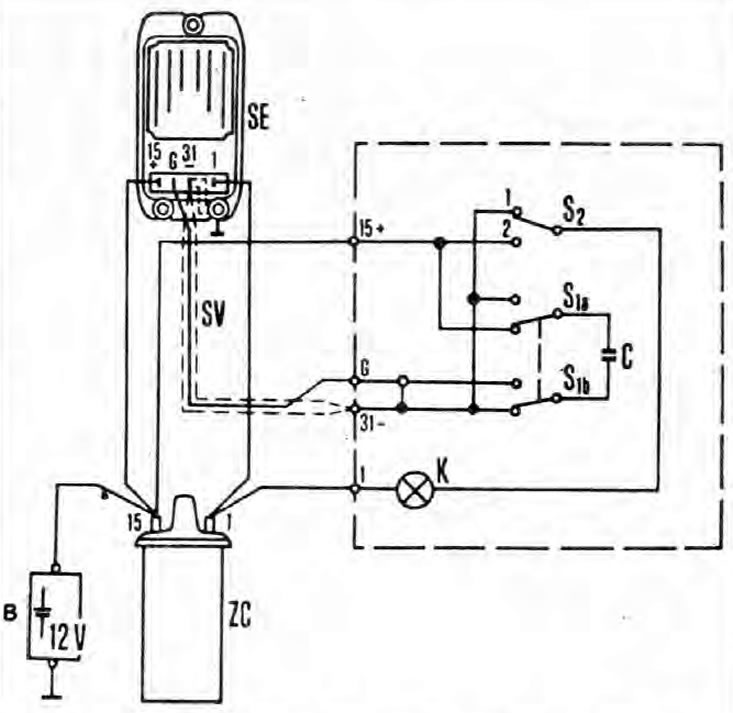
Fig. 5.5. Wiring diagram of the ignition system testing unit
B - Car battery; C - Capacitor (2 microfarads); K - Control lamp (12V, 2W); S1 - Push button switch (twin, 2-position); S2 - Switch (single, 2-position); SE - Control unit; SV - Shielded wire; ZC - Ignition Coil
Note: Before proceeding, please refer to the warning in Chapter 1. Always turn off the ignition before disconnecting or connecting any component and when using a multimeter to check resistance
General Provisions
1. The components of contactless ignition systems are generally very reliable. Malfunctions most often occur due to loose or dirty connections, or as a result of high-voltage burns in the traces due to dirt, moisture or damaged insulation. Always check all wiring carefully, and eliminate all possible causes of malfunction before making conclusions about the failure of any individual component of the ignition system.
2. When checking the ignition spark, hold the end of the high tension wire being tested at a distance of 10 mm from the engine.
3. Make sure that the ignition coil does not idle (i.e. without a load in the form of a distributor or anything else with a suitable resistance), otherwise the control unit may be damaged. It is necessary to create a spark gap as just described or ground the high-tension wire of the ignition coil.
4. Do not attempt to diagnose misfires by removing one high tension wire at a time. There is a risk of electric shock and insulation damage.
The engine does not start
Preliminary checks
5. If the engine does not turn over at all, or turns over very slowly, check the battery and starter. Connect a voltmeter across the battery terminals (observe polarity). Disconnect the ignition coil high tension wire from the distributor cap and ground it, then note the voltage while cranking the engine for no more than ten seconds. If the result is less than 9.5 volts, check the battery, starter and charging system.
6. If the engine cranks at normal speed but does not start, check the secondary circuit. Attach a strobe light (according to the manufacturer's instructions) and turn the engine over with the starter. If there are flashes, then voltage is reaching the spark plugs, so check them first. If there are no flashes, check the high-tension wires, then the distributor cap, carbon brush and distributor rotor (Section 1, And Chapter 2 from this Section).
[View the original on the website skodabook.ru]
7. If there is spark, check the fuel system (Section 4).
8. If there is still no ignition spark, check the voltage at the "+" terminal of the ignition coil (black and orange wires); it should be equal to the battery voltage (i.e. at least 11.7 volts) If the voltage drop between the battery and the ignition coil is greater than 1 volt, check the wiring connection from the ignition switch to the battery and its grounding until you find the fault.
9. If the power to the ignition coil is normal, check the primary winding of the coil (and, if possible, secondary) as described in Chapter 4. Replace the ignition coil if it is defective, but first carefully check the condition of the primary circuit connections.
10. If the ignition coil is OK, the ignition control unit or distributor pulse winding is probably faulty. For a quick check, connect a low-power lamp to the terminals of the primary winding of the ignition coil. If the lamp flashes when the engine is cranked, then most likely the starter, control unit and distributor are OK.
11. If the control unit and distributor are normal, the primary circuit is OK, then the fault is in the secondary circuit components. Check them carefully as described above.
12. If the test lamp does not flash, the fault is either in the distributor pulse winding or in the ignition control unit. Further testing can be performed as follows.
Specific checks
13. Make a block for testing the ignition system (see Fig. 5.5).
14. Disconnect the high tension wire from the distributor cap. Position the end of the wire approximately 10 mm from the engine, or connect it to a spark gap tester.
15. Disconnect the wiring connecting the distributor to the control unit. Connect the ignition system test unit to the control unit as shown and turn on the ignition.
16. The test is carried out with switch S2 first in one position, then in the other. In each position, the reaction is observed when switch S1 is pressed several times, this simulates switching the input from the distributor. Observe the control lamp in the test block and the spark gap. The possible results and the sequence of actions are given in the table below.
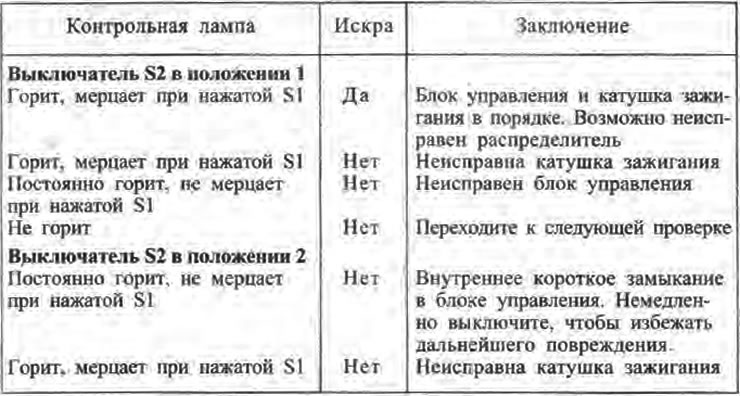
17. If after the above checks it is found that the control unit and ignition coil are working correctly, measure the resistance of the distributor pulse winding. If the resistance does not correspond to the data given in the Specifications, replace the distributor.
Misfires
18. Irregular misfires may be caused by a loose connection or broken wire in the low voltage circuit, or by a faulty distributor rotor on the ignition coil side.
19. With the ignition off, carefully check the entire system. If possible, check the primary circuit as described above.
20. Make sure the ignition coil, distributor cap and high tension wires are clean and dry. Check the wires and spark plugs (replacement if necessary), then check the distributor cap, carbon cheek and distributor rotor (Section 1).
21. Regular misfires are most likely due to a faulty distributor cap, high-tension wires or spark plugs. Using a stroboscope as described above, check to see if high voltage is present on the wires.
22. If there is no high voltage on one wire, the fault will be in that wire or in the distributor cap. If there is voltage on the wires, the fault will be in the spark plugs; check them and replace them if in doubt.
23. If there is no high voltage, check the ignition coil; its secondary winding may fail under load.