



Right suspension support for 1.3L petrol engine
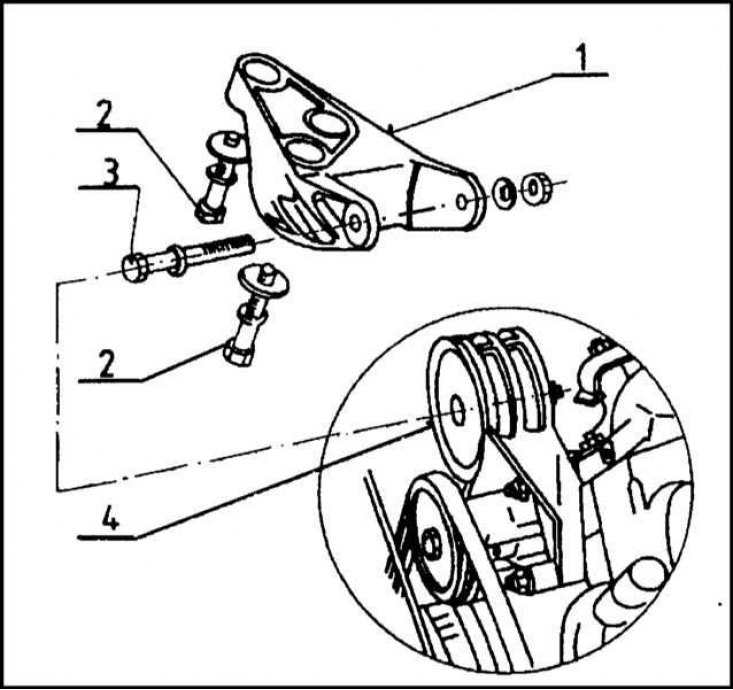
1 - Bracket; 2 - Bolt; 3 - Bolt; 4 - Elastic sleeve
Right suspension support for diesel engine and petrol engine 1.6 l
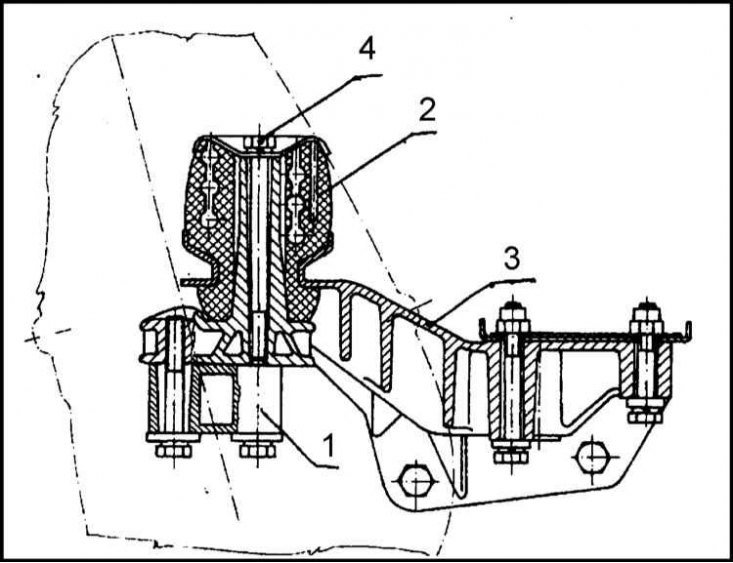
1 - Bracket; 2 - Pillow; 3 - Bracket; 4 - Bolt
Left support of the power unit suspension (all engines)

1 - Gearbox cover; 2 - Elastic sleeve; 3 - Bolt; 4 - Bolt; 5 - Washer; 6 - Bolt; 7 - Washer; 8 - Corner; 9 - Corner; 10 - Bracket; 11 - Bolt; 12 - Washer; 13 - Washer; 14 - Nut; 15 - Bolt; 16 - Washer
Lower support of the powertrain suspension (all engines)
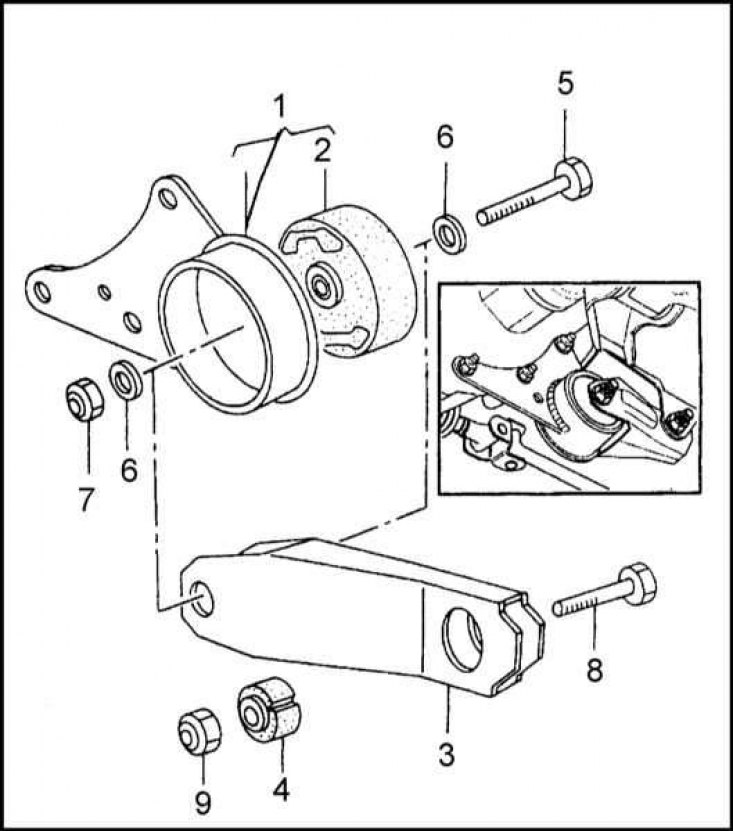
1 - Bracket; 2 - Elastic sleeve; 3 - Elastic sleeve; 4 - Reactive lever; 5 - Bolt; 6 - Washers; 7 - Nut; 8 - Bolt; 9 - Nut
Preparation and precautions
Before you begin to dismantle the engine for the purpose of performing a general or major overhaul, you need to take some preparatory measures.
The availability and equipment of a work area is extremely important. The area should be spacious enough to accommodate a car, a strong workbench/assembly stand, and the necessary materials and equipment. The best option is a large garage or indoor workshop. In extreme cases, a flat area with asphalt or concrete pavement will do.
Information presented on the website: SKODABOOK.ru
You should also take care to equip a place for storing components, tools and other materials removed from the engine. A lightweight collapsible rack with fairly wide shelves is best suited for this purpose.
Before you begin dismantling the power unit, clean the engine compartment and the outside of the engine to help keep the tools you use clean and tidy.
A winch, A-frame or other suitable lifting equipment is also a prerequisite for successful completion of the work. Make sure that the lifting equipment and rigging are rated for the total weight of the power unit (engine with transmission). Do not forget about the need to strictly comply with safety regulations.
If an amateur mechanic is removing an engine for the first time, he should enlist the help of an assistant. Timely advice from a more experienced mechanic will be useful. During the process of removing the unit from the car, many situations arise when some procedures must be performed simultaneously, which is often impossible to do by one person.
Try to plan all aspects of the upcoming work in advance. Prepare all the necessary tools and equipment. Special devices that significantly facilitate the upcoming work and significantly increase the level of safety include a powerful trolley jack, a set of wrenches and replaceable socket heads with a suitable (preferably ratchet) drive, a couple of strong wooden blocks, and enough rags and solvent to remove traces of fuel, oil and coolant. If you do not have personal lifting equipment, before renting a winch, try to carry out all the necessary preparatory work in advance in order to minimize the rental period and, consequently, the material costs associated with it.
Be prepared to stop using your car while the repair work is being carried out. Part of the procedures that require highly qualified personnel and the use of special equipment will have to be entrusted to car service specialists. Remember that car repair shops usually have a very tight work schedule, and therefore it would be wise to worry about it in advance and agree with the staff on the timing of your order.
On all Skoda Felicia models, the powertrain assembly is removed from the engine compartment through the lower opening, and therefore care should be taken to securely fix the car in a raised position, when there is enough free space underneath it. The optimal condition would be the presence of a low overpass on the work site.
Work slowly, in an organized manner, and try not to violate basic safety rules!
Powertrain Suspension - General Information
The power unit is attached to the supporting elements of the car body by means of elastic supports that absorb vibrations of the running engine and soften jerks of the unit during acceleration and braking. For all units used on the cars under consideration, a 3-point suspension is provided. The right support of units with a diesel engine and a 1.6 l petrol engine differs from the support of units with a 1.3 l petrol engine. The lower support, in addition to the vertical load, additionally perceives reactive moments that occur during sharp acceleration or engine braking.
The right support of 1.3 l engines consists of a bracket (1), which is attached with bolts (2) to the left mudguard reinforcement. The engine is attached to the support with a bolt (3) through an elastic bushing (4), located in the tide on the water pump housing. The location of the pump above the engine's center of gravity helps reduce the vibration level of the power unit.
The right support of diesel engines and 1.6 l petrol engines consists of a bracket (1) attached to the cylinder block and connected via an elastic cushion (2) to a bracket (3) secured to the body. The central bolt (4) provides the necessary preliminary compression of the elastic cushion via a support washer when screwed into the bracket (1).
The left support of the power unit of all engines is made integral with the rear cover of the manual transmission. In the body of the cover support there is a hole into which an elastic bushing (2) is inserted. The bushing is connected by means of a bolt (6) and corners (8) and (9) to a bracket (10), fixed to the body with bolts (11) and (15).
The lower support consists of a reaction lever (3), a bracket (1) and bushings (2) and (4). The necessary preliminary compression of the bushing (2) is ensured by tightening the bolt (5). Nuts (7) and (9) are self-locking.