



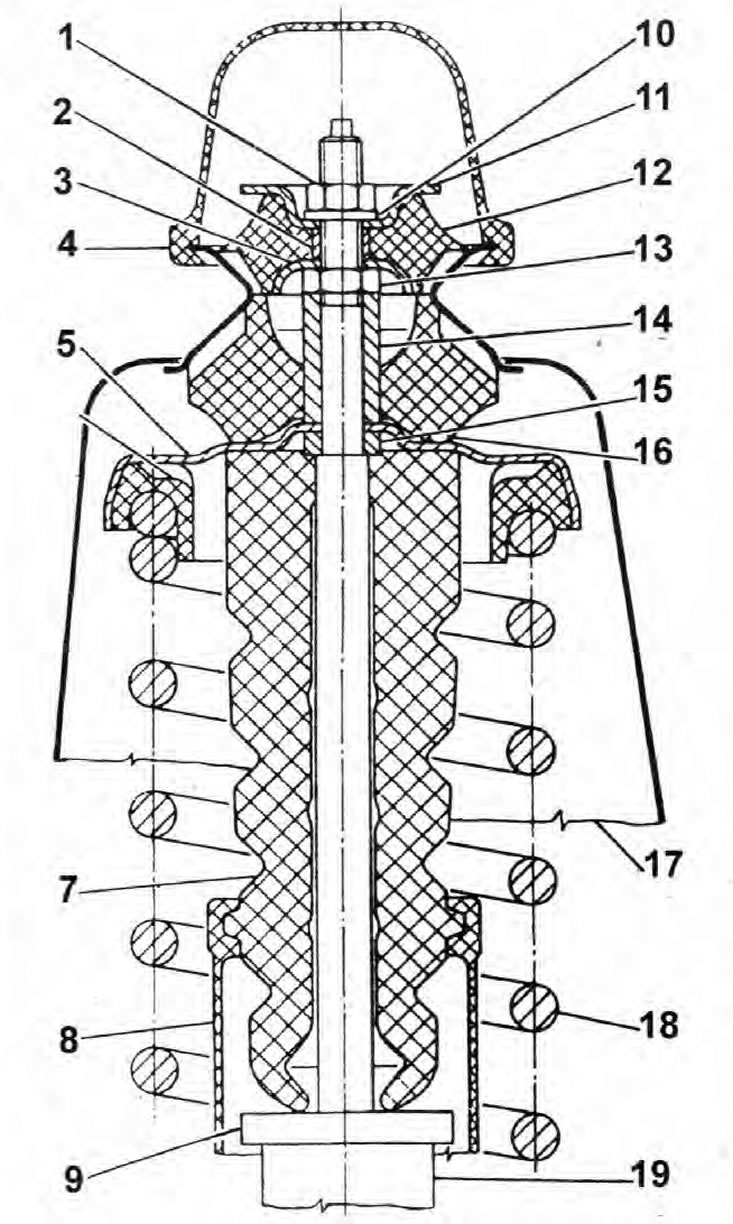
Fig. 10.11. Upper mount of the rear suspension unit in section
1. Upper mounting nut; 2. Gasket; 3. Lower support cup; 4. Lid (where is available); 5. Upper spring support cup; 6. Spring washer; 7. Rubber buffer; 8. Dust cover; 9. Lid (where is available); 10. Washer; 11. Upper support cup; 12. Rubber cushion; 13. Piston rod nut; 14. Gasket; 15. Gasket; 16. Bottom rubber cushion; 17. Body; 18. Spring; 19. Shock absorber.
Removal
1. Place the car on a level surface, engage any gear and block the front wheels.
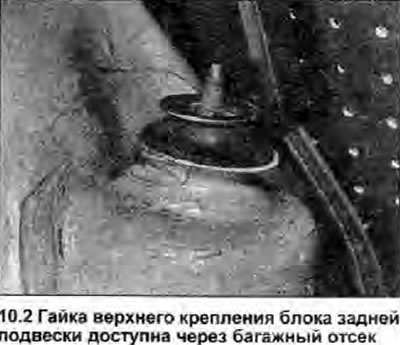
2. Working in the cabin, unscrew the upper mount nut (see photo). Remove the nut and washer, then the upper support cup, rubber buffer and lower support cup.
3 Jack up the rear of the vehicle and support it securely on axle stands so that both wheels are clear of the ground: remove a wheel if better access is required.
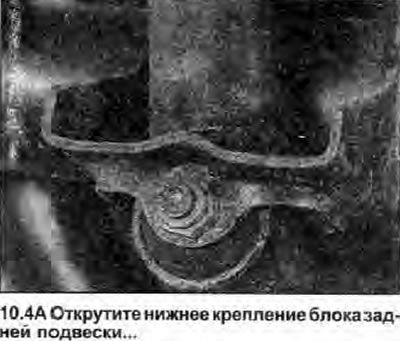
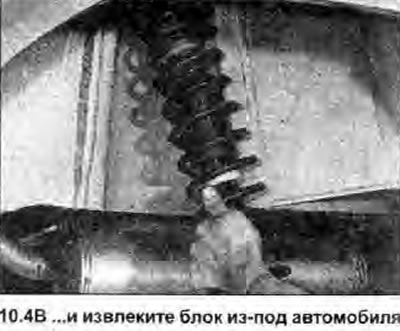
4. Unscrew the lower mount and carefully remove the suspension unit from under the car (see photo).
 |
 |
Bulkhead
Warning: Before disassembling the suspension strut, it is necessary to compress the spring using a special tool. Any attempt to disassemble the strut without such a tool may result in injury; do not attempt to remove the piston rod nut while the strut is installed on the vehicle.
[Data taken from an online portal: skodabook]
Note: If either front spring needs replacing, it is recommended to replace both as a matched pair. Both springs should have the same marking, contact your Skoda dealer. Likewise, if either front strut needs replacing, it is recommended to replace both as a matched pair. Store the struts in an upright position. If the strut is being refitted after long-term storage, clamp it vertically in a vice and pump the shock absorber by moving the piston rod up and down several times until it stops, to flush the channels and restore the damping properties.
5. Remove the suspension unit from the vehicle and clean it thoroughly.
6. While holding the piston rod from turning with a wrench, loosen the nut, but do not remove it completely yet.
7. Install the spring pullers and compress the spring evenly to release the upper spring support cup.
8. Remove the piston rod nut and remove the upper mount components, upper spring seat, rubber pad, dust cap and spring.
9. Inspect all strut components and replace any that are worn or damaged. Pay particular attention to the upper mount components, looking for cracks, deformation or contamination of the rubber.
10. Check the top mount ball bearing, which should rotate freely and without play. If the bearing rotates stiffly, is corroded or has play, replace it. Press the insert out of the bearing support plate, then knock out the bearing. A new bearing can be installed using a press or vice.
11. If the spring is broken, damaged or the free length is significantly less than specified in Specifications, it needs to be replaced.
12. Check the operation of the shock absorber by clamping it vertically in a vice and moving the piston rod all the way up and down; there should be a uniform resistance in both directions. If the damping is weak, there are oil leaks, the piston rod is bent or damaged, the shock absorber must be replaced.
13. Assembly is carried out in the reverse order of removal, paying attention to the following:
- a) Pull the piston rod completely out of the shock absorber. Install the spring (compressed), the upper support, and check that the upper mount components are installed in the correct order.
- b) To tighten the piston rod nut with the tightening force specified Specifications, attach a spring balance or similar tool to the wrench.
- c) After the nut is tightened, loosen the spring compressor tools and remove them, then check that the upper mount rotates freely.
- d) Install the rack into the vehicle.
Installation
14. Install in the reverse order of removal, paying attention to the following.
- a) Thoroughly clean the wheel arch area and all mounting points
- b) Tighten all nuts and bolts to the specified tightening torque Specifications, where given.