



Note: Please read the warnings at the beginning of this Section carefully Replacement of hoses and tubes of the hydraulic tract of the brake system.
Checking the status
Note: The discs are always replaced in pairs for both brake mechanisms of a given axle to avoid loss of directional stability of the vehicle when braking.
1. Set the parking brake, then jack up the front of the vehicle and support it. Remove the appropriate front wheels.
2. Rotate the disc slowly and carefully inspect it on both sides for deep scratches, burrs and cavities. Minor roughness can be ignored, but if serious defects are detected, the disc must be replaced.
3. The presence of rust spots and brake dust on the outer edge of the disc surface is normal. If desired, the disc can be simply cleaned with sandpaper. If a step has formed on the edge of the disc as a result of excessive wear of the working surface, the thickness of the disc should be checked using a micrometer. Measure at several points along the perimeter of the disc both in the contact area with the brake pads and outside it. A disc worn below the permissible limit must be replaced.
4. Using a plunger-type dial gauge or a flat metal bar and a blade-type feeler gauge, evaluate the runout value of the disc and make sure that it does not exceed the permissible value. The runout value is measured along a circle located 10.0 mm from the outer edge of the disc. If the measurement result is outside the permissible value, the disc must also be replaced, but first make sure that the hub bearing is in good condition.
5. Carefully inspect the disc for cracks, paying particular attention to the areas around the wheel bolt holes. If defects are found, replace the disc (paired with the opposite).
Removal
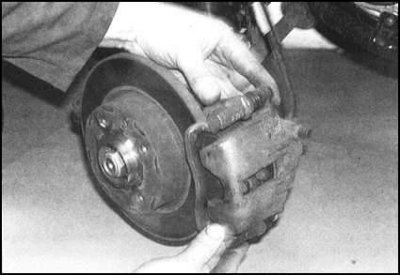
1. Remove the two bolts securing the brake caliper anchor bracket to the hub assembly. Remove the caliper from the disc and tie it to the suspension spring with wire (try not to put tension on the flexible brake hose).
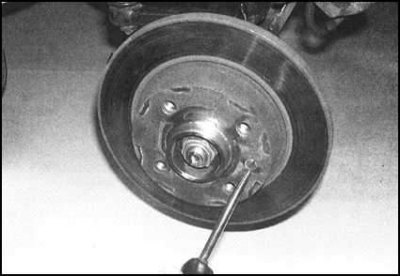
2. Screw in the mounting screw and remove the brake disc from the hub assembly. If the disc is tightly fitted, tap it with a soft-faced hammer to loosen it.
Installation
1. Make sure that the mating surfaces of the disc and hub are absolutely clean when installing. When installing a new disc, remove all traces of preservative from it with solvent.
2. Install the disc on the hub and tighten the mounting screw to the required torque.
3. Return the caliper assembly to its original place - make sure the brake pads are positioned correctly on both sides of the disc. Screw in and tighten the mounting bolts to the required torque.
4. Replace the wheel, lower the car to the ground and tighten the wheel bolts to the required torque. Press the foot brake several times to seat the pads on the disc, then you can start driving.
Original text is located on [www.SKODABOOK.ru]